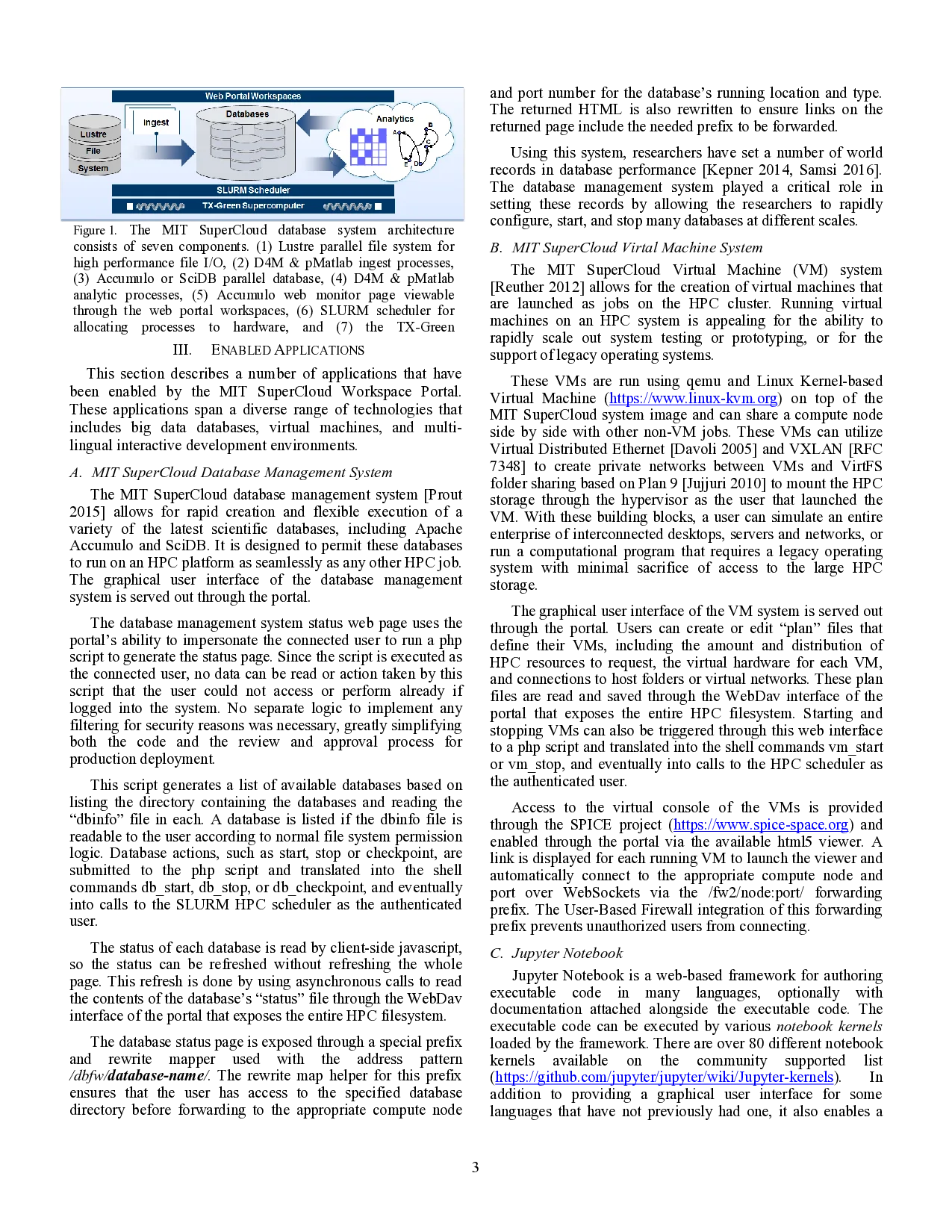
The MIT SuperCloud Portal Workspace enables the secure exposure of web services running on high performance computing (HPC) systems. The portal allows users to run any web application as an HPC job and access it from their workstation while providing authentication, encryption, and access control at the system level to prevent unintended access. This capability permits users to seamlessly utilize existing and emerging tools that present their user interface as a website on an HPC system creating a portal workspace. Performance measurements indicate that the MIT SuperCloud Portal Workspace incurs marginal overhead when compared to a direct connection of the same service.
Deep Dive into MIT SuperCloud Portal Workspace: Enabling HPC Web Application Deployment.
The MIT SuperCloud Portal Workspace enables the secure exposure of web services running on high performance computing (HPC) systems. The portal allows users to run any web application as an HPC job and access it from their workstation while providing authentication, encryption, and access control at the system level to prevent unintended access. This capability permits users to seamlessly utilize existing and emerging tools that present their user interface as a website on an HPC system creating a portal workspace. Performance measurements indicate that the MIT SuperCloud Portal Workspace incurs marginal overhead when compared to a direct connection of the same service.
1
MIT SuperCloud Portal Workspace: Enabling HPC
Web Application Deployment
Andrew Prout, William Arcand, David Bestor, Bill Bergeron, Chansup Byun, Vijay Gadepally, Matthew Hubbell,
Michael Houle, Michael Jones, Peter Michaleas, Lauren Milechin, Julie Mullen, Antonio Rosa, Siddharth Samsi,
Albert Reuther, Jeremy Kepner
MIT Lincoln Laboratory, Lexington, MA, U.S.A.
Abstract—The MIT SuperCloud Portal Workspace enables the
secure exposure of web services running on high performance
computing (HPC) systems. The portal allows users to run any
web application as an HPC job and access it from their
workstation while providing authentication, encryption, and
access control at the system level to prevent unintended access.
This capability permits users to seamlessly utilize existing and
emerging tools that present their user interface as a website on an
HPC system creating a portal workspace. Performance
measurements indicate that the MIT SuperCloud Portal
Workspace incurs marginal overhead when compared to a direct
connection of the same service.
Keywords-Jupyter Notebook; HPC; MIT SuperCloud
I.
INTRODUCTION
The merger of traditional HPC systems, big data clouds,
and elastic computing clouds has highlighted new challenges in
managing a combined SuperCloud. One key challenge is
addressing the need to run web applications and provide the
end-users access to them [Kwan 1995, Thomas 2000, Alosio
2001, Milne 2009, Cholia 2010, Atwood 2016, Schuller 2016].
Web-based applications have become a common deployment
method for many application development efforts, such as the
Jupyter notebook interface to Python, R, Matlab, Octave, and
Julia programming languages. Numerous projects expect their
users to run private web servers and interact via the web
browser. Enabling these same applications on a high
performance computing (HPC) system encounters many
challenges that do not exist in the local workstation context.
The ability for users to start arbitrary web applications that are
sufficiently open to the network for that user to connect to them
raises obvious security concerns. The design of most HPC
systems, in which compute nodes do not have direct external
network connectivity, also complicates this goal.
Traditional solutions for this problem, such as SSH port
forwarding, are burdensome to teach to users who are not
familiar with them. These solutions also can be a security risk
in themselves if the tunnel endpoint on the user’s workstation is
not correctly set up to limit access to just that user. The tunnel
endpoints could easily be accessible to other users on the local
network or on the same system if it’s shared by multiple users.
Even applications that have security built in do not solve
these problems. Such applications either must be integrated
into the HPC system to use its existing authentication systems
or must set up their own parallel authentication system. If
integrated into the HPC system, they are no longer a separate
user application, as integration would require privileged access
to the HPC system. If standing up their own parallel
authentication system, that system must be evaluated against
the security posture of the system and separately monitored for
attacks, weaknesses, reported flaws, and updates that could
affect the overall system security. Neither of these options can
scale to meet the goal of permitting users to run arbitrary web
applications for their own consumption.
We have addressed these challenges by building a Portal
Workspace technology capable of dynamically forwarding web
applications. The portal acts as a reverse proxy to the internal
network of the HPC system that is capable of being
dynamically reconfigured by end users to expose their web
applications to the external network. It handles encryption,
authentication, and authorization of specific users’ access to
exposed applications.
The organization of the rest of this paper is as follows.
Section II describes the technologies used to create the MIT
SuperCloud Portal Workspace. Section III describes some
examples of efforts enabled by this technology. Section IV
shows the performance results and overhead of the system.
Section V describes future work in this area. Section VI
summarizes the results.
II.
TECHNOLOGIES
The MIT SuperCloud Portal Workspace builds on a number
of existing technologies for operating and managing a large,
heterogeneous HPC system. These include the software stack,
the scheduler, firewall, as well as the Portal Workspace itself.
A. MIT SuperCloud
The MIT SuperCloud software stack enables traditional
enterprise computing and cloud computing workloads to be run
on an HPC cluster [Reuther 2013] (see Figure 1). The software
stack runs on many different HPC clusters based on a variety of
hardware technologies. It supports systems with 10 GigE, and
FDR InfiniBand or Intel OmniPath running Internet Protocol
over InfiniBand
…(Full text truncated)…
This content is AI-processed based on ArXiv data.