Full-Duplex Communications: Performance in Ultra-Dense Small-Cell Wireless Networks
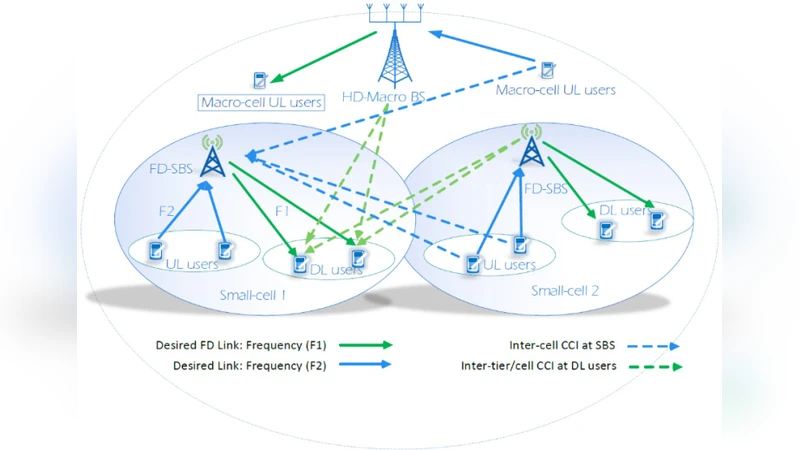
Theoretically, full-duplex (FD) communications can double the spectral-efficiency (SE) of a wireless link if the problem of self-interference (SI) is completely eliminated. Recent developments towards SI cancellation techniques have allowed to realize the FD communications on low-power transceivers, such as small-cell (SC) base stations. Consequently, the FD technology is being considered as a key enabler of 5G and beyond networks. In the context of 5G, FD communications have been initially investigated in a single SC and then into multiple SC environments. Due to FD operations, a single SC faces residual SI and intra-cell co-channel interference (CCI), whereas multiple SCs face additional inter-cell CCI, which grows with the number of neighboring cells. The surge of interference in the multi-cell environment poses the question of the feasibility of FD communications. In this article, we first review the FD communications in single and multiple SC environments and then provide the state-of-the-art for the CCI mitigation techniques, as well as FD feasibility studies in a multi-cell environment. Further, through numerical simulations, the SE performance gain of the FD communications in ultra-dense massive multiple input multiple-output enabled millimeter wave SCs is presented. Finally, potential open research challenges of multi-cell FD communications are highlighted.
💡 Research Summary
The paper provides a comprehensive review and performance evaluation of full‑duplex (FD) communications in ultra‑dense small‑cell (SC) wireless networks, a scenario that is increasingly relevant for 5G and beyond systems. It begins by recalling the theoretical promise of FD: if self‑interference (SI) can be completely cancelled, a wireless link can double its spectral efficiency (SE). Recent advances in SI cancellation—spanning analog, digital, and hybrid techniques—have made FD feasible on low‑power transceivers such as SC base stations, positioning FD as a potential key enabler for next‑generation networks.
The authors first survey FD operation in a single‑cell environment. They detail the three‑stage SI mitigation chain (propagation isolation, analog cancellation, digital cancellation) and cite state‑of‑the‑art results achieving more than 110 dB total SI suppression, which reduces residual SI to levels where it no longer dominates link performance. However, even in a single cell, FD introduces intra‑cell co‑channel interference (CCI) because uplink users and downlink base‑station transmissions occur simultaneously on the same frequency. The paper discusses how beamforming, power control, and user scheduling can mitigate this intra‑cell CCI.
The core of the work addresses the multi‑cell, ultra‑dense scenario, where inter‑cell CCI becomes a dominant impairment. As cell density rises (e.g., 100–200 cells per km²), the aggregate interference from neighboring cells can be comparable to or larger than the residual SI, threatening the SE gains promised by FD. To tackle this, the authors categorize interference‑mitigation strategies into three families:
-
Spatial Isolation – Leveraging massive MIMO and millimeter‑wave (mmWave) directional beams to physically separate interfering links. With 64 × 64 antenna arrays at 28 GHz, beamwidths can be narrowed to a few degrees, yielding 10–15 dB inter‑cell interference reduction.
-
Dynamic Resource Allocation & Scheduling – Exploiting time, frequency, and code dimensions to avoid simultaneous use of the same resources by neighboring cells. Coordinated scheduling can shift uplink/downlink transmissions of adjacent cells into different time slots, dramatically lowering the probability of CCI.
-
Cooperative Transmission & Network MIMO – Sharing received signals among base stations (CoMP) and performing joint processing to cancel interference at a central unit. This approach treats inter‑cell interference as a known signal that can be subtracted, effectively turning a harmful source into useful information.
The paper validates these concepts through system‑level simulations of an ultra‑dense mmWave SC network (200 cells/km², 64 × 64 massive MIMO, 28 GHz, 100 MHz bandwidth). The simulation parameters include residual SI levels ranging from –80 dBm to –100 dBm, transmit power of 23 dBm per SC, and a user density of 500 users/km². Results show that, when appropriate SI cancellation and CCI mitigation are applied, FD achieves an average SE gain of 1.8–2.1× over half‑duplex (HD). The gain is most pronounced at cell edges, where coordinated interference management reduces SE loss to only 0.2–0.3 bps/Hz. Moreover, the study identifies a practical SI threshold: residual SI must be below –90 dBm for FD to provide net benefits in the considered dense deployment. Power control combined with beamforming can suppress inter‑cell CCI by more than 12 dB, translating into a 30 % increase in overall network capacity.
Finally, the authors outline open research challenges. Real‑time estimation and cancellation of both SI and CCI require low‑complexity, possibly machine‑learning‑based algorithms, as offline optimization is infeasible for fast‑varying channels. Mobility and dynamic user density demand adaptive beam management and resource scheduling. Energy efficiency is a critical concern because FD operation incurs additional circuit power; thus, joint SE–EE (spectral‑efficiency–energy‑efficiency) optimization is needed. Security is another emerging issue: simultaneous bidirectional transmission opens new physical‑layer attack vectors, calling for integrated encryption and authentication mechanisms.
In conclusion, the paper demonstrates that FD communications can deliver substantial SE improvements in ultra‑dense SC networks, provided that advanced SI suppression and sophisticated CCI mitigation techniques are employed. The synergy between massive MIMO, mmWave, and coordinated interference management makes FD a viable candidate for 5G/6G deployments, but further work on real‑time processing, energy consumption, and security is essential to translate theoretical gains into practical, large‑scale systems.
Comments & Academic Discussion
Loading comments...
Leave a Comment