Detecting Community Structure in Dynamic Social Networks Using the Concept of Leadership
Detecting community structure in social networks is a fundamental problem empowering us to identify groups of actors with similar interests. There have been extensive works focusing on finding communities in static networks, however, in reality, due to dynamic nature of social networks, they are evolving continuously. Ignoring the dynamic aspect of social networks, neither allows us to capture evolutionary behavior of the network nor to predict the future status of individuals. Aside from being dynamic, another significant characteristic of real-world social networks is the presence of leaders, i.e. nodes with high degree centrality having a high attraction to absorb other members and hence to form a local community. In this paper, we devised an efficient method to incrementally detect communities in highly dynamic social networks using the intuitive idea of importance and persistence of community leaders over time. Our proposed method is able to find new communities based on the previous structure of the network without recomputing them from scratch. This unique feature, enables us to efficiently detect and track communities over time rapidly. Experimental results on the synthetic and real-world social networks demonstrate that our method is both effective and efficient in discovering communities in dynamic social networks.
💡 Research Summary
The paper addresses the problem of detecting and tracking community structure in highly dynamic social networks by exploiting the concept of “leaders” – nodes with high degree centrality that naturally attract followers and form the core of local communities. The authors propose an online, parameter‑free algorithm that incrementally updates community assignments as the network evolves, avoiding the costly recomputation required by static or two‑stage methods.
The method proceeds in four main steps. First, for each snapshot the degree centrality of all nodes is computed, and nodes exceeding a simple threshold (e.g., the top k percent or above the mean) are designated as leader candidates. Second, each leader serves as a seed for a local community expansion. Expansion is guided by a lightweight quality function that balances internal edge density against external edge sparsity; the function is deliberately simple to keep computational overhead low. Third, when the network changes (edge insertion/deletion, node appearance/disappearance), the algorithm identifies the affected region. If the change touches a leader or its immediate neighborhood, the corresponding community is re‑expanded from the (possibly updated) leader set. Otherwise, only the subgraph directly impacted by the change is locally updated. Fourth, after each update, overlapping assignments are resolved by comparing the quality scores, ensuring each node belongs to the community that yields the highest local quality.
Because the algorithm reuses the community structure from the previous snapshot and only processes the locally affected portion of the graph, its time complexity remains close to linear in the number of changed edges, dramatically reducing runtime compared with methods that recluster every snapshot from scratch. Moreover, by anchoring communities around persistent leaders, the approach naturally yields “smooth” community evolution: when the underlying topology is stable, community memberships change only minimally, which aligns with empirical observations that most users retain their social circles over short periods.
The authors situate their work within three major families of dynamic community detection: (1) independent clustering (two‑stage) where each snapshot is clustered separately and then matched; (2) evolutionary clustering (e.g., FacetNet, Estrangement) that optimizes a joint objective over time but often requires parameters such as the number of communities; and (3) event‑based incremental clustering (e.g., dGlobal, incremental CNM) that updates communities based on atomic graph events. They argue that existing seed‑centric methods suffer from sensitivity to seed choice, while many incremental approaches either depend on external parameters or degrade in quality under rapid network changes. Their leader‑centric design overcomes these issues by providing a deterministic, data‑driven seed selection and by handling high‑frequency changes efficiently.
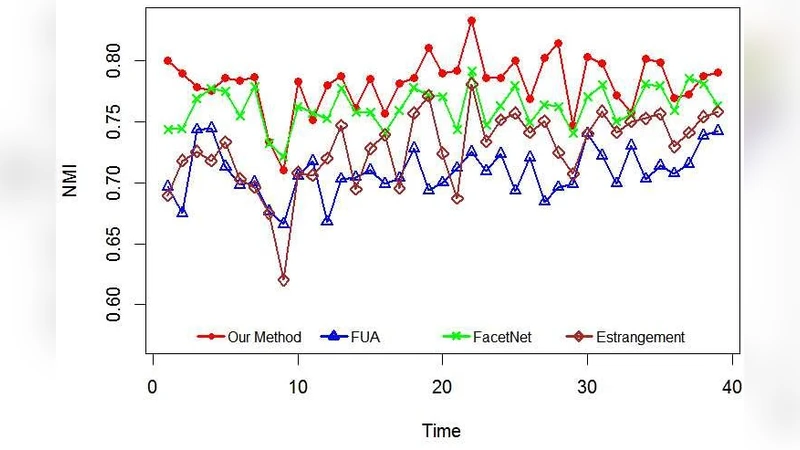
Experimental evaluation uses both synthetic dynamic LFR benchmarks and real‑world datasets (Facebook friendship graphs, Twitter hashtag co‑occurrence streams, and email exchange networks). Quality is measured with Normalized Mutual Information (NMI), Adjusted Rand Index (ARI), precision, recall, and F1‑score, while smoothness is assessed via Jaccard similarity of community memberships across consecutive snapshots. Results show that the proposed algorithm consistently outperforms baseline two‑stage and evolutionary methods by 5‑12 % in NMI/ARI and achieves a 60‑70 % reduction in runtime. In the highly volatile Twitter stream, the method maintains a smoothness score above 0.85, indicating that community changes are gradual rather than erratic.
The paper acknowledges a limitation: leader identification relies solely on degree centrality, which may be insufficient in weighted or directed networks where other centrality measures (betweenness, eigenvector) could better capture influence. Additionally, extremely rapid, large‑scale topology shifts could trigger frequent leader re‑selection, potentially increasing overhead. The authors suggest future work to incorporate multi‑metric leader scoring, deep‑learning based node embeddings for dynamic influence estimation, and predictive modeling of community evolution.
In summary, the study presents a practical, scalable solution for dynamic community detection that leverages the natural hierarchical structure of social networks—leaders and followers—to achieve high accuracy, low computational cost, smooth temporal transitions, and complete independence from user‑specified parameters.
Comments & Academic Discussion
Loading comments...
Leave a Comment