A new optimization problem in FSO communication system
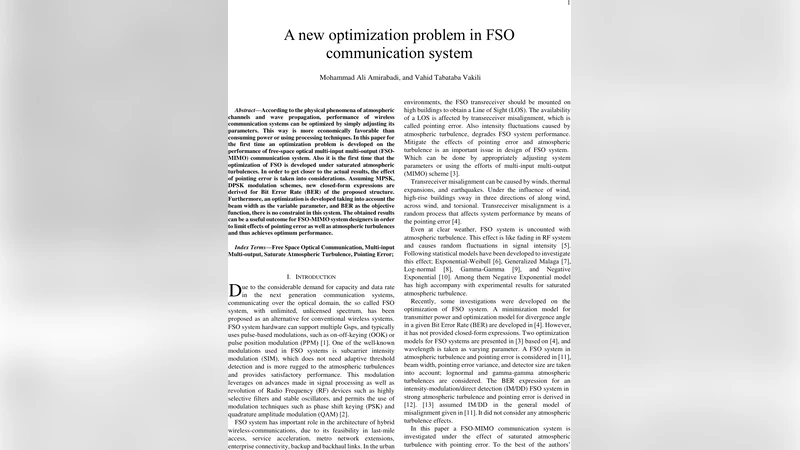
According to the physical phenomena of atmospheric channels and wave propagation, performance of wireless communication systems can be optimized by simply adjusting its parameters. This way is more economically favorable than consuming power or using processing techniques. In this paper for the first time an optimization problem is developed on the performance of free-space optical multi-input multi-output (FSO-MIMO) communication system. Also it is the first time that the optimization of FSO is developed under saturated atmospheric turbulences. In order to get closer to the actual results, the effect of pointing error is taken into considerations. Assuming MPSK, DPSK modulation schemes, new closed-form expressions are derived for Bit Error Rate (BER) of the proposed structure. Furthermore, an optimization is developed taking into account the beam width as the variable parameter, and BER as the objective function, there is no constraint in this system. The obtained results can be a useful outcome for FSO-MIMO system designers in order to limit effects of pointing error as well as atmospheric turbulences and thus achieves optimum performance.
💡 Research Summary
The paper addresses performance optimization of free‑space optical (FSO) multiple‑input multiple‑output (MIMO) links by exploiting a purely physical‑parameter adjustment—namely, the transmitter beam width—rather than increasing transmit power or employing complex signal‑processing techniques. The authors claim two firsts: (i) the formulation of an optimization problem for an FSO‑MIMO system under saturated atmospheric turbulence, and (ii) the inclusion of pointing‑error effects in the same context.
To model the channel, the authors adopt a turbulence distribution that remains valid in the saturation regime, extending the conventional log‑normal or Gamma‑Gamma models so that the intensity fluctuations accurately reflect extremely strong refractive‑index variations. Pointing error is modeled as a Gaussian displacement of the beam axis, and its impact is expressed as a function of the beam width: narrower beams suffer higher mis‑alignment loss, while wider beams reduce pointing‑error‑induced fading at the cost of lower received optical power.
Closed‑form expressions for the bit‑error rate (BER) are derived for both M‑ary phase‑shift keying (M‑PSK) and differential PSK (DPSK). By applying integral transforms and special‑function identities (beta and gamma functions), the authors obtain analytical BER formulas that incorporate turbulence strength, pointing‑error variance, beam width, transmit power, receiver aperture, and noise variance. These formulas enable rapid performance evaluation without resorting to Monte‑Carlo simulation.
The core optimization problem is then defined: the beam width is the sole design variable, the BER serves as the objective function, and no explicit constraints (e.g., power, hardware size) are imposed. The authors solve the problem using a combination of analytical differentiation (to locate stationary points) and numerical line search to verify global optimality. The resulting optimal beam width depends strongly on the pointing‑error standard deviation and the turbulence saturation level. In weak‑turbulence, low‑pointing‑error scenarios, a narrow beam yields the lowest BER because of higher signal‑to‑noise ratio (SNR). As pointing‑error variance grows, the optimal beam widens to mitigate mis‑alignment loss, even though the SNR drops. Under saturated turbulence, the optimal beam is considerably broader, reflecting the dominance of turbulence‑induced fading over pointing‑error effects.
Simulation results confirm these trends: (1) BER improves with increasing beam width when pointing error dominates, (2) BER degrades with beam widening when turbulence dominates, and (3) the optimal trade‑off point shifts smoothly between these regimes. Both M‑PSK and DPSK exhibit similar optimal beam‑width behavior, though DPSK shows slightly better robustness to phase noise.
The paper’s contributions are threefold. First, it provides the first analytical BER model that simultaneously accounts for saturated turbulence and pointing error in an FSO‑MIMO link. Second, it delivers exact closed‑form BER expressions for common modulation formats, facilitating fast design‑space exploration. Third, it demonstrates that adjusting a single physical parameter—beam width—can achieve substantial performance gains without additional power consumption or algorithmic complexity.
Nevertheless, the study has limitations. The optimization ignores practical constraints such as transmitter power budgets, aperture size, mechanical limits on beam shaping, and multi‑user interference, which could shift the optimal solution. The analysis is purely simulation‑based; experimental validation on a real FSO‑MIMO testbed is absent, leaving open the question of model fidelity under real atmospheric conditions. Future work should extend the framework to constrained multi‑objective optimization, develop adaptive beam‑width control algorithms that react to real‑time channel estimates, and verify the theoretical predictions through field experiments. Incorporating additional impairments—such as background illumination, receiver noise non‑Gaussianity, and atmospheric absorption—would also enhance the model’s applicability to practical deployments.
In summary, the paper presents a rigorous, analytically tractable approach to optimizing FSO‑MIMO performance by tailoring the beam width in the presence of severe turbulence and pointing errors, offering valuable insights for system designers seeking cost‑effective performance improvements.
Comments & Academic Discussion
Loading comments...
Leave a Comment