A Novel Hybrid Islanding Detection Method for Inverter-based DG
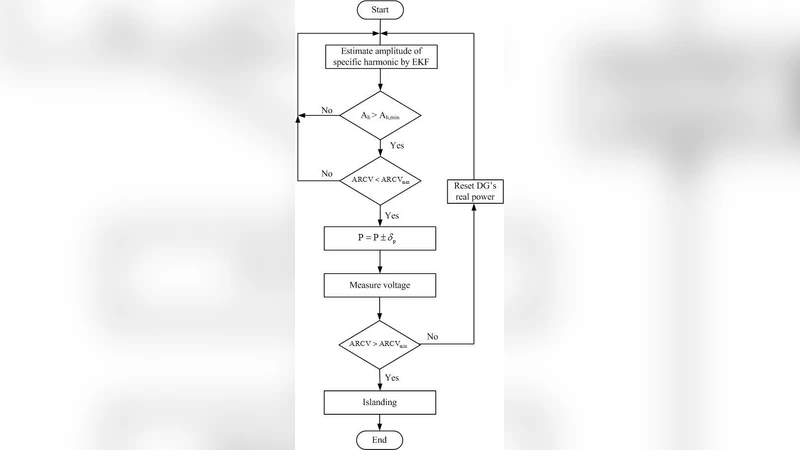
A novel method for achieving a better performance using the combination of the available passive and active methods has been proposed. The algorithm detects the islanding in proper time by using harmonic detection, the average rate of change of voltage and shifting power generation. Harmonic detection in this method decreases process time and also differentiates between islanding and other power systems events. For harmonic detection, extended Kalman filter has been used. Besides, the reliability of the method increases using the average rate of change of the voltage. The proposed method uses a strategy for decreasing the non-detection zone. In this strategy, minimum and maximum average rates of change of voltage limits are defined to improve the security of the system. Therefore, three main specifications of a proper method, reliability, security and time of process are achievable by the combination of these passive and active methods. By applying different power system events under different power conditions, the proposed method has been verified in Simulink software.
💡 Research Summary
The paper proposes a hybrid islanding detection scheme for inverter‑based distributed generation (DG) that combines a passive harmonic‑based method, a passive voltage‑rate‑of‑change method, and an active power‑shifting step. The authors argue that existing passive techniques suffer from poorly chosen thresholds, large non‑detection zones (NDZ), and difficulty detecting islanding when load and generation are closely matched, while active techniques introduce perturbations that can degrade power quality and increase detection time. To overcome these drawbacks, the proposed algorithm proceeds in three logical stages.
First, an Extended Kalman Filter (EKF) continuously estimates the amplitude of a specific inter‑harmonic component at 75 Hz (the third harmonic of the 25 Hz fundamental). In islanded operation, inverter switching non‑linearities cause this harmonic to be amplified; EKF’s nonlinear state‑space model enables rapid (sub‑cycle) extraction of the amplitude, providing an early indication that islanding may be occurring.
Second, the average rate of change of voltage (ARCV) is computed over a short observation window (two cycles). Two thresholds, ARCV_min and ARCV_max, are predefined. If the measured ARCV lies between these limits, the event is considered a candidate for islanding; values above ARCV_max typically correspond to severe faults, while values below ARCV_min correspond to modest load changes. This dual‑threshold strategy dramatically reduces false positives from faults and load variations.
Third, if the first two criteria are inconclusive, the algorithm actively reduces the output power of one DG (to about 12 % of its rated value) and recomputes ARCV. Because islanding causes a noticeable voltage response to this power shift, the ARCV after the shift will satisfy ARCV_min only in the islanded case, confirming the condition.
The method is validated on a nine‑bus test system containing three inverter‑based wind farms (buses 8, 10, 11) using MATLAB/Simulink. Four test scenarios are examined: (1) islanding, (2) load decrease, (3) three‑phase fault, and (4) single‑phase fault, each applied at 0.1 s into a 0.3 s simulation. For each case, the authors report the estimated 75 Hz harmonic amplitude and two ARCV values (before and after power shifting). Results show that islanding produces a large harmonic amplitude (up to 172 pu) and ARCV values that fall within the predefined window, whereas faults generate either excessively high ARCV (exceeding ARCV_max) or negligible harmonic content, leading to their rejection. After the power‑shifting step, only the islanded case continues to satisfy the ARCV_min condition, confirming detection.
Overall detection time is less than four cycles (≈0.03 s), well below the 2‑second limit mandated by IEEE 929‑1988 and IEC 1547‑2003. By integrating EKF‑based harmonic detection, ARCV thresholding, and a brief active power perturbation, the scheme achieves the three desired attributes of islanding detection: reliability (low false‑alarm rate), security (robustness against non‑islanding events), and speed (fast response).
The paper’s contributions are threefold: (i) introducing EKF for rapid inter‑harmonic estimation, (ii) defining dynamic ARCV bounds to shrink the NDZ, and (iii) employing a controlled power‑shift as a final verification step without causing significant power quality degradation. Limitations include the need for real‑world implementation of the power‑shift command on commercial inverters, assessment of the method’s scalability to multiple‑DG networks, and experimental validation on hardware‑in‑the‑loop or field‑tested microgrids. Future work should address these practical aspects and explore adaptive thresholding that accounts for varying grid conditions.
Comments & Academic Discussion
Loading comments...
Leave a Comment