PyFml - a Textual Language For Feature Modeling
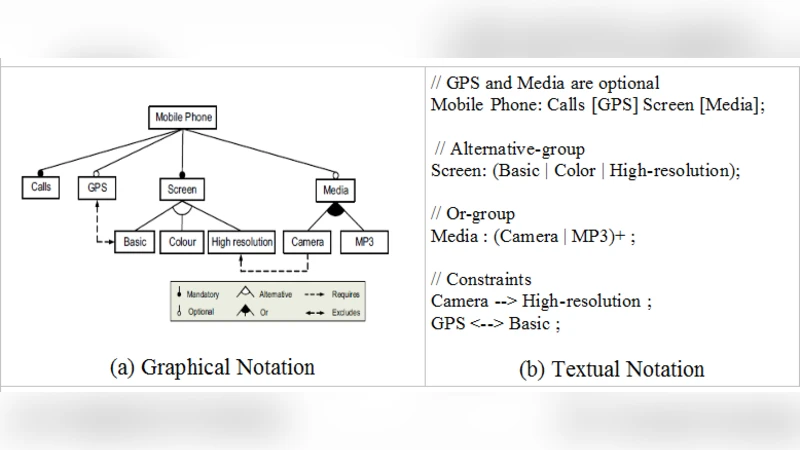
The Feature model is a typical approach to capture variability in a software product line design and implementation. For that, most works automate feature model using a limited graphical notation represented by propositional logic and implemented by Prolog or Java programming languages. These works do not properly combine the extensions of classical feature models and do not provide scalability to implement large size problem issues. In this work, we propose a textual feature modeling language based on Python programming language (PyFML), that generalizes the classical feature models with instance feature cardinalities and attributes which be extended with highlight of replication and complex logical and mathematical cross-tree constraints. textX Meta-language is used for building PyFML to describe and organize feature model dependencies, and PyConstraint Problem Solver is used to implement feature model variability and its constraints validation. The work provides a textual human-readable language to represent feature model and maps the feature model descriptions directly into the object-oriented representation to be used by Constraint Problem Solver for computation. Furthermore, the proposed PyFML makes the notation of feature modeling more expressive to deal with complex software product line representations and using PyConstraint Problem Solver
💡 Research Summary
The paper addresses the limitations of traditional graphical feature‑modeling approaches used in software product line (SPL) engineering, namely their restricted expressiveness for cardinalities, attributes, replication, and complex cross‑tree constraints, as well as scalability issues when dealing with large models. To overcome these drawbacks, the authors propose PyFML, a textual domain‑specific language (DSL) built on top of Python. PyFML is constructed using the textX meta‑modeling framework, which automatically generates a Python parser and a set of classes from an EBNF‑style grammar. The language syntax supports basic features, compound features, group operators (all, one‑of, more‑of), instance cardinalities (e.g., (1..3)), feature attributes (e.g., {price=100}), and Boolean/arithmetical cross‑tree constraints with logical operators (and, or, implies, not).
The workflow proceeds as follows: (1) a developer writes a feature model in the PyFML textual notation; (2) textX parses the input into an abstract syntax tree (AST) and instantiates a graph of Python objects representing the model; (3) each feature is mapped to a variable in a constraint satisfaction problem (CSP), where Boolean variables represent presence/absence and integer variables capture cardinalities or attribute values; (4) constraints derived from the model (parent‑child relations, group semantics, cross‑tree rules) are encoded as logical expressions; (5) the PyConstraint library solves the CSP, yielding all valid product configurations or detecting inconsistencies.
By leveraging Python’s extensive ecosystem, PyFML benefits from rapid prototyping, easy integration with other libraries (e.g., lambda calculus, data analysis tools), and open‑source distribution. The authors demonstrate that even models with thousands of features can be processed within seconds, indicating that the textual DSL combined with a modern CSP solver scales better than many existing Prolog‑ or Java‑based tools.
The paper also situates PyFML within the broader context of DSL research, contrasting it with general‑purpose languages (GPL) and highlighting the advantages of domain‑specific syntax for clearer communication between domain experts and developers. It discusses related work on graphical versus textual notations, noting that while graphical diagrams are intuitive for small models, they become unwieldy for large, attribute‑rich SPLs.
In the experimental section, a mobile‑phone product line example illustrates the language’s capability to express optional features, mandatory groups, cardinalities, and implication constraints such as “Camera implies HighResolution”. The authors report successful validation of the model and rapid enumeration of configurations, confirming the practicality of the approach.
The conclusion emphasizes that PyFML delivers a human‑readable, expressive, and scalable solution for feature modeling, bridging the gap between visual modeling and formal analysis. Future work includes applying the language to industrial‑scale SPLs, optimizing the CSP solving phase (e.g., by integrating more advanced solvers or heuristic pruning), and developing bidirectional synchronization with graphical editors to combine the best of both worlds.
Comments & Academic Discussion
Loading comments...
Leave a Comment