A discrete random model describing bedrock profile abrasion
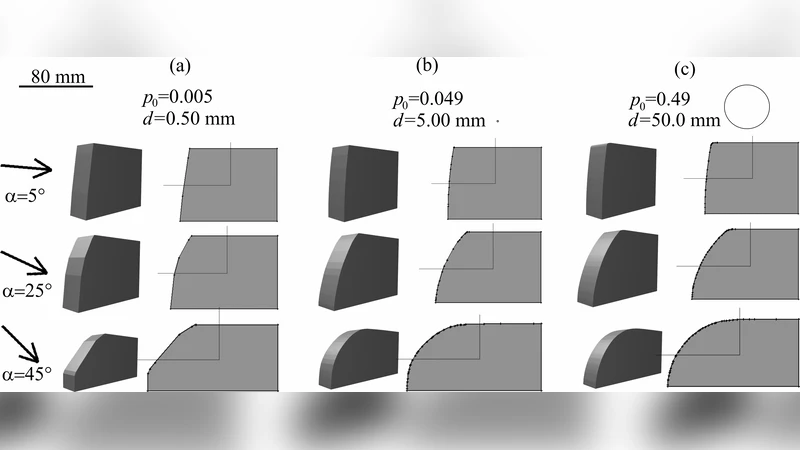
We use a simple, collision-based, discrete, random abrasion model to compute the profiles for the stoss faces in a bedrock abrasion process. The model is the discrete equivalent of the generalized version of a classical, collision based model of abrasion. Three control parameters (which describe the average size of the colliding objects, the expected direction of the impacts and the average volume removed from the body due to one collision) are sufficient for realistic predictions. Our computations show the robust emergence of steady state shapes, both the geometry and the time evolution of which shows good quantitative agreement with laboratory experiments.
💡 Research Summary
The paper presents a discrete, stochastic abrasion model that captures the evolution of bedrock obstacle stoss faces under the impact of moving sediment particles in river channels. Building on Firey’s classical curvature‑driven abrasion equation and its later generalization, the authors replace the continuous partial‑differential formulation with a Monte‑Carlo‑type algorithm that treats each collision as an elementary event. The bedrock profile (P) and the abrasive grains (G) are represented as two‑dimensional polygons. Collisions are classified into two mutually exclusive types: (A) a vertex of P striking an edge of G, and (B) an edge of P being hit by a vertex of G. The probability of type‑A events, p₀, is linked to the relative size of the grains (diameter d) versus the obstacle height (h). When d≫h, p₀≈1 and the model reduces to Firey’s infinite‑plane limit; when d≪h, p₀≈0, corresponding to sand‑blasting conditions.
For each event a random amount of material Δ, drawn from a log‑normal distribution (mean Δ, variance σ₂²), is removed from the profile. In type‑A events the incoming direction α is sampled from a log‑normal distribution centred on a mean impact angle ᾱ with small spread σ₁; the algorithm selects the vertex whose adjacent edge normals bracket α, cuts the profile at that point, and inserts two new vertices, thereby mimicking the erosion of a sharp tip. In type‑B events an edge is chosen with probability proportional to its length, and the edge is translated inward parallel to itself, reproducing the wear of a flat surface. Repeating these stochastic events yields a progressive reshaping of the profile.
The model’s essential control parameters are the mean impact angle ᾱ and the size‑ratio parameter p₀; σ₁, σ₂ and Δ mainly set the temporal scaling. The authors calibrated the model against laboratory flume experiments in which rectangular marble blocks (height h = 80 mm) were exposed to limestone pebbles of 60–80 mm diameter moving as bedload under a flow of ~3 m s⁻¹. From the measured d/h ratio they inferred p₀≈0.37–0.44. Numerical simulations with p₀≈0.40, ᾱ≈26°, and Δ≈0.01 reproduced the observed evolution: an initially square cross‑section became a convex upstream face, the erosion rate was highest near the top and decreased toward the base, and a steady‑state shape emerged after a few hundred simulated steps.
A systematic exploration of parameter space showed that large p₀ (large grains) generates smooth, rounded profiles composed of many short edges, whereas small p₀ (fine grains) yields polygonal shapes with pronounced edges and vertices. Moreover, the authors identified a robust empirical relationship between the mean impact angle ᾱ and the average slope β of the evolving profile: ᾱ≈58.8°−0.346 β−0.0033 β² (β in degrees), which held across a wide range of p₀ values. This coupling reflects the physical fact that steeper obstacles redirect incoming particles to strike at larger angles.
Time evolution in the model aligns closely with experimental measurements. By treating Δ as a proxy for elapsed time, the simulated erosion curves match the laboratory data both in shape and in rate, confirming that the stochastic event sequence faithfully captures the underlying physics. The model also reproduces historical sand‑blasting experiments (Schoewe 1932), where very small p₀≈0.035 and ᾱ≈30° produced the characteristic angular profiles observed in those tests.
In conclusion, the discrete random abrasion model successfully bridges the gap between idealized continuous curvature‑driven theories and the complex, directionally biased, finite‑size particle impacts that dominate natural riverine erosion. Its parameters have direct physical meaning, allowing straightforward calibration from field or laboratory data. The model predicts the emergence of steady‑state obstacle shapes, explains the dependence of final geometry on grain size and impact direction, and provides a quantitative tool for forecasting bedrock landscape evolution in fluvial environments.
Comments & Academic Discussion
Loading comments...
Leave a Comment