Point systems in Games for Health: A bibliometric scoping study
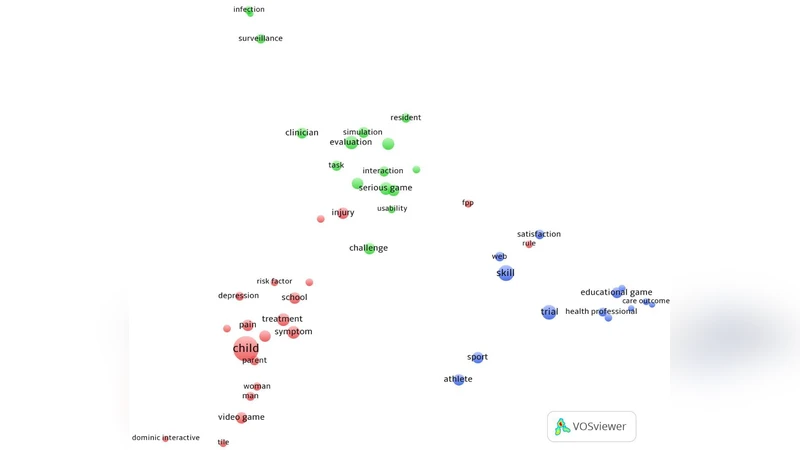
Very few details about point systems used in games for health are reported in scientific literature. To shed some light on this topic a bibliometric study, analyzing the papers containing terms related to games for health and point systems was performed and a mini taxonomy was derived. The search string game* AND health AND (point* OR score) AND system* in a Scopus bibliographic database was used to produce the corpus. We limited the search to articles, reviews and conference papers written in English and to topics related to medical, health and social subjects. The corpus papers abstracts and titles were analysed by VOSviewer and a scientific landscape was generated. The search resulted in a corpus consisting of 354 papers. The derived taxonomy contains three objects; video games, serious games and educational games. The biblimetric mapping and taxonomy revealed some interesting conclusions: (1) the video games have mostly negative effects on health, (2) the serious games might have both a direct positive health effects on users and also indirect effects by improved competencies of health professionals, and (3) the research is concerned not only to computer based educational games, but also to traditional table games and sporting games. Based on the derived taxonomy we can conclude that point systems should reward physical activity and healthy living style and punish sedentary activities.
💡 Research Summary
The paper conducts a bibliometric scoping study to illuminate how point‑based scoring systems are described and employed in games for health. Using the Scopus database, the authors constructed a search query that combined the terms “game*”, “health”, “point* OR score”, and “system*”. The search was limited to English‑language articles, reviews, and conference papers that fall under medical, health, or social subject areas. This query yielded a corpus of 354 documents.
The authors then extracted titles and abstracts from the corpus and processed them with VOSviewer, a software tool for constructing and visualizing bibliometric networks. By analyzing co‑occurrence of keywords, they generated a scientific landscape that revealed three major clusters, which they interpreted as distinct “objects” within the games‑for‑health domain: (1) video games, (2) serious games, and (3) educational games (including traditional board and sport games).
The video‑game cluster is dominated by literature that emphasizes negative health outcomes such as increased sedentary behavior, addiction, and mental‑health concerns. Within this cluster, point systems are frequently portrayed as mechanisms that reinforce prolonged play, thereby exacerbating the adverse effects. Consequently, the authors argue that point‑based designs in pure entertainment video games should be reconsidered if health‑related goals are intended.
In contrast, the serious‑game cluster contains studies that report both direct health benefits for end‑users (e.g., rehabilitation, chronic‑disease management, promotion of physical activity) and indirect benefits for health professionals (e.g., training, competency development). Here, points function as immediate feedback and reward, boosting motivation, adherence, and learning outcomes. The literature suggests that when points are explicitly tied to measurable physical actions—such as steps taken, minutes of exercise, or completion of therapeutic tasks—they can effectively drive behavior change.
The educational‑game cluster expands the scope beyond digital platforms to include tabletop, card, and sport games used for health education. In this context, points serve to structure learning objectives, foster competition or collaboration, and provide social comparison cues. The studies indicate that point systems can enhance engagement and facilitate the acquisition of healthy habits when they are transparent, incremental, and socially visible.
From these observations, the authors derive several design recommendations for point systems in health‑oriented games. First, points should be aligned with physical activity and healthy lifestyle choices, rewarding actions that increase movement or improve nutrition. Second, points should penalize sedentary or unhealthy behaviors, thereby creating a balanced “reward‑punishment” dynamic. Third, the visibility and immediacy of points are crucial; users need to see their progress in real time to maintain motivation. Fourth, personalization—adjusting point thresholds and rewards to individual fitness levels or therapeutic goals—enhances relevance and adherence. Fifth, incorporating social elements (leaderboards, peer comparison) can amplify motivation but must be managed to avoid negative competition.
The study’s methodological contribution lies in its systematic mapping of the literature, which uncovers gaps and trends that were previously scattered across disparate fields. While the bibliometric approach offers a broad overview, the authors acknowledge limitations: the reliance on Scopus and English‑language publications may exclude relevant research from other databases or languages, and the analysis does not delve into the granular design details of specific point systems. Future work should therefore include systematic reviews of intervention studies that evaluate point‑based mechanisms empirically, as well as cross‑cultural investigations to capture a more global perspective.
In summary, the paper demonstrates that point systems in games for health are not uniformly discussed; their impact varies dramatically across game types. By categorizing the literature into video, serious, and educational games, the authors highlight that points can either reinforce harmful sedentary patterns or serve as powerful levers for promoting physical activity and health education. The derived taxonomy and accompanying recommendations provide a practical framework for researchers, designers, and policymakers aiming to develop point‑based gamified interventions that genuinely support healthier behaviors.
Comments & Academic Discussion
Loading comments...
Leave a Comment