Seafloor geodetic constraints on interplate coupling of the Nankai Trough megathrust zone
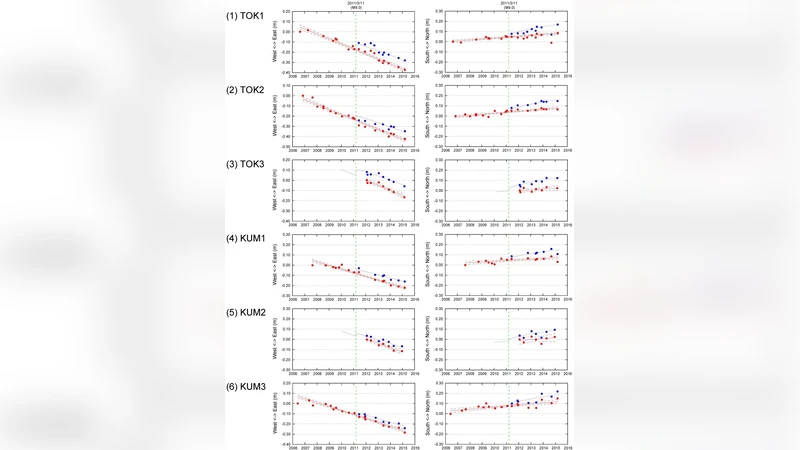
Interplate megathrust earthquakes have inflicted catastrophic damage on human society. An extremely hazardous megathrust earthquake is predicted to occur along the Nankai Trough off southwestern Japan, an economically active and densely populated area with historical records of megathrust earthquakes. Megathrust earthquakes are the result of a plate subduction mechanism and occur at interplate slip-deficit (or coupling) regions. Many past studies have attempted to capture slip-deficit rate (SDR) distributions for assessing future earthquake disasters. However, they could not capture a total view of the megathrust earthquake source region because they had no seafloor geodetic data. The Hydrographic and Oceanographic Department of the Japan Coast Guard (JHOD) has been developing a highly precise and sustainable seafloor geodetic observation network deployed in this subduction zone to broadly obtain direct information related to offshore SDR. Here, we present seafloor geodetic observation data and an offshore interplate SDR distribution model. Our data suggests that most offshore regions in this subduction zone have positive SDRs. Specifically, our observations indicate previously unknown high-SDR regions that are important for tsunami disaster mitigation and low-SDR regions that are consistent with distributions of shallow slow earthquakes and subducting seamounts. This is the first direct evidence suggesting that coupling conditions are related to these seismological and geological phenomena. These observations provide new fundamental information for inferring megathrust earthquake scenarios and interpreting research on the Nankai Trough subduction zone.
💡 Research Summary
The authors present the first comprehensive seafloor geodetic dataset for the Nankai Trough megathrust zone, obtained with a network of fifteen GPS‑Acoustic (GPS‑A) stations deployed by the Japan Coast Guard. Traditional on‑shore GNSS networks have been unable to resolve offshore interplate coupling because they lack direct measurements on the seafloor. By combining high‑precision GPS positioning on the surface with acoustic ranging to seafloor transponders, the GPS‑A technique achieves centimeter‑level accuracy and a temporal sampling rate sufficient to detect interseismic deformation.
Data were collected from 2006 onward; six stations were installed before the 2011 Tohoku‑oki earthquake, and nine additional stations were added later to improve spatial coverage. Raw time series contain coseismic steps and post‑seismic viscoelastic deformation associated with the 2011 event. The authors removed these contributions using a coseismic slip model derived from combined on‑shore and seafloor observations and a 3‑D finite‑element viscoelastic relaxation model. After correction, all stations display steady horizontal velocities ranging from 3 to 6 cm yr⁻¹ relative to the stable Amur plate, with 95 % confidence ellipses indicating robust estimates.
These velocities were inverted to produce a spatial map of slip‑deficit rate (SDR), i.e., the rate at which the subducting Philippine Sea plate is “locked” to the overriding Amur plate. The resulting SDR map reveals that virtually the entire offshore interface is positively coupled, confirming that strain accumulation occurs beneath the trench. Importantly, the map identifies distinct high‑SDR patches (≈5–6 cm yr⁻¹) and low‑SDR patches (≈2–3 cm yr⁻¹).
High‑SDR zones (labeled B and F in the paper) correspond closely with the source regions of the historic 1944 Tonankai and 1946 Nankai‑Do earthquakes and with the anticipated Tokai megathrust rupture. These patches extend from the deep interface up to the shallow trench axis, implying that a future rupture could propagate into very shallow depths, a scenario known to generate large tsunamis (as demonstrated by the 2011 Tohoku event). Some high‑SDR cells even exhibit “overshoot” values exceeding the plate convergence rate of 6.5 cm yr⁻¹, which may reflect viscoelastic stress transfer or uncertainties in the convergence model.
Low‑SDR zones (A, C, and E) are spatially coincident with regions of abundant very‑low‑frequency earthquakes (VLFEs) and with subducting seamounts or ridges (e.g., the Kyushu‑Palau ridge). The authors argue that the presence of topographic asperities and elevated pore‑fluid pressures reduces effective coupling, producing the observed low‑SDR. This direct seafloor evidence supports earlier indirect inferences that subducting bathymetric features and VLFEs are signatures of weak coupling.
The study therefore adds a new “shallow” segmentation to the classic “deep” segmentation of the Nankai megathrust. While deep segmentation controls the overall rupture length, shallow high‑SDR patches dominate tsunami generation potential. Conversely, shallow low‑SDR patches act as barriers that can arrest rupture propagation, as illustrated by the 1944 Tonankai rupture stopping at a low‑SDR zone.
Methodologically, the work demonstrates that GPS‑A can achieve sub‑centimeter accuracy over multi‑year periods, that coseismic/post‑seismic corrections are essential for interseismic studies, and that integrating seafloor and on‑shore data yields a more complete picture of interplate coupling.
The authors plan to continue the observations for decades, aiming to detect possible temporal changes in SDR (e.g., decadal loading cycles) and to compare the Nankai results with other subduction zones worldwide. Their findings provide critical constraints for probabilistic earthquake and tsunami hazard models, improve the realism of rupture simulations, and underline the necessity of offshore geodetic monitoring for coastal megathrust systems.
Comments & Academic Discussion
Loading comments...
Leave a Comment