A Direct Method for the Transient Stability Analysis of Transmission Switching Events
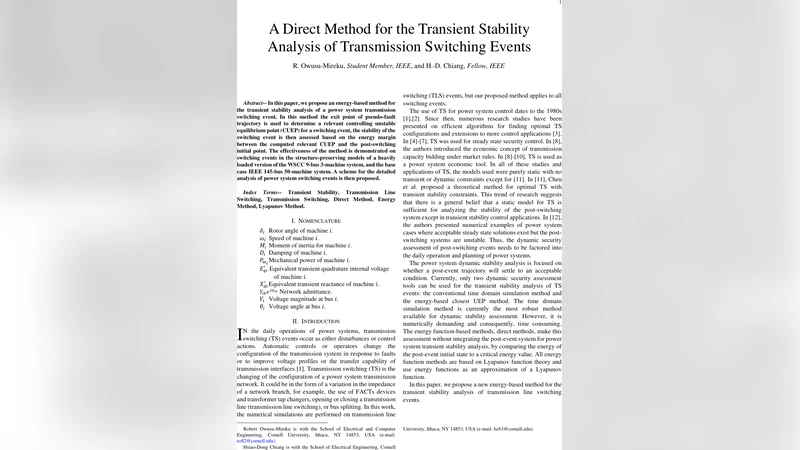
In this paper, we propose an energy-based method for the transient stability analysis of a power system transmission switching event. In this method the exit point of pseudo-fault trajectory is used to determine a relevant controlling unstable equilibrium point (CUEP) for a switching event, the stability of the switching event is then assessed based on the energy margin between the computed relevant CUEP and the post-switching initial point. The effectiveness of the method is demonstrated on switching events in the structure-preserving models of a heavily loaded version of the WSCC 9-bus 3-machine system, and the base case IEEE 145-bus 50-machine system. A scheme for the detailed analysis of power system switching events is then proposed.
💡 Research Summary
This paper introduces an energy‑based direct method for assessing the transient stability of power‑system transmission switching events. Traditional transient stability studies rely on time‑domain simulations of fault initiation, clearing, and post‑fault dynamics. While accurate, such simulations become computationally prohibitive for large‑scale networks and are ill‑suited for real‑time operational decision‑making, especially when numerous switching scenarios must be evaluated. To overcome these limitations, the authors propose a novel framework that treats a switching operation as a “pseudo‑fault” – a temporary disturbance that instantaneously changes the network topology but is removed as soon as the new configuration is established.
The analysis is performed on a structure‑preserving model, which retains both bus voltage angles and generator rotor angles, thereby capturing the coupled electromechanical dynamics essential for transient stability. Within this model, the pseudo‑fault trajectory is traced from the pre‑switching operating point. The first point at which this trajectory exits the basin of attraction of the pre‑switching equilibrium is identified as the “exit point.” This exit point represents the state of maximum potential energy that the system attains before it begins to converge toward a new equilibrium.
Using the exit point as an initial guess, the method computes the Controlling Unstable Equilibrium Point (CUEP). The CUEP is the unstable equilibrium that lies on the boundary of the stability region and requires the smallest amount of energy to be crossed; it therefore governs the stability margin of the switching event. The total system energy at the CUEP is obtained by summing the electrical potential energy (derived from the network susceptance matrix) and the kinetic energy of rotating masses.
The key stability indicator is the “energy margin,” defined as the difference between the system’s energy at the post‑switching initial state (immediately after the line is opened or closed) and the energy at the CUEP. A positive margin indicates that the post‑switching state resides within the stability region and cannot reach the CUEP, implying stable operation. Conversely, a negative margin signals that the system possesses enough energy to cross the CUEP, predicting loss of synchronism or voltage collapse. Because the margin is computed analytically from the energy function, the method yields a binary stability verdict without the need for exhaustive time‑domain integration.
The authors validate the approach on two benchmark systems. First, a heavily loaded WSCC 9‑bus, 3‑machine test case is examined under several line‑opening and line‑closing scenarios. The energy‑margin predictions match the outcomes of detailed time‑domain simulations, while the computational time is reduced to a few seconds. Second, the method is applied to the base‑case IEEE 145‑bus, 50‑machine system, demonstrating scalability to realistic, high‑dimensional networks. Even with complex topology changes, the CUEP and associated energy margins are obtained accurately, and the total analysis time is an order of magnitude faster than conventional simulation‑based studies.
Beyond the core algorithm, the paper proposes a systematic workflow for practical switching‑event analysis: (1) model the pre‑switching system and define initial conditions; (2) formulate the pseudo‑fault and locate the exit point; (3) compute the CUEP using the exit point as a seed; (4) evaluate the energy margin; and (5), if needed, corroborate the result with a limited time‑domain simulation. This workflow equips system operators with a rapid, physics‑based tool to screen candidate switching actions, identify those that may jeopardize stability, and design remedial measures such as pre‑emptive generation re‑dispatch or reactive power support.
In conclusion, the paper delivers a rigorous yet computationally efficient energy‑function methodology that transforms transmission switching stability assessment from a simulation‑heavy task into a near‑real‑time analytical process. Future research directions include extending the framework to incorporate nonlinear load models, high‑penetration renewable generation, and sequences of multiple switching events, as well as embedding the algorithm into operator‑center decision‑support platforms. Such advancements promise to enhance the reliability and security of modern power grids while accommodating the increasing operational flexibility demanded by renewable integration and market‑driven reconfiguration.
Comments & Academic Discussion
Loading comments...
Leave a Comment