Revisiting slope influence in turbulent bedload transport: consequences for vertical flow structure and transport rate scaling
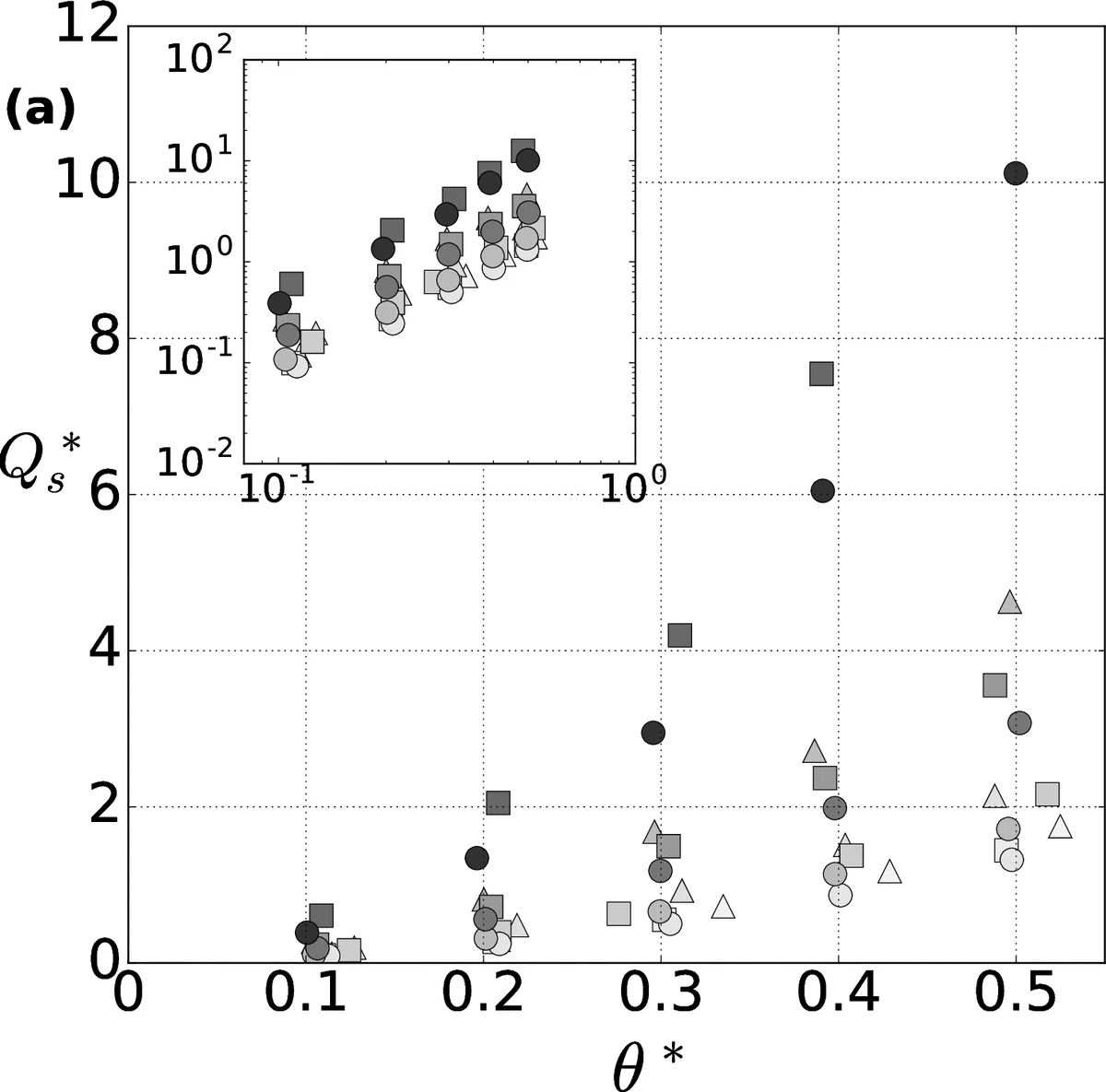
Gravity-driven turbulent bedload transport has been extensively studied over the past century in regard to its importance for Earth surface processes such as natural riverbed morphological evolution. In the present contribution, the influence of the longitudinal channel inclination angle on gravity-driven turbulent bedload transport is studied in an idealised framework considering steady and uniform flow conditions. From an analytical analysis based on the two-phase continuous equations, it is shown that : (i) the classical slope correction of the critical Shields number is based on an erroneous formulation of the buoyancy force, (ii) the influence of the slope is not restricted to the critical Shields number but affects the whole transport formula and (iii) pressure-driven and gravity-driven turbulent bedload transport are not equivalent from the slope influence standpoint. Analysing further the granular flow driving mechanisms, the longitudinal slope is shown to not only influence the fluid bed shear stress and the resistance of the granular bed, but also to affect the fluid flow inside the granular bed - responsible for the transition from bedload transport to debris flow. The relative influence of these coupled mechanisms allows us to understand the evolution of the vertical structure of the granular flow and to predict the transport rate scaling law as a function of a rescaled Shields number. The theoretical analysis is validated with coupled fluid-discrete element simulations of idealised gravity-driven turbulent bedload transport, performed over a wide range of Shields number values, density ratios and channel inclination angles. In particular, all the data are shown to collapse onto a master curve when considering the sediment transport rate as a function of the proposed rescaled Shields number.
💡 Research Summary
This paper revisits the role of channel slope in gravity‑driven turbulent bedload transport and demonstrates that the classical slope correction applied to the critical Shields number is fundamentally flawed. The authors first point out that the traditional expression for the buoyancy force, f_b = –ρ_f g V, neglects the contribution of the fluid stress tensor and is therefore inappropriate for turbulent flows where Reynolds stresses dominate. By invoking the Maxey‑Riley formulation, they show that buoyancy should be expressed as f_b = –π d³/6 ∇·σ_f, where σ_f includes both hydrostatic pressure and turbulent stresses. This correction leads to a revised critical Shields number that depends not only on the slope angle α and the grain friction coefficient μ_s but also on the particle‑to‑fluid density ratio ρ_p/ρ_f:
θ_c(α) = θ_0 cos α /
Comments & Academic Discussion
Loading comments...
Leave a Comment