High-Resolution Angle Tracking for Mobile Wideband Millimeter-Wave Systems with Antenna Array Calibration
Millimeter-wave (mmWave) systems use directional beams to support high-rate data communications. Small misalignment between the transmit and receive beams (e.g., due to the mobility) can result in significant drop of the received signal quality especially in line-of-sight communication channels. In this paper, we propose and evaluate high-resolution angle tracking strategies for wideband mmWave systems with mobility. We custom design pairs of auxiliary beams as the tracking beams, and use them to capture the angle variations, towards which the steering directions of the data beams are adjusted. Different from conventional beam tracking designs, the proposed framework neither depends on the angle variation model nor requires an on-grid assumption. For practical implementation of the proposed methods, we examine the impact of the array calibration errors on the auxiliary beam pair design. Numerical results reveal that by employing the proposed methods, good angle tracking performance can be achieved under various antenna array configurations, channel models, and mobility conditions.
💡 Research Summary
The paper addresses the critical problem of beam misalignment in mobile millimeter‑wave (mmWave) systems, where even slight angular deviations caused by user equipment (UE) mobility can dramatically degrade link quality, especially in line‑of‑sight (LOS) scenarios. Conventional beam‑tracking solutions rely on a grid‑of‑beams approach: a predefined set of narrow beams is periodically swept, and the best beam is selected based on received power measurements. While simple, this method suffers from limited angular resolution (determined by the grid spacing), high training overhead, and latency, making it unsuitable for fast‑varying channels.
To overcome these limitations, the authors propose a high‑resolution angle‑tracking framework based on auxiliary beam pairs (ABP). Instead of sweeping many narrow beams, the base station (BS) simultaneously transmits two closely spaced “auxiliary” beams surrounding the current data‑beam (the anchor beam). The UE measures the received power of each auxiliary beam, computes their ratio, and maps this ratio to an angular offset using a pre‑derived monotonic relationship. Because the mapping is continuous, the method does not require the angle to lie on a predefined grid, achieving effectively infinite resolution limited only by noise and hardware impairments.
Key features of the proposed framework include:
- Model‑free tracking – No assumptions about the temporal evolution of AoD/AoA (e.g., linear or Gaussian models) are needed; the method works purely on instantaneous power measurements.
- Feedback strategies – Two schemes are examined:
- Direct feedback: the UE reports the absolute estimated angle to the BS.
- Differential feedback: the UE reports only the change relative to the previous estimate. The latter dramatically reduces uplink overhead, which is especially beneficial in frequency‑division duplex (FDD) systems.
- Wideband compatibility – The ABP design is extended to OFDM‑based wideband systems. By averaging the power ratios over multiple sub‑carriers, the estimator becomes robust to frequency‑selective fading.
- Array‑calibration awareness – Realistic analog beamforming hardware suffers from phase‑shifter quantization, gain imbalance, and mutual coupling, leading to radiation‑pattern distortions. The authors analyze how such calibration errors corrupt the power‑ratio‑to‑angle mapping, increasing tracking error probability and reducing spectral efficiency.
- Calibration procedures – Two practical calibration methods are introduced for the shared‑array architecture (few RF chains driving many antennas):
- Receive‑combining based calibration: the UE transmits known reference signals; the BS, using multiple RF chains, estimates per‑antenna complex gains and constructs a compensation matrix.
- Transmit‑side calibration: the BS sequentially transmits a set of known pilot beams; the UE measures the responses and feeds back the estimated per‑antenna errors, enabling the BS to correct its transmit pattern. Both methods are shown to significantly mitigate the impact of phase/amplitude errors, restoring the ABP’s high‑resolution capability even with residual calibration errors.
The system model assumes a hybrid analog‑digital transceiver with a uniform planar array (UPA) at the BS and a uniform linear array (ULA) at the UE. The wideband channel follows a geometric multipath model with a small number of dominant paths, each characterized by AoD (azimuth/elevation), AoA, delay, and complex gain. The authors decompose the UPA response into separate elevation and azimuth spatial‑frequency vectors, allowing independent tracking of the two angular dimensions.
Simulation results cover a broad set of scenarios:
- Various antenna configurations (e.g., 64‑element UPA, 32‑element ULA).
- LOS‑dominant and mixed LOS/NLOS channels with 3–5 paths.
- UE speeds from 0 to 30 km/h, corresponding to Doppler spreads typical for mmWave.
- SNR values from 0 dB to 20 dB.
Key findings:
- Angle estimation error: ABP tracking reduces the root‑mean‑square angular error by a factor of 5–7 compared with the conventional grid‑of‑beams method.
- Feedback overhead: Differential feedback cuts uplink bits by roughly 70 % while preserving estimation accuracy.
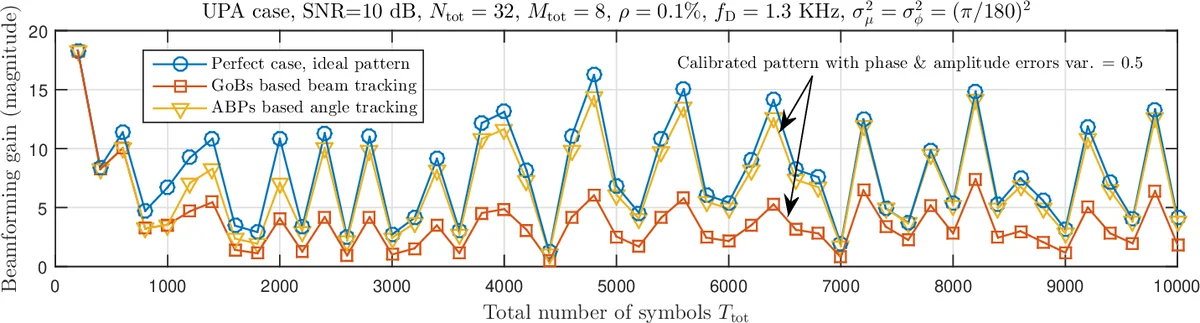
- Spectral efficiency: With calibrated arrays, the proposed scheme achieves >95 % of the ideal (perfect‑alignment) spectral efficiency at 10 dB SNR, whereas the grid‑based approach suffers a 15–20 % loss.
- Robustness to calibration errors: When phase/amplitude mismatches are within ±5°, performance degradation is negligible; larger mismatches can be effectively compensated by the proposed calibration procedures.
The paper also discusses practical implementation aspects, such as the timing of dedicated tracking channels (DTC) within the frame structure, the possibility of periodic versus aperiodic triggering, and the transition period needed to reconfigure analog beamformers between data and tracking phases.
In conclusion, the authors deliver a comprehensive solution for high‑resolution angle tracking in mobile wideband mmWave systems that is model‑agnostic, low‑overhead, and robust to hardware imperfections. The auxiliary‑beam‑pair concept, combined with efficient calibration and feedback designs, offers a viable path for next‑generation 5G NR and future IEEE 802.11ay deployments where rapid beam alignment is essential. Future work suggested includes extending the method to multi‑user multi‑beam scenarios, integrating machine‑learning‑based prediction for proactive tracking, and experimental validation on hardware testbeds.
Comments & Academic Discussion
Loading comments...
Leave a Comment