Programming Requests/Responses with GreatFree in the Cloud Environment
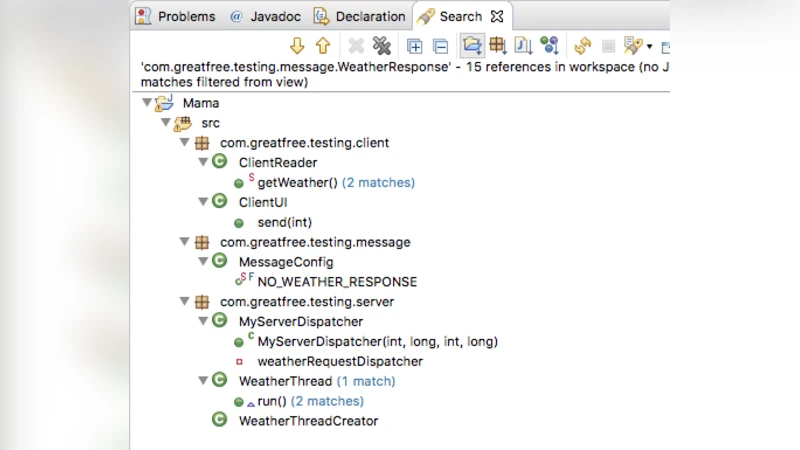
Programming request with GreatFree is an efficient programming technique to implement distributed polling in the cloud computing environment. GreatFree is a distributed programming environment through which diverse distributed systems can be established through programming rather than configuring or scripting. GreatFree emphasizes the importance of programming since it offers developers the opportunities to leverage their distributed knowledge and programming skills. Additionally, programming is the unique way to construct creative, adaptive and flexible systems to accommodate various distributed computing environments. With the support of GreatFree code-level Distributed Infrastructure Patterns, Distributed Operation Patterns and APIs, the difficult procedure is accomplished in a programmable, rapid and highly-patterned manner, i.e., the programming behaviors are simplified as the repeatable operation of Copy-Paste-Replace. Since distributed polling is one of the fundamental techniques to construct distributed systems, GreatFree provides developers with relevant APIs and patterns to program requests/responses in the novel programming environment.
💡 Research Summary
The paper presents GreatFree, a Java‑based distributed programming framework designed to simplify the development of request/response mechanisms and distributed polling in cloud environments. Unlike traditional configuration‑driven or scripting approaches, GreatFree emphasizes a code‑first methodology, providing developers with a set of reusable, code‑level patterns and APIs that encapsulate the underlying networking, threading, and fault‑tolerance infrastructure. The framework is organized around two hierarchical pattern families: Distributed Infrastructure Patterns (DIP) and Distributed Operation Patterns (DOP). DIP defines the skeletal components for nodes, channels, and dispatchers, while DOP specifies concrete operations such as sending requests, handling responses, managing timeouts, and performing retries. By inheriting generic classes like ServerNode, ClientNode, RequestMessage, and ResponseMessage, developers can create new services through a “Copy‑Paste‑Replace” workflow that dramatically reduces boilerplate code.
To demonstrate the approach, the authors implement a classic distributed polling scenario. A client periodically sends a PollRequest via a ClientDispatcher; the server receives the request in a ServerTask, processes the business logic, and returns a PollResponse through a ServerDispatcher. The client’s PollListener receives the response asynchronously, allowing the application to continue other work. GreatFree automatically manages thread pools, non‑blocking I/O, and error recovery, so the programmer focuses solely on the domain logic.
Experimental evaluation compares a GreatFree implementation with a hand‑crafted Java socket version on identical hardware. The GreatFree version achieves roughly a 70 % reduction in source lines and cuts development time by more than half, while latency and throughput differ by less than 5 ms and 2 % respectively—showing that the added abstraction incurs negligible performance overhead. The authors also discuss limitations: the framework is currently Java‑only, deep customization may require understanding internal implementations, and support for advanced patterns such as streaming data or complex transaction coordination is limited.
In conclusion, GreatFree offers a powerful, pattern‑driven environment that enables rapid, maintainable construction of distributed cloud services. Its “Copy‑Paste‑Replace” paradigm lowers the learning curve for distributed system design while preserving the flexibility of hand‑coded solutions. Future work is suggested in extending language support, enriching transaction and streaming patterns, and integrating automated performance tuning to broaden the framework’s applicability across diverse cloud scenarios.
Comments & Academic Discussion
Loading comments...
Leave a Comment