Doppler Spread Estimation in MIMO Frequency-selective Fading Channels
One of the main challenges in high-speed mobile communications is the presence of large Doppler spreads. Thus, accurate estimation of maximum Doppler spread (MDS) plays an important role in improving the performance of the communication link. In this…
Authors: Mostafa Mohammadkarimi, Ebrahim Karami, Octavia A. Dobre
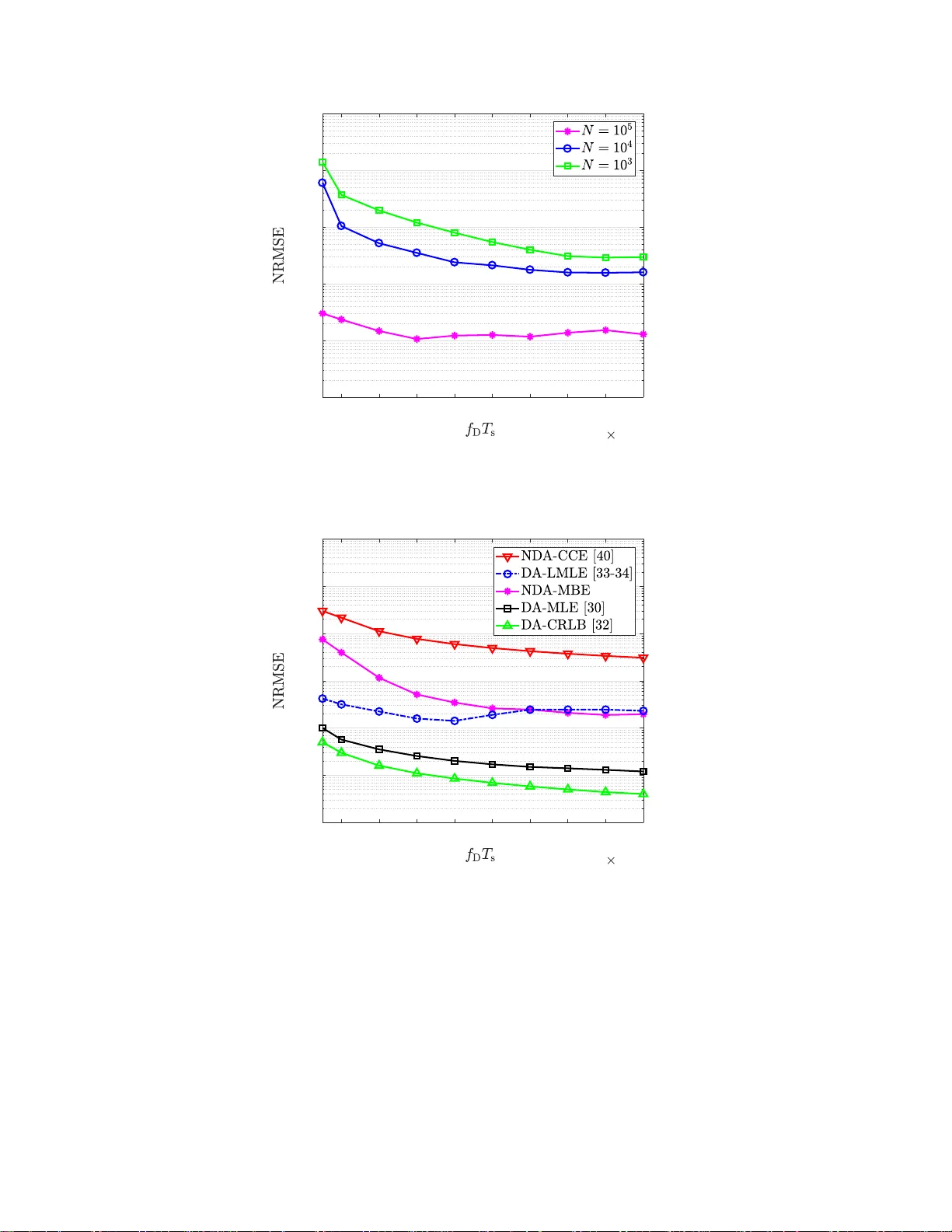
1 Doppler Spread Estimation in MIMO Frequenc y-selecti v e F ading Channels Mostafa Mohammadka rimi, Student Member , IEEE, Ebrahim Karami, Stude nt Me mber , IEEE, Octavia A. Dob re, Senior Member , IEEE, and Moe Z. W in F ellow , IEEE Abstract One of the main challenges in high-speed mobile communication s is the presence of large Doppler spreads. Thus, accurate estimation of maximum Doppler spread (MDS) plays an important role in improving the perform ance of the communication link. In this paper , we deriv e the data-aided (DA) and non-data-aided (ND A) Cramer-Rao lower bounds (CR L Bs) and maximum likelihood estimators (MLEs) for the MDS in multiple-input multi ple-output (MIMO) frequency-selecti ve fading channel. Moreov er , a low- complex ity NDA-mom ent-based estimator (MBE) is proposed. The proposed ND A-MBE relies on the second- and fourth-order moments of the receiv ed si gnal, which are employ ed to estimate the normalized squared autocorrelation function of the fading channel. T hen, the problem of MDS estimation is formulated as a non-linear regression problem, and the least-squares curve- fitting optimization technique is applied t o determine the estimate of the MDS. This is the fir st time in the l iterature when DA- and NDA -MDS esti mation is in vestigated for MIMO frequenc y-selectiv e fading channel. S imulation results sho w that there is no significant performance gap between the deri ved ND A-MLE and ND A-CRLB e ven w hen the observ ation windo w is relativ ely small. Furthermore, the significant reduced-complex ity in the NDA-M BE leads to lo w root-mean-squa re error (NRMSE) ov er a wide range of MDSs when the observ ation windo w is selected large enough. Index T erms Maximum Doppler spread, data-aided, non-data-aided, multiple-input multiple-output, frequency-selecti ve, Cramer-Rao lower bound (CRLB), fourth-order moment, autocorrelation, non-linear regression, maximum likelihood estimator (MLE). I . I N T R O D U C T I O N M AXIMUM DOPPLER SPREAD m easures the coh erence time, related to the rate of ch ange, of wireless com mu- nication ch annels. I ts k n owledge is imp ortant to d e sign efficient wireless commun ication systems for high-spee d vehicles [ 1 ]–[ 3 ]. In particular, accur ate estimation of the maximum Do ppler spread (MDS) is requ ired f o r the design of adaptive tra nsceiv ers, as well as in c e llular and smart an tenna systems [ 3 ]–[ 12 ]. For example, in the context of ad a p tiv e transceivers, system p arameters such as coding, mod ulation, and power a re ada p ted to the ch anges in the chann e l [ 4 ]–[ 7 ]. In cellular systems, h andoff is dictated b y the velocity of the mobile station, which is also dire c tly obtained from the Dop pler informa tio n. Knowledge of the rate of the ch a nnel change is also em ployed to reduce unnecessary hando ff; the hando ff is initiated based on the receiv ed power at the mobile station, and the optimu m window size for power estimation dep ends o n the MDS [ 7 ]–[ 10 ]. In the c o ntext of smart antenna systems, the MDS is used in the design of th e maximum likelihood (ML) M. Mohammadkari mi, E. Karami, and O. A. Dobre are with the Department of Electrical and Computer Engineeri ng, Memorial Univ ersity , St. John’ s, NL, Canada (e-mail: { m.mohamm adkarimi, ekarami, odobre } @mun.ca ). M. Z. W in is with the Laboratory for Information and Decision Systems (LIDS), Massachusett s Institute of T echn ology , Cambridge, MA, USA (e-mail: moewin@mit.edu ). 2 space-time tran scei vers [ 11 ], [ 1 2 ]. In addition , k nowledge o f MDS is required fo r chann el tracking and equalizatio n, as well as for the selection of the op timal interleaving length in wireless commu nication systems [ 13 ]. In general, parameter estimators can be categorized as: i) data-aided (D A), where the estimation relies on a pilo t or prea m ble sequence [ 14 ]–[ 18 ], ii) no n-data-aid ed (NDA ), where the estimation is perf ormed with no a priori kn owledge ab out the transmitted symbo ls [ 19 ]–[ 23 ], and iii) code- aided ( CA), where th e decod in g ga in is used via iterative feed back to enha nce the estimation perfo rmance of the desired pa r ameters [ 24 ]–[ 29 ]. W ith regard to the MDS estimatio n, the DA app roach o f ten pr ovides accurate estimates fo r slowly-varying ch annels b y employing a red uced nu mber o f pilo t symb o ls, wher eas this do es not hold fo r fast-varying chann els. In the latter case, the details of the channel variations cann ot be captured accura tely , and mor e pilots ar e requir ed, which r e su lts in increa sed overhead and reduced system capacity . There are five majo r classes of MDS estimato rs: ML-based, power spectral density (PSD) - based, lev el-cro ssing-rate (LCR)- based, covariance-based, and cyclostationar ity -based estimator s. T he ML-based estimator maxim izes th e likelihood fun ction, and, in gen eral, is asympto tically unbiased, achieving the Cramer-Rao lower bound (CRLB) [ 30 ]–[ 32 ]. Howe ver, maximum likelihood e stimator (MLE) for MDS suf fers from significant computationa l co mplexity . He n ce, dif fere nt mod ified lo w- complexity MLEs for M DS in single - input single-o utput (SISO) flat-fading chan nel were developed [ 33 ], [ 34 ]. W ith the PSD-based estimator s, some u nique features from the Doppler spectrum are obtain ed through th e sample per io dogram of the received sign al [ 35 ]. Cov ariance- based estimators extract the Doppler inform ation which exists in the sample auto-covariance of the received signa l [ 36 ]–[ 38 ]. LCR-based estimators rely on the numbe r of le vel crossings of the received sig n al statistics, which is p r oportio n al to the MDS [ 39 ]. The cyclostationarity-b ased estimators exploit the cyclostationarity o f the received signal [ 40 ]. Com paring with oth er MDS estimators, the advantage of the cyclostationarity- b ased estimato r s is the robustness to stationary noise and interferen ce. While the pro b lem of MDS estimatio n in SISO flat-fading chann e l h a s been extensively investigated in the liter ature [ 30 ]– [ 40 ], the MDS estimation in multiple-in put m u ltiple-outp ut (MIM O) freque ncy-selectiv e or in MIMO flat-fadin g ch annel has not been con siderably exp lo red. Fu r thermor e , DA -MDS estimation ha s mainly b een studied in the literature . T o th e best of ou r knowledge, only a few works have ad dressed MDS etimation in co njunction with multiple antenna sy stems. In [ 32 ], the au thors derived an asymptotic DA-MLE and D A-CRLB for joint MDS and n oise variance estimation in MIMO flat-fading ch a n nel. I n [ 40 ], the cyclic correlatio n (CC) of linearly modu lated sign als is exploited fo r the MDS estimatio n for single tran sm it an tenna scenarios. While bo th DA and ND A estimators ar e stud ied in [ 40 ], only f requency-flat fading an d sing le transmit antenn a are considered . In this paper, we inv estigate the pro blem o f MDS estimation in MI M O f requency-selective fading chann el for bo th DA an d ND A scenarios. Th e D A-CRLB, ND A-CRLB, DA-MLE, and NDA -MLE in MIMO frequ ency-selectiv e fading channe l are derived. In addition , a low-comp lexity ND A-moment- based estima to r (M BE) is propo sed. Th e pr oposed MBE relies on the second- an d fourth -order moments of the r eceiv ed signal a long w ith the lea st-sq uare (LS) curve-fitting optimization techn ique to estimate the normalized squared autocorr elation function (AF) and MDS o f the fading cha n nel. Sin ce the p roposed MBE is NDA , it removes th e need of pilots an d preambles used for D A-MDS estimation , and th us, it results in in c reased system 3 capacity . The N DA-MBE outperf orms the derived DA -MLE in the p resence of imp erfect time-freq uency synchroniza tion. Also, the MBE outperfo rms the ND A-CC estimator (CCE) in [ 40 ] and the DA low-complexity MLE in [ 33 ], [ 34 ] in SISO systems and under flat fading channels and in the presence of perfec t time-fre quency sy nchron ization. A. Contributions This paper brings the following or ig inal con tributions: • The D A- and ND A-CRLBs for MDS estimation in MIMO freq uency-selective fadin g chan nel are deriv ed; • The D A- and ND A-MLEs for MDS in MIMO fre quency-selective fading cha n nel are der i ved; • A low-complexity NDA-MBE is p r oposed. T he proposed estimator exhibits the f ollowing advantages: – lo wer comp utational complexity comp ared to the M LEs; – does not requir e time synchr onization; – is robust to th e c a rrier frequen cy offset; – increases system capacity; – does not requir e a priori knowledge o f no ise p ower , signal power , and cha n nel delay profile; – does not requir e a priori knowledge o f the nu m ber o f transmit antenna s; – removes the n e ed of joint par ameter estimation , such as carr ie r frequen cy offset, signal power , n o ise p ower , and channel delay pro file estimation; • The optimal combin ing me thod f or the ND A-MBE in case of multiple receiv e antennas is derived throu gh the bo otstrap technique . B. Notations Notation. Rand om variables are displayed in sans serif, uprig ht fo nts; their realizatio ns in serif, italic fon ts. V ectors and matrices ar e denoted by bold lowercase an d upper c ase letter s, respectively . For example, a rando m variable and its realiza tion are deno ted by x an d x ; a random vector and its realization are d enoted by x and x ; a rando m matrix and its realiza tio n are denoted by X and X , respectively . Th r ougho ut the paper, ( · ) ∗ is used f o r the complex co n jugate, ( · ) † is u sed for tran spose, | · | represents the absolute value operato r , ⌊·⌋ is the floor f unction, δ i,j denotes the Kron ecker delta f unction, n ! is th e factorial of n , E {·} is the statistical expectation , ˆ x is an estimate of x , an d det( A ) denotes th e determina nt of the matrix A . The re st of the paper is organized as follows: Section II de scr ibes the system mod el; Section III obtains th e DA - and ND A-CRLBs for MDS estimation in MI M O frequen cy-selecti ve fading; Section IV de r i ves the DA- and ND A-MLEs f or MDS in MIM O freq uency-selective fading ch a n nel; Section V introduces the proposed NDA-MBE for M DS; Section VI evaluates the co mputation al c o mplexity o f the der i ved estimators; Section VII pr e sents num erical results; and Section VII I conclu d es the paper . 4 I I . S Y S T E M M O D E L Let us consider a MIMO wireless co mmunicatio n system with n t transmit anten n as and n r receive antenn as, wher e the received signals are affected b y time-varying freq uency-selective Rayleigh fading and are corr upted b y additive white Gaussian noise. The discrete-time comp lex-valued b aseband signal at the n th receive antenna is expressed a s [ 41 ] r ( n ) k = n t X m =1 L X l =1 h ( mn ) k,l s ( m ) k − l + w ( n ) k k = 1 , ..., N , (1) where N is the numb er of observation symbols, L is the length of the channel impulse resp onse, s ( m ) k is the sym bol tran smitted from the m th antenna at time k , satisfy ing E s ( m 1 ) k 1 ( s ( m 2 ) k 2 ) ∗ = σ 2 s m 1 δ m 1 ,m 2 δ k 1 ,k 2 , with σ 2 s m 1 being the tr a nsmit power of the m 1 th anten na, w ( n ) k is the complex-valued additive white Gaussian noise at the n th receive antenna a t time k , whose variance is σ 2 w n , and h ( mn ) k,l denotes the ze r o-mean complex-valued Gaussian fading process between the m th transmit and n th receiv e antennas fo r the l th tap of the fading channe l and at time k . I t is con sidered th at the chan nels for different ante n nas are indepen d ent, with the cross-co rrelation of the l 1 and l 2 taps gi ven by 1 E n h ( mn ) k,l 1 h ( mn ) k + u,l 2 ∗ o = σ 2 h ( mn ) ,l 1 J 0 (2 π f D T s u ) δ l 1 ,l 2 , (2) where J 0 ( · ) is the zero-or der Bessel func tion of the first kind, σ 2 h ( mn ) ,l 1 is the variance of the l 1 th tap between the m th transmit and n th receive antennas, T s denotes the symbol p eriod, and f D = v / λ = f c v / c represents th e MDS in H z , with v as the relativ e spee d between the tra nsmitter and receiver , λ as the wavelength, f c as the car rier freq uency , and c as the speed of light. I I I . C R L B F O R M D S E S T I M AT I O N In this section, the D A- and NDA-CR LB for MDS estimation in MIMO f requency-selective fadin g channel are d erived. A. D A-CRLB Let us co n sider s ( m ) k = s ( m ) k , m = 1 , 2 , · · · , n t , k = 1 , 2 , · · · , N − L + 1 , as employed pilots for DA-MDS estimation. The received sign al a t n th receive an tenna in ( 1 ) can be written as r ( n ) k = ¯ r ( n ) k + j ˘ r ( n ) k = n t X m =1 L X l =1 ¯ h ( mn ) k,l ¯ s ( m ) k − l − ˘ h ( mn ) k,l ˘ s ( m ) k − l + ¯ w ( n ) k + j n t X m =1 L X l =1 ¯ h ( mn ) k,l ˘ s ( m ) k − l + ˘ h ( mn ) k,l ¯ s ( m ) k − l + ˘ w ( n ) k ! , (3) where ¯ r ( n ) k , Re r ( n ) k , ˘ r ( n ) k , I m r ( n ) k , ¯ h ( mn ) k,l , Re h ( mn ) k,l , ˘ h ( m,n ) k,l , I m h ( mn ) k,l , ¯ s ( mn ) k − l , Re s ( mn ) k − l , and ˘ s ( mn ) k − l , Im s ( mn ) k − l . Let us define r ( n ) , h ¯ r ( n ) 1 ¯ r ( n ) 2 · · · ¯ r ( n ) N ˘ r ( n ) 1 ˘ r ( n ) 2 · · · ˘ r ( n ) N i † (4) 1 Here we consider the Jakes channel; it is worth noting that dif ferent parametric channel models can be also considere d. 5 and r , h r (1) † r (2) † · · · r ( n r ) † i † . (5) The e le m ents of the vector r ( n ) , n = 1 , 2 , · · · , n t , are linear combination s of the cor related Gaussian ra ndom variables as in ( 3 ). Thus, r , is a Gau ssian r andom vector with p robability d ensity function (PDF) given by p ( r | s ; θ ) = exp − 1 2 r † Σ − 1 ( s , θ ) r (2 π ) N n r det 1 2 Σ ( s , θ ) , (6) where Σ ( s , θ ) , E { rr † } , s , s (1) † s (2) † · · · s ( n t ) † † , s ( m ) , ¯ s ( m ) 1 ¯ s ( m ) 2 · · · ¯ s ( m ) N − L +1 ˘ s ( m ) 1 ˘ s ( m ) 2 · · · ˘ s ( m ) N − L +1 † , and θ , [ ξ ϑ f D ] † is the parameter vector, with ξ , [ σ 2 w 1 · · · σ 2 w n r ] † (7a) ϑ , [ ϑ † 1 ϑ † 2 · · · ϑ † L ] † (7b) ϑ l , h σ 2 h (11) ,l · · · σ 2 h (1 n r ) ,l σ 2 h (21) ,l · · · (7c) σ 2 h (2 n r ) ,l · · · σ 2 h ( n t 1) ,l · · · σ 2 h ( n t n r ) ,l i † . Since r ( n 1 ) and r ( n 2 ) , n 1 6 = n 2 , a re unc orrelated rando m vectors, i.e . E r ( n 1 ) r ( n 2 ) † = 0 , the covariance m atrix of r , Σ ( s , θ ) , is b lock diagona l as Σ ( s , θ ) , E { rr † } = Σ (1) Σ (2) . . . Σ ( n r ) , (8) where Σ ( n ) , E r ( n ) r ( n ) † . By employing ( 2 ), ( 3 ), and ( 4 ), using the fact the rea l an d imag inary pa rt of the fading tap are independ ent random v ariab les with E | ¯ h ( mn ) k,l | 2 = | ˘ h ( mn ) k,l | 2 = σ 2 h ( mn ) ,l / 2 , and after some alg ebra, the elements of the covariance matr ix Σ ( n ) , n ∈ { 1 , 2 , · · · , n r } , are obtaine d as E n ¯ r ( n ) k ¯ r ( n ) k + u o = E n ˘ r ( n ) k ˘ r ( n ) k + u o (9a) = 1 2 n t X m =1 L X l =1 σ 2 h ( mn ) ,l ¯ s ( m ) k − l ¯ s ( m ) k + u − l + ˘ s ( m ) k − l ˘ s ( m ) k + u − l J 0 (2 π f D T s u ) + σ 2 w n 2 δ u, 0 E n ¯ r ( n ) k ˘ r ( n ) k + u o = − E n ˘ r ( n ) k ¯ r ( n ) k + u o (9b) 1 2 n t X m =1 L X l =1 σ 2 h ( mn ) ,l ¯ s ( m ) k − l ˘ s ( m ) k + u − l − ˘ s ( m ) k − l ¯ s ( m ) k + u − l 6 J 0 (2 π f D T s u ) . The Fisher inform ation matrix of the paramete r vector θ , I ( θ ) , for the zero-mea n Gau ssian observation vector in ( 6 ) is obtained as [ I ( θ )] ij , − E ( ∂ 2 ln p ( r | s ; θ ) ∂ θ i ∂ θ j ) (10) = 1 2 tr " Σ − 1 ( s , θ ) ∂ Σ ( s , θ ) ∂ θ i Σ − 1 ( s , θ ) ∂ Σ ( s , θ ) ∂ θ j # . For the MDS, f D , I ( f D ) , [ I ( θ )] xx , x = n t n r L + n r + 1 , and one obtains I ( f D ) = − E ( ∂ 2 ln p ( r | s ; θ ) ∂ f 2 D ) (11) = 1 2 tr " Σ − 1 ( s , θ ) ∂ Σ ( s , θ ) ∂ f D 2 # , where ∂ Σ ( s , θ ) ∂ f D is ob ta in ed by r e placing J 0 (2 π f D T s u ) with − 2 π uT s J 1 (2 π f D T s u ) in Σ ( s , θ ) , where J 1 ( · ) is the Bessel function of the first kind. Finally , by employing ( 11 ), the D A-CRLB f or MDS estimation in MIMO f requency-selective fading ch annel is obtained as V ar( ˆ f D ) ≥ I − 1 ( f D ) = 1 1 2 tr " Σ − 1 ( s , θ ) ∂ Σ ( s , θ ) ∂ f D 2 # . (12) I ( f D ) = − E ( ∂ 2 ln p ( r ; ϕ ) ∂ f 2 D ) = − 1 | M | N ′ n t Z x ∂ 2 ∂ f 2 D ln | M | N ′ n t X i =1 exp − 1 2 x † Σ − 1 ( c h i i , ϕ ) x det 1 2 Σ ( c h i i , ϕ ) ! | M | N ′ n t X q =1 exp − 1 2 x † Σ − 1 ( c h q i , ϕ ) x (2 π ) N n r det 1 2 Σ ( c h q i , ϕ ) d x . (19) B. ND A-CRLB Let u s conside r that the symb ols transmitted by each antenna are selected from a constellation with eleme n ts { c 1 c 2 · · · c | M | } , where 1 | M | P | M | i =1 | c i | 2 = 1 . The PDF of the received vector r for ND A-MDS estimation is expressed as p ( r ; ϕ ) = X c p ( r , c ; ϕ ) , (13) where c is the c onstellation vector as c , c (1) † c (2) † · · · c ( n t ) † † , c ( m ) , ¯ c ( m ) 1 − L ¯ c ( m ) 2 − L · · · ¯ c ( m ) N − 1 ˘ c ( m ) 1 − L ˘ c ( m ) 2 − L · · · ˘ c ( m ) N − 1 † , c ( m ) k = ¯ c ( m ) k + j ˘ c ( m ) k is the co nstellation po int of the m th transmit antenn a at time k , and ϕ , [ β † ξ † ϑ † f D ] † with β , [ σ 2 s 1 σ 2 s 2 · · · σ 2 s n t ] † , and ξ and ϑ are given in ( 7 ). 7 By employing th e chain rule of proba bility and usin g p ( c = c h i i ) = | M | − N ′ n t , N ′ , N + L − 1 , one can write ( 13 ) as p ( r ; ϕ ) = X c p ( r , c ; ϕ ) = X c p ( c = c ) p ( r | c = c ; ϕ ) = 1 | M | N ′ n t | M | N ′ n t X i =1 p ( r | c = c h i i ; ϕ ) , (14) where c h i i represents the i th possible constellatio n vector a t the transmit-side. Similar to the D A-CRLB, p ( r | c = c h i i ; ϕ ) is Gaussian and p r | c = c h i i ; ϕ = exp − 1 2 r † Σ − 1 ( c h i i , ϕ ) r (2 π ) N n r det 1 2 Σ ( c h i i , ϕ ) , (15) where Σ ( c h i i , ϕ ) , E r h i i r † h i i is the covariance matrix of th e received vecto r r h i i giv en the co nstellation vector is c = c h i i , i = 1 , 2 , · · · , | M | N ′ n t . The 2 N n r × 2 N n r covariance matrix Σ ( c h i i , ϕ ) is block diag o nal a s in ( 8 ), where its diagon al elem e n ts, i.e., Σ ( n ) h i i , E n r ( n ) h i i r ( n ) h i i † o , n ∈ { 1 , 2 , · · · , n r } , are obtaine d as E n ¯ r ( n ) k, h i i ¯ r ( n ) k + u, h i i o = E n ˘ r ( n ) k, h i i ˘ r ( n ) k, h i i o (16a) = 1 2 n t X m =1 L X l =1 σ 2 h ( mn ) ,l σ 2 s m ¯ c ( m ) k − l, h i i ¯ c ( m ) k + u − l, h i i + ˘ c ( m ) k − l, h i i ˘ c ( m ) k + u − l, h i i J 0 (2 π f D T s u ) + σ 2 w n 2 δ u, 0 E n ¯ r ( n ) k, h i i ˘ r ( n ) k + u, h i i o = − E n ˘ r ( n ) k, h i i ¯ r ( n ) k, h i i o (16b) = 1 2 n t X m =1 L X l =1 σ 2 h ( mn ) ,l σ 2 s m ¯ c ( m ) k − l, h i i ˘ c ( m ) k + u − l, h i i − ˘ c ( m ) k − l, h i i ¯ c ( m ) k + u − l, h i i J 0 (2 π f D T s u ) . By substituting ( 15 ) into ( 14 ), one obtains p ( r ; ϕ ) = 1 | M | N ′ n t | M | N ′ n t X i =1 exp − 1 2 r † Σ − 1 ( c h i i , ϕ ) r (2 π ) N n r det 1 2 Σ ( c h i i , ϕ ) . (17) Finally , by employing ( 17 ), the ND A-CRLB for MDS estimation in MIMO frequency-selective fading channel is expressed as V ar( ˆ f D ) ≥ I − 1 ( f D ) = 1 − E n ∂ 2 ln p ( r ; ϕ ) ∂ f 2 D o , (18) where I ( f D ) is given in ( 19 ) on the top of this page, and R x , R x 1 R x 2 · · · R x (2 N n r ) . As seen, the r e is no an explicit expression for ( 19 ), and thus, for the CRLB in ( 18 ). Therefo re, num e rical meth o ds are u sed to solve ( 1 9 ) and ( 18 ). 8 κ ( n ) u = E n r ( n ) k 2 | r ( n ) k + u 2 o = n t X m =1 L X l =1 E n h ( mn ) k,l 2 h ( mn ) k + u,l 2 o σ 4 s m + n t X m 1 =1 n t X m 2 6 = m 1 L X l =1 E n h ( m 1 n ) k,l 2 h ( m 2 n ) k + u,l 2 o σ 2 s m 1 σ 2 s m 2 + n t X m =1 L X l 1 =1 L X l 2 6 = l 1 E n h ( mn ) k,l 1 2 h ( mn ) k + u,l 2 2 o σ 4 s m + n t X m 1 =1 n t X m 2 6 = m 1 L X l 1 =1 L X l 2 6 = l 1 E n h ( m 1 n ) k,l 1 2 h ( m 2 n ) k + u,l 2 2 o σ 2 s m 1 σ 2 s m 2 + 2 σ 2 w n n t X m =1 L X l =1 E n h ( mn ) k,l 2 o σ 2 s m + σ 4 w n , u ≥ L. (28) I V . M L E S T I M AT I O N F O R M D S In this section, we derive th e D A- and ND A-MLEs for MDS in MIMO fr equency-selective fading chann el. A. D A-MLE for MDS The D A-MLE for f D is obtain e d as ˆ f D = arg max f D p ( r | s ; θ ) , (20) where p ( r | s ; θ ) is giv en in ( 6 ). Since p ( r | s ; θ ) is a differentiable fu n ction, the DA-MLE for f D is obtained from ∂ ln p ( r | s ; θ ) ∂ f D = 0 . (21) By substituting ( 6 ) in to ( 21 ) and after some mathematical manipu la tio ns, one obtains ∂ ln p ( r | s ; θ ) ∂ f D = − 1 2 tr " Σ − 1 ( s , θ ) ∂ Σ ( s , θ ) ∂ f D # (22) + 1 2 r † Σ − 1 ( s , θ ) ∂ Σ ( s , θ ) ∂ f D Σ − 1 ( s , θ ) r . As seen in ( 22 ), there is n o closed-for m solutio n for ( 21 ). Thu s, numerical methods need to be used to obtain solution . By employing th e Fisher -scor ing m e thod [ 42 ], 2 the solution of ( 22 ) can be iteratively obtaine d as ˆ f [ t +1] D = ˆ f [ t ] D + I − 1 ( f D ) ∂ ln p ( r | s ; θ ) ∂ f D f D = ˆ f [ t ] D , (23) where I ( f D ) and ∂ ln p ( r | s ; θ ) ∂ f D are giv en in ( 11 ) and ( 22 ), respectively . B. ND A-MLE for MDS Similar to the D A-MLE, the NDA -MLE for MDS is ob tain ed fr om ˆ f D = arg max f D p ( r ; ϕ ) , (24) 2 The Fisher-scorin g method replac es the Hessian matrix in the Ne wtown -Raphson method with the negat iv e of the Fisher information matrix [ 43 ]. 9 where p ( r ; ϕ ) is g i ven in ( 17 ). Since p ( r ; ϕ ) is a linear combin ation of differentiable fu nctions, the NDA-MLE for f D is obtained from ∂ ln p ( r ; ϕ ) ∂ f D = 0 . (25) By substituting ( 17 ) into ( 25 ) and a fter some algebra , one obtains | M | N ′ n t X i =1 ( r † Σ − 1 ( c h i i , ϕ ) ∂ Σ ( c h i i , ϕ ) ∂ f D Σ − 1 ( c h i i , ϕ ) r det 1 2 Σ ( c h i i , ϕ ) − tr h Σ − 1 ( c h i i , ϕ ) ∂ Σ ( c h i i , ϕ ) ∂ f D i det 1 2 Σ ( c h i i , ϕ ) ) = 0 (26) Similar to the D A-MLE, there is no closed -form solu tion fo r ( 26 ); thus, numer ic a l methods are used to solve ( 26 ). V . N DA - M O M E N T - B A S E D ( M B ) E S T I M A T I O N O F M D S In th is section, we propo se an ND A-MB MDS estimator for multiple inp ut single o utput (MISO) systems under frequency- selecti ve Rayleigh fading chan nel by e m ploying the fourth- order moment of the rec ei ved sign al. Then, an extension of the propo sed estimator to the MIMO systems is provid ed. A. ND A-MBE for MDS in MIS O S ystems Let us assume that th e par ameter vector ϕ = [ β † ξ † ϑ † f D ] † is u nknown at the receive-side. The statistical MB approach enables u s to pr opose an NDA-MBE to estimate f D without any pr iori knowledge of β , ξ , and ϑ . Let u s consider th e fourth - order two-conjug ate momen t of the received signa l a t the n th receive ante n na, d efined as κ ( n ) u ∆ = E n r ( n ) k 2 r ( n ) k + u 2 o . (27) W ith the transmitted symbols, s ( m ) k , m = 1 , ..., n t being ind ependen t, drawn from sym metric comp lex-valued co nstellation points, 3 and with u ≥ L , κ ( n ) u is expressed as in ( 28 ) at the top of this page (see Append ix I fo r pro of). By employing th e first-order autoregressive mod e l of the Rayleigh fading chann el, on e can wr ite [ 45 ], [ 46 ] h ( mn ) k,l = Ψ u h ( mn ) k + u,l + v ( mn ) k,l , (29) where Ψ u , J 0 (2 π f D T s u ) an d v ( mn ) k,l is a zero -mean complex-valued Gaussian white p r ocess with variance E {| v ( mn ) k,l | 2 } = (1 − | Ψ u | 2 ) σ 2 h ( mn ) ,l , which is indepen dent of h ( mn ) k,l . By using ( 29 ) and exploiting the p roperty of a complex-valued Gau ssian rando m variable z ∼ N c 0 , σ 2 z that E {| z | 2 n } = n ! σ 2 n z [ 47 ], one obtains E n h ( mn ) k,l 2 | h ( mn ) k + u,l 2 o (30) = E ( J 0 (2 π f d T s u ) h ( mn ) k + u,l + v ( mn ) k,l ) 2 h ( mn ) k + u,l 2 3 E ( s ( m ) k ) 2 = 0 for M -ary phase-shift -keyi ng (PSK) and quadrature amplit ude modulation (QAM), M > 2 [ 44 ]. 10 = J 2 0 (2 π f d T s u ) E n h ( mn ) k + u,l 4 o + E n v ( mn ) k,l 2 | h ( mn ) k + u,l 2 o + J 0 (2 π f d T s u ) E n h ( mn ) k + u,l h ( mn ) k + u,l 2 ( v ( mn ) k,l ) ∗ o + J 0 (2 π f d T s u ) E n ( h ( mn ) k + u,l ) ∗ h ( mn ) k + u,l 2 ( v ( mn ) k,l ) o = 2 J 2 0 (2 π f d T s u ) σ 4 h ( mn ) ,l + 1 − J 2 0 (2 π f d T s u ) σ 4 h ( mn ) ,l = 1 + J 2 0 (2 π f d T s u ) σ 4 h ( mn ) ,l m = 1 , ...n t , l = 1 , ..., L. W ith the channel taps l 1 and l 2 being uncorrela ted for eac h tran smit a n tenna, i.e., E h ( mn ) k,l 1 ( h ( mn ) k,l 2 ) ∗ = σ 2 h ( mn ) ,l 1 δ l 1 ,l 2 and employing E n h ( m 1 n ) k,l 1 2 h ( m 2 n ) k + u,l 2 2 o (31) = σ 2 h ( m 1 n ) ,l 1 σ 2 h ( m 2 n ) ,l 2 h (1 − δ l 1 ,l 2 )(1 − δ m 1 ,m 2 ) + δ l 1 ,l 2 (1 − δ m 1 ,m 2 ) + (1 − δ l 1 ,l 2 ) δ m 1 ,m 2 i + σ 4 h ( m 1 n ) ,l 1 1 + J 2 0 (2 π f d T s u ) δ m 1 ,m 2 δ l 1 ,l 2 , one can write ( 28 ) as κ ( n ) u = n t X m =1 L X l =1 σ 4 h ( mn ) ,l σ 4 s m 1 + J 2 0 (2 π f d T s u ) (32) + n t X m 1 =1 n t X m 2 6 = m 1 L X l =1 σ 2 h ( m 1 n ) ,l σ 2 h ( m 2 n ) ,l σ 2 s m 1 σ 2 s m 2 + n t X m =1 L X l 1 =1 L X l 2 6 = l 1 σ 2 h ( mn ) ,l 1 σ 2 h ( mn ) ,l 2 σ 4 s m + n t X m 1 =1 n t X m 2 6 = m 1 L X l 1 =1 L X l 2 6 = l 1 σ 2 h ( m 1 n ) ,l 1 σ 2 h ( m 2 n ) ,l 2 σ 2 s m 1 σ 2 s m 2 + 2 σ 2 w n n t X m =1 L X l =1 σ 2 h ( mn ) ,l σ 2 s m + σ 4 w n . ˆ f [ t +1] D = ˆ f [ t ] D − M max P u = U min 8 π T s u ˆ Ψ ( n ) u − J 2 0 (2 π f [ t ] D T s u ) J 0 2 π f [ t ] D T s u J 1 2 π f [ t ] D T s u ∂ 2 ∂ f 2 D U max P u = U min ˆ Ψ ( n ) u − J 2 0 (2 π f D T s u ) 2 f D = f [ t ] D (42) ∂ 2 ∂ f 2 D U max X u = U min ˆ Ψ u − J 2 0 (2 π f D T s u ) 2 f D = f [ t ] D = M max X u = U min ( 32 π 2 T 2 s u 2 J 2 0 2 π f [ t ] D T s u J 2 1 2 π f [ t ] D T s u + 8 π T s u 2 π T s u J 2 0 2 π f [ t ] D T s u − J 2 1 2 π f [ t ] D T s u − J 0 2 π f [ t ] D T s u J 1 2 π f [ t ] D T s u f [ t ] D ! ˆ Ψ ( n ) u − J 2 0 (2 π f [ t ] D T s u ) ) 11 Further, let us consid er the second-o rder momen t of th e received sig nal, i.e., µ ( n ) 2 ∆ = E {| r ( n ) k | 2 } . By using ( 1 ), it can b e easily shown that µ ( n ) 2 = n t X m =1 L X l =1 σ 2 h ( mn ) ,l σ 2 s m + σ 2 w n . (33) By employing ( 32 ) and ( 33 ), one obtain s the nor malized sq uared AF of the fading ch annel a s (see Appendix II for proof ) Ψ u ∆ = J 2 0 (2 π f d T s u ) = η ( n ) κ ( n ) u − µ ( n ) 2 2 , (34) where η ( n ) = 1 / n t P m =1 L P l =1 σ 4 h ( mn ) ,l σ 4 s m . For n on-con stant modulu s constellation s, η ( n ) is expressed in terms o f µ ( n ) 4 ∆ = E | r ( n ) k | 4 and µ ( n ) 2 as (see Appe n dix III for proof ) η ( n ) = 2(Ω s − 1) µ ( n ) 4 − 2 µ ( n ) 2 2 , (35) where Ω s = 1 | M | P | M | i =1 | c i | 4 is a constan t, and 1 < Ω s ≤ 2 . 4 Finally , substitutin g ( 35 ) in to ( 34 ) y ields Ψ u ∆ = 2(Ω s − 1) κ ( n ) u − µ ( n ) 2 2 µ ( n ) 4 − 2 µ ( n ) 2 2 . (36) As seen, the normalized squared AF o f the fading channe l is expressed as a n on-linear functio n of the µ ( n ) 2 , µ ( n ) 4 , and κ ( n ) u . In practice, statistical momen ts are estimated by time averages of the r e c ei ved signa l. For ( 36 ), the following e stima to rs of the moments are employed ˆ µ ( n ) 2 = 1 N N X k =1 r ( n ) k 2 (37) ˆ µ ( n ) 4 = 1 N N X k =1 | r ( n ) k 4 ˆ κ ( n ) u = 1 N − u N − u X k =1 r ( n ) k 2 r ( n ) k + u 2 , where u ≥ L > 0 . By substituting the correspo nding estimators in ( 36 ), the estimate of the normalize d squared AF is given as ˆ Ψ ( n ) u ∆ = 2 (Ω s − 1) ˆ κ ( n ) u − ˆ µ ( n ) 2 2 ˆ µ ( n ) 4 − 2 ˆ µ ( n ) 2 2 . (38) Now , based on ( 34 ) and ( 38 ), the problem of MDS estimation ca n be formulated as a non-line a r regression pro blem. G iven the estimated n o rmalized squ ared AF , ˆ Ψ ( n ) u , the non-linear regression m odel assumes th a t the relationship between ˆ Ψ ( n ) u and 4 For 16-QAM, 64-QAM, and complex-v alue d zero-mean Gaussian signals, Ω s is 1.32, 1.38, and 2, respecti vely [ 44 ]. 12 Ψ u is modeled through a disturb ance term or err or variable ǫ ( n ) u as [ 48 ], [ 49 ] ˆ Ψ ( n ) u = Ψ u + ǫ ( n ) u (39) = J 2 0 (2 π f D T s u ) + ǫ ( n ) u , u = U min , . . . , U max , where U min and U max are the maximu m and minim um d elay lags, r espectiv ely . T o so lve the no n-linear regression prob lem in ( 39 ), the LS cu rve-fitting o p timization tech n ique is em ployed. Based on the LS cur ve-fitting optimization, the estimate of f D , i.e., ˆ f D , is ob tained thro ugh minimizin g the sum of the squared residuals (SSR) as [ 49 ] minimize f D U max X u = U min ˆ Ψ ( n ) u − J 2 0 (2 π f D T s u ) 2 subject to f l ≤ f D ≤ f h , (40) where f l and f h are the m inimum an d maximum possible MDSs, respectively . T o o btain ˆ f D , we consider the de r i vati ve o f the SSR with respect to f D and set it equa l to zero as follows: M max X u = U min 8 π T s u ˆ Ψ ( n ) u − J 2 0 (2 π f D T s u ) (41) J 0 (2 π f D T s u ) J 1 (2 π f D T s u ) = 0 . As seen , for the non- linear regression, the deriv ative in ( 41 ) is a function o f f D . Thus, an explicit solu tion f o r ˆ f D cannot be obtained. Howe ver , num erical me th ods [ 50 ] can b e employed to solve the LS cu rve-fitting optim iz a tion pr oblem in ( 4 0 ). By employing the Newton-Raphson method, ˆ f D can be iterativ ely obtained as it is shown in ( 42 ) at th e top o f next p age. The main pro b lem with the Newton-Raphso n m ethod is that it suffers f rom the co n vergence pro b lem [ 43 ]. Since the p arameter space for th e MDS estimation is on e-dimensio n al, the g rid search m ethod can be employed, which en sures the glob al optima lity of the solution . W ith the grid search me thod, the parame te r space, i.e. , [ f l , f h ] is discretized as a grid with step size δ , a n d the value which minimizes SSR is considered as the e stima ted f D . This pro cedure can be perfo rmed in two steps, includ ing a r ough estimate of the MDS, ˆ f (r) D , by cho osing a larger step size ∆ fo llowed b y a fine estimate, ˆ f (s) D , through small grid step size δ aroun d the ro u gh estimate, i.e., ˆ f (r) D − ∆ , ˆ f (r) D + ∆ . A fo rmal description of th e propo sed ND A-MBE f or MDS in MISO frequen cy-selecti ve c h annel is p resented in Algorithm 1 . It is worth noting that f D can be estimated by using a d ownsampled version of ˆ Ψ ( n ) u . For the case of unifo rm downsampling, i.e., u = ℓu s , the SSR is given as N la − 1 X ℓ =0 ˆ Ψ ( n ) U min + ℓu s − Ψ U min + ℓu s 2 , (43) where u s is the downsampling per iod expr e ssed in delay lags, N la is the numb er of delay lag, Ψ ℓu s = J 2 0 2 π f D T s ( U min + ℓu s ) , (44) 13 Algorithm 1 : ND A-MBE for MDS in MISO systems 1: Set f l , f h , ∆ , and δ 2: Acquire the measurem ents r ( n ) k N k =1 3: Estimate the statistics ˆ µ ( n ) 2 , ˆ µ ( n ) 4 , and ˆ κ ( n ) u , by employing ( 37 ) 4: Compute ˆ Ψ ( n ) u , ∀ u ∈ U min , . . . , U max by using ( 38 ) 5: Obtain ˆ f (r) D by solving the minimization prob lem in ( 40 ) thr ough the grid search method with grid step size ∆ 6: Obtain ˆ f (s) D by solving the m inimization problem in ( 40 ) through the gr id search method over ˆ f (r) D − ∆ , ˆ f (r) D + ∆ with grid step size δ 7: ˆ f D = ˆ f (s) D and ˆ Ψ ( n ) U min + ℓu s = 2 (Ω s − 1) ˆ κ ( n ) U min + ℓu s − ˆ µ ( n ) 2 2 ˆ µ ( n ) 4 − 2 ˆ µ ( n ) 2 2 . (45) The downsampled version of ˆ Ψ ( n ) u is usually employed for the roug h MDS estimation, where ∆ is a large value. B. ND A-MBE for MDS in MIMO S ystems The perf o rmance of the propo sed ND A-MBE fo r MDS in MISO system can be imp r oved when employin g multiple rec e i ve antennas due to the spatial diversity , b y combining the estimated normalized squared AFs, ˆ Ψ ( n ) u , n = 1 , ..., n r as e Ψ u = n r X n =1 λ ( n ) u ˆ Ψ ( n ) u , (46) where Λ u , λ (1) u λ (2) u · · · λ ( n r ) u † , with P n r n =1 λ ( n ) u = 1 , is the weighting vector . Let u s defin e ˆ Ψ u , ˆ Ψ (1) u ˆ Ψ (2) u · · · ˆ Ψ ( n r ) u † . The mean square error (MSE) of the comb ined nor malized sq u ared AF in ( 46 ) is expressed as E n e Ψ u − Ψ u 2 o = Λ † u C u Λ u + Λ † u µ u − Ψ u 2 , (47) where C u , E n ˆ Ψ u − µ u ˆ Ψ u − µ u † o and µ u , E ˆ Ψ u . By e m ploying the method o f Lagran ge mu ltipliers, the optimal weighting vector Λ op u in ( 47 ) in terms of minim um MSE is obtained as Λ op u = 1 † y u − 1 y u , (48) where y u , C u + ( µ u − Ψ u 1 )( µ u − Ψ u 1 ) † − 1 1 and 1 , [1 1 · · · 1] † is an n r -dimension al vector of ones. As seen , the o ptimal weightin g vector, Λ op u , in ( 48 ) dep ends on th e true value o f MDS, i.e. , f D , thro ugh the true normalize d squared AF , Ψ u , in y u . T o obtain the optimal weightin g vector , the mean vector µ u and covariance m atrix C u are requir ed to be estimated fr om the received symbo ls. One approac h is bo otstrapping [ 51 ]–[ 53 ]. The b ootstrap method suggests to re-sample the empirica l joint cumulative d istribution functio n (CDF) o f ˆ Ψ u to estimate µ u and C u as summar ized in Algor ithm 2 . 5 5 Since ˆ Ψ ( n ) u , n = 1 , ..., n r are uncorrelate d random va riables, C u is a diagonal matrix. Thus, only the diagonal elements of ˆ C u are employed to obtain the optimal weighting vector . 14 Algorithm 2 : Bootstrap Algorithm for Optimal Combinin g 1: Set N B 2: for t = 1 , 2 , · · · , N B do 3: Draw a ra ndom sample of size N , with r eplacement, from X , { 1 , 2 , · · · , N } and nam e it X ⋆ 4: for n = 1 , 2 , · · · , n r do ˆ Ψ ( n ) ⋆ u [ t ] = 1 N − u P k ∈ X ⋆ r ( n ) k 2 r ( n ) k + u 2 − 1 N P k ∈ X ⋆ | r ( n ) k 2 2 1 N P k ∈ X ⋆ | r ( n ) k 4 − 2 1 N P k ∈ X ⋆ | r ( n ) k 2 2 5: end for 6: ˆ Ψ ⋆ u [ t ] , 2(Ω s − 1) ˆ Ψ (1) ⋆ u ˆ Ψ (2) ⋆ u · · · ˆ Ψ ( n r ) ⋆ u † 7: end for 8: Γ u = h ˆ Ψ ⋆ u [1] ˆ Ψ ⋆ u [2] · · · ˆ Ψ ⋆ u [ N B ] i 9: ˆ µ u = 1 N B P N B t =1 ˆ Ψ ⋆ u [ t ] 10: ˆ C u = 1 N B − 1 ( Γ u − ˆ µ u 1 † )( Γ u − ˆ µ u 1 † ) † 1 100 200 300 400 500 600 -0.2 0 0.2 0.4 0.6 0.8 1 1.2 Fig. 1. Illustra tion of the non-linear LS regression for the uniformly sampled normalize d squared AF for f D T s = 0 . 02 and f D T s = 0 . 005 , with n t = 1 , n r = 2 , L = 1 , u s = 2 , and at γ = 10 dB. As seen in Alg o rithm 2 , the optimal weig hting vector for e ach d e la y lag u is derived at the expense o f higher computa tio nal complexity . In order to avoid this com putational co mplexity , the sub optimal equ al weight co mbining meth od ca n be em ployed as e Ψ u = 1 n r n r X n =1 ˆ Ψ ( n ) u . (49) Fig. 1 shows h ow e Ψ u fits Ψ u throug h the equal weight combinin g in ( 49 ) for f d T s = 0 . 02 a n d f d T s = 0 . 00 5 with n t = 1 , n r = 2 , L = 1 , u s = 2 , an d at γ = 10 dB. Finally , similar to the MISO scena r io, the prob le m of MDS estimation for multip le receive antennas is fo rmulated as non - linear regression pr oblem in ( 39 ) for e Ψ u . A formal descrip tion of the prop osed NDA-MBE for MDS in MI MO frqu e ncy-selectiv e channel is presented in Algor ithm 3 . 15 Algorithm 3 : ND A-MBE for MDS in MIMO systems 1: Set f l , f h , ∆ , and δ 2: Acquire the measurem ents { r ( n ) k } N k =1 , ∀ n ∈ 1 , . . . , n r 3: Estimate the statistics ˆ µ ( n ) 2 , ˆ µ ( n ) 4 , and ˆ κ ( n ) u , by employing ( 37 ) for { r ( n ) k } N k =1 , ∀ n ∈ 1 , . . . , n r 4: Compute ˆ Ψ ( n ) u , ∀ u ∈ U min , . . . , U max , ∀ n ∈ 1 , . . . , n r , by using ( 38 ) 5: Compute e Ψ u , ∀ u ∈ U min , . . . , U max , by using ( 49 ) 6: Obtain ˆ f (r) D by solving the minimization prob lem in ( 40 ) for e Ψ u throug h the grid search meth o d with step size ∆ 7: Obtain ˆ f (s) D by solv ing the minimization prob lem in ( 40 ) for e Ψ u via the grid search method over ˆ f (r) D − ∆ , ˆ f (r) D + ∆ with step size δ 8: ˆ f D = ˆ f (s) D T abl e I N U M B E R O F R E A L A D D I T I O N S , R E A L M U LT I P L I C A T I O N S , A N D C O M P L E X I T Y O R D E R O F T H E P RO P O S E D N DA - M B E. Algorithm Real additions Real multi plications Order MISO N + 2 N g − ( U max + U min ) 2 N la + 3 N − N g − 1 N + N g − ( U max + U min ) 2 + 2 N la + 3 N + 4 O ( N ) MIMO n r N − ( U max + U min ) 2 N la + 3 N − 1 + (2 N la − 1) N g n r N − ( U max + U min ) 2 + 2 N la + 3 N + 4 + N g N la + 1 O ( N ) C. Semi-b lind ND A- MBE The p roposed ND A-MBE for MISO and MIMO systems do n ot req u ire knowledge of the p a rameter vector ϕ = [ β † ξ † ϑ † f D ] † . In other words, th e propo sed NDA-MBE in section V -A and V -B are blind. For the scenarios in which the variance of the ad ditiv e noise can be a ccurately estimated at the receive an tennas, i.e., ξ is k nown, a semi-b lind NDA -MBE for the case of SISO transmission and flat- fading channel, i.e., n t = 1 and L = 1 , can be pro posed. In this case, for the n th receive antennas, one can easily obtain 6 µ ( n ) 2 = σ 2 h n σ 2 s + σ 2 w n (50) and η ( n ) = ( σ 4 h n σ 4 s ) − 1 = 1 µ ( n ) 2 − σ 2 w n 2 . (51) By using ( 34 ), ( 50 ) and ( 51 ), and by rep lacing the statistical momen ts and the noise variance with their corresp onding estimates, one obtains ˆ Ψ ( n ) u = ˆ κ ( n ) u − ˆ µ ( n ) 2 2 ˆ µ ( n ) 2 − ˆ σ 2 w 2 , (52) where ˆ σ 2 w n is th e estimate of the noise variance, and ˆ κ ( n ) u and ˆ µ ( n ) 2 are given in ( 37 ). Clearly , similar to the SISO transmission, the optimal and suboptima l comb in ing m ethods f or the multiple receiv e antenn a s can be employed , as well. 6 The index of transmit antenna , i.e., m = 1 and the inde x of channel tap, i.e., l = 1 is dropped. 16 256 512 1024 2048 10 4 10 6 10 8 10 10 10 12 Fig. 2. Computat ional complex ity comparison of the proposed NDA-MBE, the low-compl exity D A-ML E in [ 33 ], [ 34 ], and the D A-COMA T estimator in [ 38 ]. V I . C O M P L E X I T Y A NA L Y S I S By employing the two steps grid search method to solve the optimizatio n prob lem in ( 40 ), th e number o f real additio ns and multiplications emp loyed in th e pro posed ND A-MBE is shown in T able I , wh ere N la is th e numb er of delay lag, N g , ( N g 1 + N g 2 ) , and N g 1 and N g 2 are th e num ber of grid points used for the ro ugh and fine estimation, respe cti vely . As seen, th e propo sed ND A-MBE exhibits a complexity orde r of O ( N ) . It sho uld be mentio ned that the complexity order o f the der i ved D A-MLE and ND A-MLE are O ( N 3 ) and O ( | M | N ′ n t ) , respectively . Fig. 2 co mpares the total numb er of operatio ns used b y the pro posed NDA -MBE with the low-complexity DA-MLE in [ 33 ], [ 3 4 ] and the D A-COMA T estimator in [ 38 ]. As seen, the propo sed NDA-MBE exhibits sign ificantly lower comp utational complexity comp ared to the DA-COMA T [ 38 ] and the low-comp lexity D A-MLE in [ 33 ], [ 34 ]. This substantial reduced - complexity en a b les th e propo sed MBE to exhib it goo d per forman c e in the ND A scenario s, wh ere th e o bservation wind ow c a n be selected large eno ugh. V I I . S I M U L AT I O N R E S U LT S In th is section, we examine th e per f ormance of the propo sed N DA-MBE, as well as th e der i ved DA -MLE a n d DA -CRLB for MDS in MIMO freq u ency-selective fading chann el thro ugh several simulation experim ents. A. Simulation Setup W e con sider a MIMO system e m ploying spatial m ultiplexing, with carr ie r f requency f c = 2 . 4 GHz. Unless oth erwise mentioned , n t = 2 , n r = 2 , T s = 10 µs , N = 1 0 5 , a nd the m o dulation is 64- QAM. The d elay pr ofile of the Rayleigh fading ch annel is σ 2 h ( mn ) ,l = β exp ( − l rms l / L ) , wh ere β is a norm alization factor, i.e., β P l ( − l rms l / L ) = 1 , with L = 5 and l rms = L/ 4 as the max im um and RMS delay spread o f the chan nel, respectively . The parame ters for the downsampled LS 17 curve-fitting optimization are U min = L , U max = ⌊ N 10 ⌋ , and u s = 10 . The add iti ve white noise was mod eled as a comp lex- valued Gaussian ra n dom variable with zero- mean and variance σ 2 w for each receive antenn as. Wit ho ut loss of gen erality , it was assumed that σ 2 s m = 1 / ( n t n r ) , m = 1 , 2 , .., n t , and thu s, the average SNR was defined as γ = 10 log 1 n r σ 2 w . Un less otherwise men tioned, the perf ormance o f the MDS estimators was p resented in terms of n ormalized root-m ean-squar e error (NRMSE), i.e., E { ( ˆ f D T s − f D T s ) 2 } 1 / 2 /f D T s , ob tained from 100 0 Mo nte Carlo trials for each f D T s ∈ [10 − 3 , 1 8 × 10 − 3 ] , with the search step size ∆ = 10 Hz and δ = 0 . 5 Hz, resp ectiv ely . B. Simulation Results Fig. 3 shows the distributions of the estimated ˆ f D by the p roposed ND A-MBE for different MDSs, f D = 1 000 Hz an d f D = 10 0 Hz, with n t = 2 , n r = 2 , and a t γ = 10 d B. As seen, the distributions are not symmetric arou nd th eir me a n values; h ence, this leads to bias in MDS estimation . Furtherm ore, Fig . 4 illustrates E { ˆ f D /f D } versus f D for γ = 10 dB and γ = 20 dB. As seen , the pro posed ND A-MBE is near ly unbiased, i.e., E { ˆ f D } ≈ f D over a wide range of MDS. This can be (a) f D = 1000 Hz (b) f D = 100 Hz Fig. 3. Distributi on of the estimated ˆ f D for the proposed ND A -MBE for n t = 2 , n r = 2 , and at γ = 10 dB. 18 200 600 1000 1400 1800 0.95 0.96 0.97 0.98 0.99 1 Fig. 4. The mean value of the estimated MDS by NDA-MBE for va rious SNR va lues for n t = 2 and n r = 2 . 1 2 4 6 8 10 12 14 16 18 10 -3 10 -3 10 -2 10 -1 10 0 Fig. 5. The NRMSE of the proposed ND A-MBE versus f D T s for dif ferent SNR values. explained, as while the distribution of the estima ted f D is n ot symm etric, the estimated values are accum ulated aroun d their mean value. It should be mentioned that b y increasing the length of the observation wind ow , N , the bias o f the p roposed estimator approa c hes zero . In Fig. 5 , the NRMSE of th e N DA-MBE versus f d T s is illustrated fo r γ = 0 dB, γ = 10 dB, and γ = 20 dB. As seen , th e propo sed estimator exhibits a goo d perfo rmance over a wide range of Doppler rates, f D T s . As observed, the NRMSE decre ases as f D T s increases. This perform a n ce imp rovement can be expla in ed, as for lower Dopp ler rates, a larger observation window 19 1 2 4 6 8 10 12 14 16 18 10 -3 10 -3 10 -2 10 -1 10 0 Fig. 6. The ef fect of n t on the performance of the proposed ND A-MBE for n r = 2 and at γ = 10 dB. 1 2 4 6 8 10 12 14 16 18 10 -3 10 -3 10 -2 10 -1 10 0 Fig. 7. The ef fect of n r on the performance of the proposed ND A-MBE for n t = 2 and at γ = 10 dB. is re quired to capture the variation of the fading chann el. Also, as expected, the NRMSE decreases as γ inc reases. This can be easily explained, as an in crease in γ leads to more accura te estimates of the statistics in ( 3 8 ). Fig. 6 p resents the NRMSE of the p roposed NDA -MBE versus f D T s for different num bers of transmit an tennas, n t , fo r n r = 2 and at γ = 1 0 dB. As expected, the NRMSE increases as the num ber of transmit an te n nas increases. Th is inc r ease can be explained, as the variance of the statistics employed in ( 38 ) increases with the numb er of transmit antenna s, thus, lea ding to higher estimation error in the LS curve-fitting . In Fig. 7 , the NRMSE of the prop osed NDA-MBE is sh own versus f D T s for different nu m bers of rece ive antenn a s, n r , for n t = 2 , and at γ = 10 dB. I t can be seen that an incr ement in n r leads to a r e d uced NRMSE. T his decrease can be easily 20 1 2 3 4 5 6 7 8 9 10 -3 10 -2 10 -1 Fig. 8. The ef fect of the paramete r U min on the performance of the proposed NDA-MBE for differen t val ues of f d T s and at γ = 10 dB. explained, as averaging at the receive-side yields more ac c urate estima tio n of Ψ u , thus, leading to a mo re accu rate resu lt in the LS curve-fitting. In Fig. 8 , th e effect of the para meter U min on the perfo rmance of the pr oposed NDA -MBE is illu stra ted fo r L = 5 and u s = 1 0 . As ob served, the pr oposed estimato r exhibits a low sen siti vity to the value of U min . This can be explained , as a large number of lags, U min ≤ u ≤ U max , are e m ployed f or fitting e Ψ u to J 2 0 (2 π f D T s u ) in the LS estimatio n; thus, the estimator is nearly robust to a few m issing delay lags, L ≤ u < U min , or nuisan c e delay lags, 1 ≤ u < L . As such, b asically the estimator does not require an accurate estimate of L . Fig. 9 shows the effect of the ob servation window size, N , on the perform ance o f the pr o posed ND A-MBE. As expected, the perfo rmance of the prop osed e stima to r improves as the length of the observation window increases. Th is perfo rmance improvement can be explained, a s the variance of the estimated statistics employed in ( 38 ) decreases when N in creases. In Fig. 10 , the NRMSE is p lo tted versus f D T s for the pro posed NDA-MBE , the low-comp lexity DA-MLE ( D A-LMLE) in [ 33 ], [ 3 4 ], the ND A-CCE in [ 4 0 ], the D A-MLE in [ 30 ], and the D A-CRLB in [ 32 ] f o r MDS estimation in SI SO fr equency-flat fading chann el for N = 1 000 and at γ = 10 dB. As seen, the propo sed NDA-MBE o utperfo rms the NDA -CCE, and p rovides a similar perfo rmance as the D A-LMLE for f D T s ≥ 0 . 012 . The perform ance degradatio n of the DA-LMLE at hig h values of f D T s is related to the secon d -order T aylor expansion employed to ap proxima te the cov arian c e matrix; this is less a ccurate at higher MDSs. Fig. 11 illu stra te s the NRMSE versus f D T s for the prop osed NDA-MBE, th e derived DA-MLE, an d the derived D A-CRLB in MI MO fre quency-selective fadin g chann el for N = 1000 an d at γ = 10 dB. In ord er to show the co n vergence pr oblem in the deriv ed D A-ML E caused by th e Fisher-scoring numer ical m ethod employed to solve the ML [ 4 3 ], the p erforma nce of 21 1 2 4 6 8 10 12 14 16 18 10 -3 10 -3 10 -2 10 -1 10 0 10 1 10 2 Fig. 9. The ef fect of the observ ation windo w size, N , on the performanc e of the proposed ND A -MBE for n t = 2 and n r = 2 in frequency- selecti ve channel, and at γ = 10 dB. 1 2 4 6 8 10 12 14 16 18 10 -3 10 -3 10 -2 10 -1 10 0 10 1 10 2 10 3 Fig. 10. Performance comparison of the proposed NDA-MBE, D A-CRLB [ 32 ], D A-MLE [ 30 ], the low-c omplexity D A-MLE in [ 33 ], [ 34 ], and the NDA-C CE in [ 40 ] in SISO frequenc y-flat fading channel for N = 10 3 at γ = 10 dB. the d e riv ed DA -MLE for the cases of sin g le initial value (SIV ) and multiple initial values (MIV) is plotted , respec ti vely . 7 As seen, b y choosing MIV , the convergence p roblem of th e Fisher-scoring metho d employed in th e derived D A-MLE is solved. Moreover, as o bserved, the perfor mance of the derived DA-MLE with MIV is close to th e D A-CRLB. This h igh perfor mance is o btained at the expense of significant co m putational comp lexity in the o rder of O ( N 3 ) . On the other han d, the propo sed NDA-MBE canno t reach the D A-CRLB. T h is beh aviour can be explain ed, as th e NDA -MBE requ ir es a larger num ber of observation symbo ls to accurately estimate the secon d- and fou rth-ord er statistics in time-varying ch annel. Howev er, th e 7 W ith the MIV method, se veral initi al val ues are considered and at conv erge nce the one that yields the m aximum is chosen. 22 1 2 4 6 8 10 12 14 16 18 10 -3 10 -3 10 -2 10 -1 10 0 10 1 10 2 Fig. 11. Performance comparison of the proposed ND A-MBE, the deri ve d D A-CRLB, and the deri ved D A-MLE (SIV and MIV) in MIMO frequenc y-selecti ve Raylei gh fading channel for n t = 2 , n r = 2 , L = 5 , N = 10 3 , and at γ = 10 dB. substantial redu ced-com p lexity enables the p roposed MBE to exhibit significantly low NRMSE in the NDA scenar ios, where the observation wind ow can be selecte d large enou gh. In Fig . 12 , the NRMSE is shown versus f D T s for the p r oposed semi-blin d ND A-MBE in ( 5 2 ), the derived NDA -MLE, and the NDA-CRLB in SISO flat-fadin g chann el for BPSK signal, N = 10 , f D T s ∈ [5 × 10 − 3 , 4 5 × 10 − 3 ] , and at γ = 20 dB. 8 As expe c te d , th e ND A-MBE d oes no t exhibit go od per f ormance for a sho rt obser vation win dow size beca use the second- and fou rth-ord er statistics em p loyed in ( 52 ) are not accurately estimated. On the other hand, the derived NDA -MLE exhib its low NRMSE even for a shor t observation win dow . Mor eover , there is no sig n ificant perfo rmance g ap between the derived ND A-MLE and ND A-CRLB, as well as the DA-MLE in [ 30 ] and the D A-CRLB in [ 32 ]. V I I I . C O N C L U S I O N In this pa p er , we derived the DA - and ND A-CRLBs an d DA- and NDA-MLE s for MDS in MIM O fre quency-selective fadin g channel. Mor e over , a low-complexity ND A-MBE fo r MISO and MIMO systems was pr oposed. The NDA-MBE emp loys the statistical momen t-based appro ach and relies o n the secon d- a nd f ourth-o rder statistics of the received signal, as well as the LS curve-fitting optim ization techn ique. Compared to the existing DA estimators, the pro posed ND A-MBE provide s h igher system capacity due to absence of p ilot. Also, the substantial reduced-c o mplexity enab les the p roposed MBE to exhibit good perfor mance in th e NDA scenarios, where the observation window can b e selected large enoug h. The NDA-MBE does not require a priori knowledge of other pa rameters, such as the nu m ber of transmit antennas; furth ermore, the propo sed ND A- MBE is robust to the time-freq uency asynch ronization . When co mpared to th e NDA-CC E, the ND A-MBE exhibits better 8 The complexity order of the deri ved ND A-MLE and NDA-CRLB are in the order of O ( | M | N ′ n t ) ; for large value s of N ′ ( N ′ = N + L − 1 ), the correspond ing curve s are not obtainabl e ev en for | M | = 2 or n t = 1 . Hence, N = 10 and SISO flat-fadi ng channel are considere d. 23 0.005 0.015 0.025 0.035 0.045 10 -1 10 0 10 1 Fig. 12. Performance comparison of the proposed semi-blind ND A-MBE in ( 52 ), the deri ved NDA-MLE, the deri ved ND A-CRLB, the DA-MLE in [ 30 ], and the DA-CRLB in [ 32 ] in SISO frequenc y-flat-fa ding channe l for N = 10 and at γ = 20 dB SNR. r ( n ) k 2 = n t X m =1 L X l =1 h ( mn ) k,l 2 s ( m ) k − l 2 + n t X m 1 =1 n t X m 2 6 = m 1 L X l =1 h ( m 1 n ) k,l h ( m 2 n ) k,l ∗ s ( m 1 ) k − l s ( m 2 ) k − l ∗ (53) + n t X m =1 L X l 1 =1 L X l 2 6 = l 1 h ( mn ) k,l 1 h ( mn ) k,l 2 ∗ s ( m ) k − l 1 s ( m ) k − l 2 ∗ + n t X m 1 =1 n t X m 2 6 = m 1 L X l 1 =1 L X l 2 6 = l 1 h ( m 1 n ) k,l 1 h ( m 2 n ) k,l 2 ∗ s ( m 1 ) k − l 1 s ( m 2 ) k − l 2 ∗ + w ( n ) k ∗ n t X m =1 L X l =1 h ( mn ) k,l s ( m ) k − l + w ( n ) k n t X m =1 L X l =1 h ( mn ) k,l ∗ s ( m ) k − l ∗ + w ( n ) k 2 . κ ( n ) u = n t X m =1 L X l =1 E n h ( mn ) k,l 2 | h ( mn ) k + u,l 2 o E n s ( m ) k − l 2 s ( m ) k + u − l 2 o + n t X m 1 =1 n t X m 2 6 = m 1 L X l =1 E n h ( m 1 n ) k,l 2 | h ( m 2 n ) k + u,l 2 o E n s ( m 1 ) k − l 2 s ( m 2 ) k + u − l 2 o + n t X m =1 L X l 1 =1 L X l 2 6 = l 1 E n h ( mn ) k,l 1 2 h ( mn ) k + u,l 2 2 o E n s ( m ) k − l 1 2 s ( m ) k + u − l 2 2 o + n t X m 1 =1 n t X m 2 6 = m 1 L X l 1 =1 L X l 2 6 = l 1 E n h ( m 1 n ) k,l 1 2 h ( m 2 n ) k + u,l 2 2 o E n s ( m 1 ) k − l 1 2 s ( m 2 ) k + u − l 2 2 o + E n w ( n ) k + u 2 o n t X m =1 L X l =1 E n h ( mn ) k,l 2 o E n s ( m ) k − l 2 o + E n w ( n ) k 2 o n t X m =1 L X l =1 E n h ( mn ) k + u,l 2 o E n s ( m ) k + u − l 2 o + E n w ( n ) k 2 o E n w ( n ) k + u 2 o . (54) perfor mance, and when comp ared to th e low-complexity DA-MLE, it exhibits similar perf o rmance for hig h MDSs. On the other han d, the d erived D A-MLE’ s perfo rmance is very close to the deriv ed D A-CRLB in MIMO frequen cy-selecti ve channel ev en when the observation window is relati vely small. Similarly , there is n o significant perform ance g ap between the derived ND A-MLE and the ND A-CRLB. 24 A P P E N D I X I T o obtain an explicit closed-fo rm expression for κ ( n ) u ∆ = E | r ( n ) k | 2 | r ( n ) k + u | 2 , we first write r ( n ) k 2 = r ( n ) k r ( n ) k ∗ by emp loyin g ( 1 ), as in ( 53 ) at the top of next p a g e. Th en, r ( n ) k + u 2 is straightforwardly calcu lated by r eplacing k with k + u in ( 53 ), and r ( n ) k 2 r ( n ) k + u 2 can be easily expressed in a summation form, which is omitted due to space constra in ts. As fading is indepen dent o f the signal an d noise, the statistical expectatio n in κ ( n ) u can be de composed into statistical expec- tations over the signal, fading, and no ise distributions, r espectively . With in depend e n t and iden tically distributed tra n smitted symbols, s ( m ) k , k = 1 , . . . , N , and u ≥ L , the sym bols fr om the m th an tenna c ontributed in r ( n ) k , i.e., { s ( m ) k − l } L l =1 , are d ifferent from those con tributed in r ( n ) k + u , i.e., { s ( m ) k + u − l } L l =1 ; furth ermore, by using th at E ( s ( m ) k ) 2 = 0 , E s ( m ) k = 0 , and the linearity proper ty of the statistical expectation, one obtain s κ ( n ) u as in ( 54 ). Finally , with E | s ( m ) k | 2 = σ 2 s m and E | w ( n ) k | 2 = σ 2 w n , ( 28 ) is obtained . A P P E N D I X I I By employing ( 33 ), one can write µ ( n ) 2 2 = n t X m =1 L X l =1 σ 2 h ( mn ) ,l σ 2 s m + σ 2 w n ! 2 = n t X m =1 L X l =1 σ 4 h ( mn ) ,l σ 4 s m + n t X m 1 =1 n t X m 2 6 = m 1 L X l =1 σ 2 h ( m 1 n ) ,l σ 2 h ( m 2 n ) ,l σ 2 s m 1 σ 2 s m 2 + n t X m =1 L X l 1 =1 L X l 2 6 = l 1 σ 2 h ( mn ) ,l 1 σ 2 h ( mn ) ,l 2 σ 4 s m + n t X m 1 =1 n t X m 2 6 = m 1 L X l 1 =1 L X l 2 6 = l 1 σ 2 h ( m 1 n ) ,l 1 σ 2 h ( m 2 n ) ,l 2 σ 2 s m 1 σ 2 s m 2 + 2 σ 2 w n n t X m =1 L X l =1 σ 2 h ( mn ) ,l σ 2 s m + σ 4 w n . (55) Then, by subtractin g µ ( n ) 2 2 in ( 55 ) from κ ( n ) u in ( 32 ), one obtain s κ ( n ) u − µ ( n ) 2 2 = J 2 0 (2 π f D T s u ) η ( n ) , (56) where η ( n ) = 1 / n t P m =1 L P l =1 σ 4 h ( mn ) ,l σ 4 s m . A P P E N D I X I I I W ith indepen d ent fadin g , no ise, and signal proce sses, by using ( 53 ) and th en ( 3 1 ) and that E { ( s ( m ) k ) 2 } = E { s ( m ) k } = E h ( mn ) k,l 2 = E w ( n ) k = 0 , similar to Appendix I , one obtains µ ( n ) 4 = E n | r ( n ) k | 4 o = 2 n t X m =1 L X l =1 σ 4 h ( mn ) ,l σ 4 s m (57) + 2 n t X m =1 L X l =1 σ 4 h ( mn ) ,l (Ω s − 1) σ 4 s m 25 + 2 n t X m 1 =1 n t X m 2 6 = m 1 L X l =1 σ 2 h ( m 1 n ) ,l σ 2 h ( m 2 n ) ,l σ 2 s m 1 σ 2 s m 2 + 2 n t X m =1 L X l 1 =1 L X l 2 6 = l 1 σ 2 h ( mn ) ,l 1 σ 2 h ( mn ) ,l 2 σ 4 s m + 2 n t X m 1 =1 n t X m 2 6 = m 1 L X l 1 =1 L X l 2 6 = l 1 σ 2 h ( m 1 n ) ,l 1 σ 2 h ( m 2 n ) ,l 2 σ 2 s m 1 σ 2 s m 2 + 4 σ 2 w n n t X m =1 L X l =1 σ 2 h ( mn ) ,l σ 2 s m + 2 σ 4 w n , where Ω s is th e fourth- order two-conju gate statistic for un it variance sign al, which represen ts the effect of the modu lation format. Finally , by emp loying ( 33 ) and ( 57 ), ( 35 ) is easily obtained . R E F E R E N C E S [1] A. F . Molisch, W ir eless Communicati ons . John W ile y & Sons, 2007. [2] G. L. St ¨ uber , Principles of Mobile Communication . Springer Science & Business Media, 2011. [3] J. Wu and P . Fan, “ A survey on high mobility wireless communicati ons: Challenges, opportunit ies and solutions, ” IEEE Access , vol. 4, pp. 450–476, Jan. 2016. [4] M. J. Chu and W . E. Stark, “Effect of mobile velocit y on communications in fading channels, ” IEEE T rans. V eh. T echnol. , vol. 49, no. 1, pp. 202–210, Jan. 2000. [5] A. J. Goldsmith and S.-G. Chua, “V ariab le-rate varia ble-po wer M-QAM for fading channel s, ” IEEE T rans. Commun. , vol. 45, no. 10, pp. 1218–1230, Oct. 1997. [6] K. Balacha ndran, S. R. Kadaba, and S. Nanda, “Channel quality estimation and rate adapt ation for cellular m obile radio, ” IEEE J . Sel. Area s Commun. , vol. 17, no. 7, pp. 1244–1256, J uly 1999. [7] C. T ep edelenlio ˘ glu, A. Abdi, G. B. Giannakis, and M. Kave h, “Estimation of Doppler spread and signal strength in mobile communications with applic ations to handof f and adapti ve transmission, ” W ir el. Commun. Mob . Comput , vol. 1, no. 2, pp. 221–242, Mar . 2001. [8] M. D . Austin and G. L. St ¨ uber , “V elocity adapti ve handoff algorithms for microcel lular systems, ” IEEE T rans. V eh. T echnol. , vol. 43, no. 3, pp. 549–561, Aug. 1994. [9] B. L. Mark and A. E. Leu, “Local avera ging for fast handof fs in cellular networks, ” IEEE T rans. W ire less Commun. , vol. 6, no. 3, pp. 866–874, Mar . 2007. [10] A. Duel-Hal len, S. Hu, and H. Hallen, “Long-range predicti on of fading signals, ” IEE E Signal Pr ocess. Mag. , vol. 17, no. 3, pp. 62–75, May 2000. [11] D.-S. Shiu, G. J . Foschini, M. J. Gans, and J. M. Kahn, “Fading correlatio n and its effec t on the capaci ty of multi-el ement antenna systems, ” IEEE T rans. Commun. , vol. 48, no. 3, pp. 502–513, Mar . 2000. [12] C.-N. Chuah et al. , “Capaci ty scali ng in MIMO wireless systems under correlate d fadi ng, ” IEEE T rans. Inf. Theory , vol. 48, no. 3, pp. 637–650, Mar . 2002. [13] T . Y ucek, R. T annious, and H. Arslan, “Doppl er spread estimation for wireless OFDM systems, ” in Proc. IEEE Advances in W ir ed and W ire less Communicat ion , Princeton , USA, Apr . 2005, pp. 233–236. [14] S. Coleri, M. Ergen, A. Puri, and A. Bahai, “Channe l estimat ion tec hniques based on pilot arrangement in OFDM systems, ” IEEE T rans. Br oadcast. , vol. 48, no. 3, pp. 223–229, Sept. 2002. [15] F . Bellili, R. Meftehi, S. Affes, and A. St ´ ephenne, “Maximum like lihood SNR estimation of linearl y-modulated signals ov er time-vary ing flat-fading SIMO channels, ” IE EE T rans. Signal Proc ess. , vol. 63, no. 2, pp. 441–456, Jan. 2015. [16] M. Marey , M. Samir , and O. A. Dobre, “EM-based joint channe l estimation and IQ imbalances for OFDM systems, ” IEE E Tr ans. Broad cast. , vol. 58, no. 1, pp. 106–113, Mar . 2012. [17] A. Khansefid and H. Minn, “On channel estimation for massiv e MIMO with pilot contaminati on, ” IEEE Commun. Lett , vol. 19, no. 9, pp. 1660–1663, Sept. 2015. 26 [18] Y . Li, H. Minn, and M. Z. W in, “Frequ ency offse t estimation for MB-OFDM-based UW B systems, ” IEE E T rans. Commun. , vol. 56, no. 6, pp. 968–979, Jun. 2008. [19] M. Mohammadkarimi, O. A. Dobre, and M. Z. W in, “Non-Data-Aided SNR Estimation for Multiple Antenna S ystems, ” in Proc. GLOBECOM , W ashi ngton, USA, Dec. 2016, pp. 1–5. [20] H. W ang, O. A. Dobre, C. Li, and D . C. Popescu, “Blind cyc lostationa rity-based symbol period estimation for FSK signals, ” IEEE Commun. Lett , vol. 19, no. 7, pp. 1149–1152, J uly 2015. [21] A. Masmoudi, F . Belli li, S. Aff es, and A. Stephenne, “ A non-data-a ided maximum likeliho od time delay estimator using importance s ampling, ” IEE E T rans. Signal Pr ocess. , vol . 59, no. 10, pp. 4505–4515, Oct. 2011. [22] M. Mohammadkarimi, E. Karami, O. A. Dobre, and M. Z. W in, “Number of transmit antenna s detect ion using time-di versi ty of the fading channel, ” IEEE T rans. Signal Pr ocess. , vol. 65, no. 15, pp. 4031–4046, Aug. 2017. [23] A. St ´ ephenne, F . Belli li, and S. Affes, “Moment-based SNR estimation ove r linearl y-modulated wirele ss SIMO channel s, ” IE EE T rans. W ireless Commun. , vol. 9, no. 2, pp. 714—-722, Feb . 2010. [24] F . Belli li, A. Methenni, S. B. Am or , S. Affes, and A. St ´ ephenne, “Time synchroniza tion of turbo-coded square-QAM-modulate d transmissions: code-aide d ML estimator and closed-form Cram ´ er-Ra o lower bounds, ” IEEE T rans. V eh. T echnol. , vol. PP , no. 91, pp. 1–1, 2017. [25] F . Bellili, A. Methen ni, and S. Affes, “Closed-form CRLBs for SNR estimat ion from turbo-coded BPSK-, MSK-, and square-QAM-modula ted signals, ” IEEE T rans. Signal Pr ocess. , vol. 62, no. 15, pp. 4018–4033, Aug. 2014. [26] N. W u, H. W ang, J. Kuang, and C. Y an, “Performance anal ysis of code-aided sym bol timing reco very on A WGN channels, ” IEE E T rans. Commun. , vol. 59, no. 7, pp. 1975–1984, Mar . 2011. [27] C. Herzet, N. Noels, V . Lottici, H. W ymeersch, M. Luise, M. Moenecla ey , and L. V andendorpe , “Code-aide d turbo synchroniz ation, ” Proc. IEEE , vol. 95, no. 6, pp. 1255–1271, July 2007. [28] F . Simoens and M. Moenecla ey , “Reduced complexi ty data-ai ded and code-aided frequenc y of fset estimation for flat-fadi ng MIMO channel s, ” vol. 5, no. 6, pp. 1558–1567, Jun 2006. [29] J. Sun and M. C. V alenti, “Joint synchronizati on and SNR estimation for turbo codes in A WGN channe ls, ” IEEE T rans. Commun. , vol. 53, no. 7, pp. 1136–1144, J uly 2005. [30] L. Krasny , H. Arslan, D. Koil pillai, and S. Chenna keshu, “Doppler spread estimation in mobile radio systems, ” IEE E Commun. Lett. , vol. 5, no. 5, pp. 197–199, May 2001. [31] Y .-R. Tsai and K.-J. Y ang, “ Approximate ML Doppler spread estimatio n ov er flat Rayle igh fading channels, ” IE EE Signal Proc ess. Lett. , vol. 16, no. 11, pp. 1007–1010, Nov . 2009. [32] A. Dogand ˇ zi ´ c and B. Zhang, “Estimating Jakes’ Doppler powe r s pectrum paramet ers using the Whittle approximat ion, ” IEEE T rans. Signal Proc ess. , vol. 53, no. 3, pp. 987–1005, Mar . 2005. [33] F . Bell ili, Y . Selmi, S. Affes, and A. Ghrayeb, “ A lo w-cost and robust maximum lik elihood joint estimator for the Doppler spread and CFO parameters ov er flat-fa ding Rayleigh channel s, ” IEE E T rans. Commun. , pp. 1–1, 2017. [34] F . Bellil i and S. Affes, “ A low-cost and robust maximum likeliho od Doppler spread estimator , ” in Pr oc. GLOBECOM , Atlanta, USA, Dec. 2013, pp. 4325–4330. [35] K. E. Baddour and N. C. Beauli eu, “Nonparametri c Doppler spread estimation for flat fading channels, ” in Proc. WCNC , New Orleans, USA, 2003, pp. 953–958. [36] K. D. Anim-Appiah, “On genera lized cov ariance -based velocit y estimation, ” IEEE T rans. V eh. T echnol . , vol. 48, no. 5, pp. 1546–1557, Sept. 1999. [37] A. Abdi, H. Zhang, and C. T epe delenliogl u, “ A unified approac h to the performance analysis of speed estimation techniques in mobile communication, ” IEEE T rans. W ir eless Commun. , vol . 56, no. 1, pp. 126–135, Jan. 2008. [38] M. Souden, S. Af fes, J. Benest y , and R. Bahroun, “Robust Doppler spread estimat ion in the presence of a residual carrier frequen cy offset , ” IEEE T rans. Signal P r ocess. , vol. 57, no. 10, pp. 4148–4153, Oct. 2009. [39] G. Park, D. Hong, and C. Kang, “Lev el crossing rate estimation with Doppler adapt iv e noise suppression techniqu e in frequency domain, ” in Proc. IEEE VTC , Orlando, USA, Oct. 2003, pp. 1192–1195. [40] H. Zhang and A. Abdi, “Cycl ostationari ty-based Doppler spread estima tion in mobile fa ding channel s, ” IEEE T ra ns. Commun. , vol. 57, no. 4, pp. 1061–1067, A pr . 2009. 27 [41] E. Biglieri, R. Calderbank, A. Constantinid es, A. Goldsmith, A. Paulraj, and H. V . Poor , MIMO W ire less Communicat ions . Cambridge Uni versity press, 2007. [42] N. T . L ongford, “ A fast s coring algorit hm for maximum lik elihood estimat ion in unbalanced m ixed models with nested random ef fects, ” Biometrika , vol. 74, no. 4, pp. 817–827, 1987. [43] S. M. Kay , Fundamental s of Statistical Signal Proc essing, V ol. I: Estimation Theory . Prent ice Hall, 1993. [44] A. Swami and B. M. Sadler , “Hierarch ical digital m odulat ion classificatio n using cumulant s, ” IEEE T rans. Commun. , vol. 48, no. 3, pp. 416–429, Mar . 2000. [45] K. E. Baddour and N. C. Beauli eu, “ Autoregre ssiv e modeli ng for fading chann el simulation, ” IEE E T ran s. W ir eless Commun. , vol. 4, no. 4, pp. 1650–1662, July 2005. [46] P . Sadeghi , R. A. Kenne dy , P . B. Rapajic, and R. Shams, “Finite -state Markov modeling of fading channels-a surve y of principle s and appl ications, ” IEEE Signal Proc ess. Mag . , vol. 25, no. 5, pp. 57–80, Sept. 2008. [47] I. Reed, “On a moment theorem for complex Gaussian processes, ” IEEE T rans. Inf. Theory , vol. 3, no. 8, pp. 194–195, Apr . 1962. [48] A. R. Gallant, Nonlinear Statist ical Models . John Wi ley & Sons, 2009, vol. 310. [49] N. R. Draper , H. Smith, and E . Pownell, A pplied Re gressio n Analysis . W ile y New Y ork, 1966, vol. 3. [50] S. S. Rao and S. Rao, Engineering Optimizati on: Theory and Practi ce . John W iley & Sons, 2009. [51] A. M. Zoubir and B. Boashash, “The bootstrap and its applica tion in signal proce ssing, ” IE EE Signal P r ocess. Mag. , vol. 15, no. 1, pp. 56–76, Jan. 1998. [52] A. M. Zoubir and D. R. Iskandler , “Bootstrap methods and application s, ” IEE E Signal Pr ocess. Mag . , vol. 24, no. 4, pp. 10–19, July 2007. [53] A. M. Zoubir and D. R. Iskander , “Bootstrap modeling of a class of nonstation ary signal s, ” IE EE T rans. Signal Pr ocess. , vol. 48, no. 2, pp. 399–408, Feb . 2000.
Original Paper
Loading high-quality paper...
Comments & Academic Discussion
Loading comments...
Leave a Comment