On the computation of zone and double zone diagrams
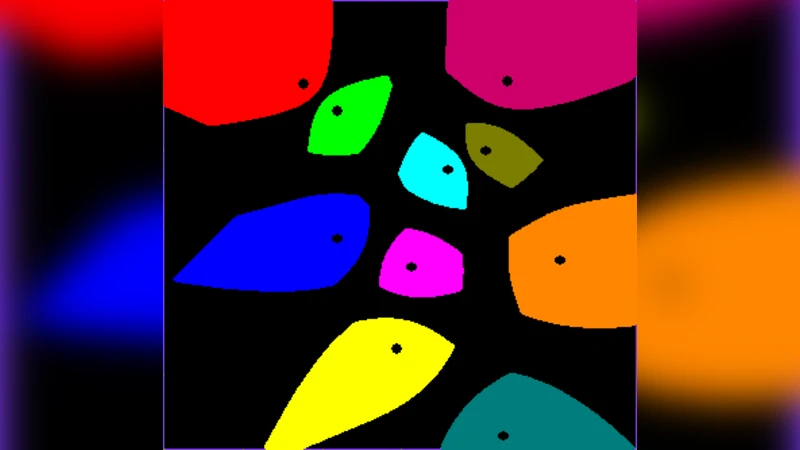
Classical objects in computational geometry are defined by explicit relations. Several years ago the pioneering works of T. Asano, J. Matousek and T. Tokuyama introduced “implicit computational geometry”, in which the geometric objects are defined by implicit relations involving sets. An important member in this family is called “a zone diagram”. The implicit nature of zone diagrams implies, as already observed in the original works, that their computation is a challenging task. In a continuous setting this task has been addressed (briefly) only by these authors in the Euclidean plane with point sites. We discuss the possibility to compute zone diagrams in a wide class of spaces and also shed new light on their computation in the original setting. The class of spaces, which is introduced here, includes, in particular, Euclidean spheres and finite dimensional strictly convex normed spaces. Sites of a general form are allowed and it is shown that a generalization of the iterative method suggested by Asano, Matousek and Tokuyama converges to a double zone diagram, another implicit geometric object whose existence is known in general. Occasionally a zone diagram can be obtained from this procedure. The actual (approximate) computation of the iterations is based on a simple algorithm which enables the approximate computation of Voronoi diagrams in a general setting. Our analysis also yields a few byproducts of independent interest, such as certain topological properties of Voronoi cells (e.g., that in the considered setting their boundaries cannot be “fat”).
💡 Research Summary
The paper tackles the algorithmic computation of zone diagrams and double zone diagrams, objects that belong to the emerging field of “implicit computational geometry”. Unlike classical Voronoi diagrams, which are defined explicitly by a set of sites and a distance function, a zone diagram is defined implicitly: each region consists of points that are at least as close to its own site as to the union of all other regions. This self‑referential definition makes the existence of a solution non‑trivial and its computation challenging.
The authors first broaden the setting in which such diagrams can be studied. They consider a complete metric space ((X,d)) that satisfies the usual triangle inequality and uniform continuity of the distance function, and they allow the sites to be arbitrary closed subsets (points, line segments, or more complex shapes). The class of spaces includes Euclidean spheres, finite‑dimensional strictly convex normed spaces (e.g., (\ell_p) spaces with (1<p<\infty)), and any other space where the distance behaves nicely.
Building on the iterative scheme originally proposed by Asano, Matoušek, and Tokuyama, the authors define a set‑valued operator
\
Comments & Academic Discussion
Loading comments...
Leave a Comment