Energy-aware Adaptive Spectrum Access and Power Allocation in LAA Networks via Lyapunov Optimization
To relieve the traffic burden and improve the system capacity, licensed-assisted access (LAA) has been becoming a promising technology to the supplementary utilization of the unlicensed spectrum. However, due to the densification of small base statio…
Authors: Yu Gu, Qimei Cui, Yue Wang
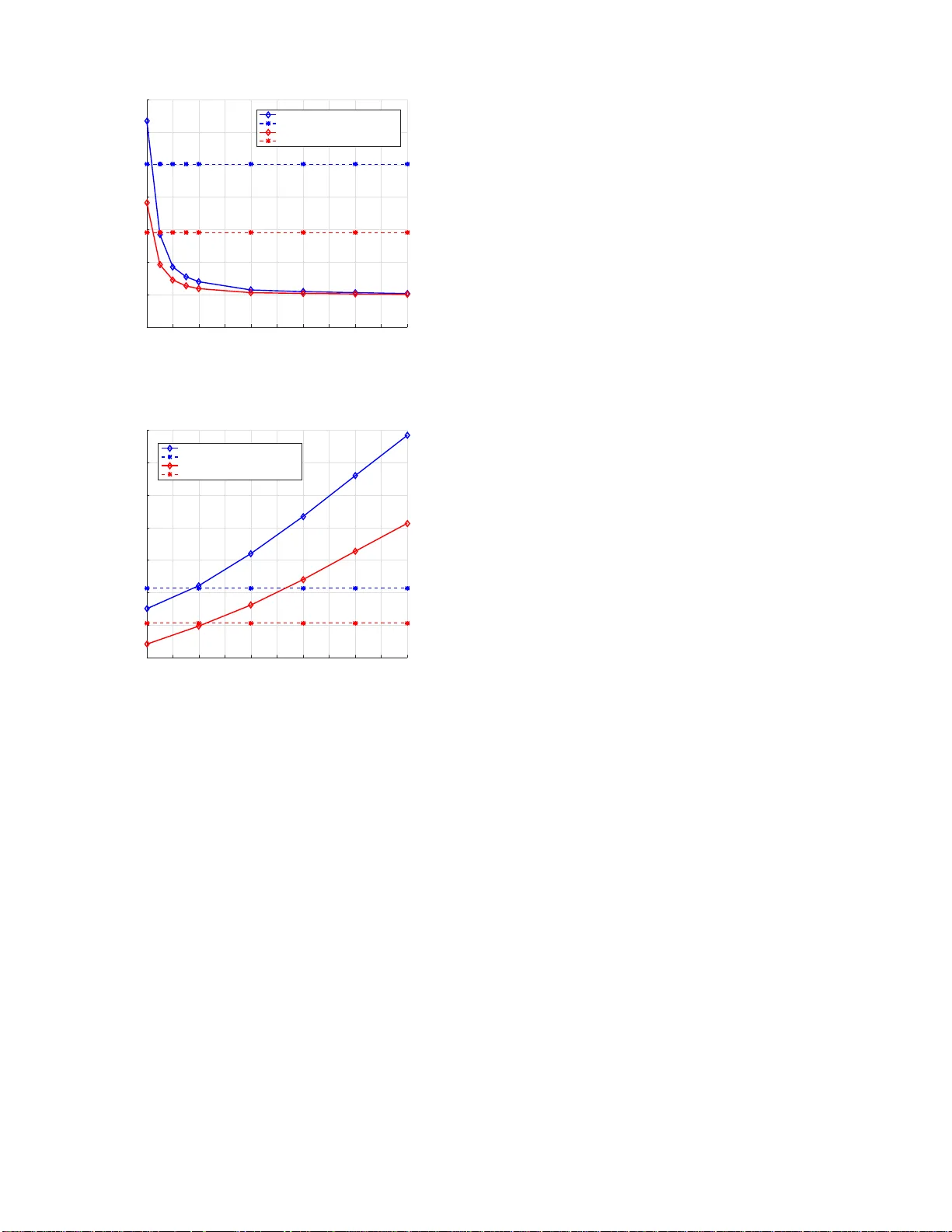
Ener gy-a ware Adapti v e Spectrum Access and Po wer Allocation in LAA Netw orks via L yapunov Optimizati o n Y u Gu, Qimei Cui, Y ue W ang, Somayeh Soleimani National Engineer ing Laborato ry for Mobile Network Beijing Un iversity of Posts and T eleco mmunica tio ns, Beijing, 10 0876 , China Email: cuiqimei@bupt.edu .cn, guyu@bupt.edu.cn Abstract —T o reliev e the traffic burden and impro ve the system capacity , licensed-assisted access (LAA) has been becoming a promising technology to th e supp lementary ut i lization of the unlicensed sp ectrum. Howev er , d ue to the den sification of small base stations (SBSs) and the d yn amic variety of the number of W i- Fi nodes in t he overlapping areas, the l icensed channel interference a n d the unlicensed c hannel collision could serio u sly influence th e Quality of Service (QoS) and the energy con- sumption. In this paper , jointly considering time-va ri an t wi reless channel conditions, dynamic traffic loads, and rand om numbers of Wi-Fi nodes, we add ress an adapt ive spectrum access and power allocation problem that enables minimizing the system power consumption u nder a certain queue stability constraint in the LAA-enabled SBSs and Wi-Fi networks. The complex stochastic optimization problem is rewritten as the d ifference of two con vex (D.C.) program in the framework of L yapun ov optimization, thu s developing an onlin e energy-awar e optimal algorithm. W e also characterize the performa n ce bound s of th e proposed algorithm wit h a t radeoff of [ O (1 /V ) , O ( V )] between power consumption and d elay theoretically . The numerical r esu lts verify the tradeoff and show that our scheme can reduce the power consumpti on ov er the existin g sch eme by up t o 72.1% under the same traffic delay . I . I N T RO D U C T I O N Due to th e explosiv e growth of mobile d ata stemming from the increasingly prev alen ce o f smart han dset devices, the scarcity of spe c trum is bec oming the bottlen eck to boost more capacity of wireless commu nication [1]. T o im prove the system capacity , a co mmon tre nd h as em e rged with deploy- ing ad d itional low power nodes ( L PNs, such as smallce lls, femtocells), and im proving the spec tr al utilization, suc h as Coordinated Multipoint (CoMP) [2]. T o fu ndamen tally br eak throug h this predicament, an emerging tec h nolog y using the unlicensed spectr um, called licensed- assisted access (LAA), has been launched into the standardization by T hird Genera- tion Partner sh ip Project (3G PP) [3]. There are three major cha llenges arising in the co existence networks o f LAA-enab led small base stations (SBSs) an d W i-Fi. The first challenge is how to guaran tee the fair and effecti ve c o existence between SBSs and W iFi. Due to the time- variant wireless ch annel cond itions and th e dyn amic v ar iety of th e n umber o f Wi-Fi nodes in the overlapping area s, SBS needs a dynam ic m echanism to le vera ge the traffi c b e tween the licensed and un licensed b ands [4]. Second ly , the rando m arrived traffic and the random acce ss mechanism o f LAA become a obstacle to guarantee QoS, which play s an importan t role in 5G n etworks. Finally , the new L AA procedu res could also have impa cts on energy consump tion of SBSs due to th e extra energy used for chan nel detection and pac ket collision. As for the coexistence of SBSs and W i- Fi, two kinds of specifications are propo sed : frame- based me c h anism (FBM) where SBS is activ ated a t periodic cycles on u nlicensed b and, and lo ad-based mecha n ism (LBM) where SBS competes fo r the unlicensed chan nel u sing listen-befo re-talk (LBT) and backoff pr ocedure like W i-Fi [ 3], [5]. [6]–[ 8] design coexis- tence mech a n isms, such as an almost blan k sub-fr ame (ABS) scheme, an interferen ce av o idance scheme [6], and adap tiv e listen-befor e-talk ( LBT) mechan ism [ 6], [8]. T o improve the system through put, [9] propo ses a Q-Learn ing ba sed dynam ic duty cycle selection technique f o r co nfiguring L TE transmis- sion g aps. A few num b er of work s have studied on QoS or energy efficiency (EE) requirem ents of SBS in th e u nlicensed band to data. [10] de sig n s a n adap tiv e a djustment of b ackoff window size of L AA to min imize the collision p robability of W i-Fi users, satisfying th e rate requirements of small c e ll users. [11] develops a power allocation algor ithm to ob tain pareto optim al between minimization of interferen ce in the lice n sed band and collision in the un licensed band, while satisfyin g the rate requirem ents o f users. [12] first in vestigates joint licensed and unlicensed resource allocations to maximize the EE thr ough Nash ba rgain ing when LAA system s ad opt a FBM me thod. Howe ver , [6]–[ 13] focus on static network m odels and d o not fully consider time- varying environment. And mo st of works ignore the delay impact of L A A network. Therefore , this paper mainly in vestigates an energy-aware adap tiv e spec- trum a c cess and power allocation problem in coexistence of LAA-enabled SBSs an d W i-Fi n e tworks, hinging on dyn amic network model that reflects re a l network co nditions. The main contributions of this paper are threef o ld. • W e ad dress an ad aptive spectrum access and power al- location problem that enables minimizing the system av- erage power consumption under a certa in qu eue stability constraint in the LAA-enabled SBSs and Wi-Fi networks, in whic h the time- variant wir eless chann el conditio ns, dynamic traffic loads, and ran dom num bers o f Wi-Fi nodes are jo intly co nsidered. L WA SBS Wi-F i A P s SBS user C h anne l on un li ce n sed b an d C h anne l on lice n se d ban d Inte rf er e nc e on lice n se d band Mac r oce l l B S Mar c oc el l user Fig. 1. System model for SBSs and W i-Fi coexiste nce. • T h e stochastic optimization problem is rewritten as the difference of two conve x (D. C.) pro gram, and solved by using the successi ve conv ex appro x imation method in the framework of L y apunov optimization, thus dev elo ping an online en ergy-aware optimal algorithm . • T h e theoretica l analy sis and simulation results show that tuning the co n trol pa r ameter V can quan titati vely ach iev e a tr adeoff of [ O (1 / V ) , O ( V )] b etween p ower consump - tion and delay . The prop osed alg orithm can reduce the power consump tion over the existing scheme by up to 72.1% u n der the same traf fic delay . The rest of the paper is o rganized as follows. In Section II , we in troduce the system model. In Section II I and Section I V , a stochastic op timization pro blem is formu lated and an o nline energy-aware algo rithm is d eveloped based on the L yapunov optimization . Finally , the nu merical r esults are pr esented in Section V , a nd c o nclusions ar e gi ven in Section VI. I I . S Y S T E M M O D E L Consider the downlink o f a two-tier wireless network in a slotted system, indexed by t ∈ { 0 , 1 , 2 , ... } , in which K SBSs share the licensed spectrum with one existing macro cell, an d contend th e av ailab le unlice nsed spectrum with W i-Fi n o des (i.e., W i-Fi APs, W i-Fi stations) by using LBT . Deno te the set of BSs as K = { 0 , 1 , 2 , ..., K } . W ith out loss of generality , the marcocell BS is indexed by 0 a nd SBSs by 1 , 2 , ..., K . W e assume that each SBS works on non-overlappin g un licensed channel. Thus, ther e is no interferen ce amon g the SBSs in the u n licensed band. Nevertheless, in the coverage of k -th SBS, there ar e N k ( t ) W i-Fi nodes at t -th time slot, co n tending the unlicensed ban d with k -th SBS. W ith N k ( t ) varying, the unlicensed b and experiences various collision s. There are S k cellular u sers in the k -th SBS, where S k = { 1 , 2 , ...S k } collects the ind exes of the users. Fu rther, data packets arrive rand omly in e very slot and are queued separ a te ly for tra nsmission to each user . Let Q ( t ) = { Q s k ( t ) , ∀ s k ∈ S k , ∀ k ∈ K } be the q ueue leng th vector, where Q s k ( t ) is the queue length of u ser s k at slot t . Let A ( t ) = { A s k ( t ) , ∀ s k ∈ S k , ∀ k ∈ K} be the arrival data length vecto r, where A s k ( t ) is the new traffic arri val a m ount of user s k at slot t . The queues Q ( t ) a re assumed to b e initially em pty . Let L = { 1 , 2 , ...L } an d W = { 1 , 2 , ...W } co llect the indexes of all the licensed and unlicen sed OFDM subcarriers, respectively . W e denote the bandwidth of each subcarrie r as B . W e deno te the licensed and unlicensed subcar rier assignmen t indicator v a riables as x ( k,l,s k ) c ( t ) and x ( k,w ,s k ) u ( t ) , respectively . Let p ( k,l,s k ) c ( t ) and g ( k,l,s k ) c ( t ) be the tran smit power and th e channel gain form the k -th SBS to s k -th user on licensed sub- carrier l at slot t , respectiv e ly . Let p ( k,w ,s k ) u ( t ) and g ( k,w ,s k ) u ( t ) be the tran smit power and the channel gain form the k -th SBS to s k -th user on u nlicensed su bcarrier w at slo t t , respec- ti vely . Denote x c ( t )= ( x ( k,l,s k ) c ( t )) , x u ( t )= ( x ( k,w ,s k ) u ( t )) , and x ( t ) = [ x c ( t ) , x u ( t )] . Denote p c ( t )= ( p ( k,l,s k ) c ( t )) , p u ( t )= ( p ( k,w ,s k ) u ( t )) , and p ( t ) = [ p c ( t ) , p u ( t )] . A. T ransmission rate and power consumptio n on the licensed band The achiev ab le transmission rate of user s k on the licensed subcarrier l at SBS k at slot t , can be given by R ( k,l,s k ) c ( t ) = B log 2 1 + x ( k,l,s k ) c ( t ) p ( k,l,s k ) c ( t ) g ( k,l,s k ) c ( t ) P j 6 = k x ( j,l,s j ) c ( t ) p ( j,l,s j ) c ( t ) g ( j,l,s k ) c ( t )+ σ 2 , (1) where σ 2 is the add iti ve white Gaussian no ise (A WGN) power . Meanwhile, it is n otew o rthy that we need to g uarantee the rate of Macr ocell’ s user s by imposing a threshold on the cross-tier interferen ce I M , which is given as fo llows X k 6 =0 x ( k,l,s k ) c ( t ) p ( k,l,s k ) c ( t ) g ( k,l,s 0 ) c ( t ) ≤ I M . (2) And the transmission power con sumption of SBS k on licensed b and is P C ( k ) c ( t ) = ξ c X l ∈L X s k ∈S k x ( k,l,s k ) c ( t ) p ( k,l,s k ) c ( t ) , (3) where ξ c is a constant that accou nts for the inefficiency o f the power amplifiers o n licensed band [14]. B. T ransmission rate and power con sumption o n the unli- censed band T o gua rantee the co existence with W i-Fi systems, we a s- sume that SBS a d opts an adap tiv e backoff scheme to access the unlicensed channel, like W i-Fi. The k -th SBS has a attemp t transmission p robab ility τ l,k and a collision probability p l,k . All the Wi - Fi nod es within the coverage of the k -th SBS are assumed to experience a same a ttempt transmission proba - bility τ w, k and a collision pro bability p w, k in the time slot. The attempt probab ility of W i-Fi nod es fo r g iv en collision probab ility p w, k is given by [1 5] τ w, k ( t ) = 1 + p w, k + · · · + p K w − 1 w, k b 0 + p w, k b 1 + · · · + p K w − 1 w, k b K w − 1 , (4) where b j is the mean backoff time of stage j and K w is the maximum numbe r of retransmissions for W i-Fi. The attempt probab ility of SBSs on unlicensed b and is τ l,k ( t ) = 1 + p l,k + · · · + p K l − 1 l,k e 0 + p l,k e 1 + · · · + p K l − 1 l,k e K l − 1 , ( 5) where e j is the mean backoff time of stage j an d K l is the maximu m nu mber o f retransmissions for Wi-Fi. W ith the slotted mod e l for the b ackoff p rocess and the decou pling assumption [15], the collision prob abilities o f SBSs and W iFi nodes are exp r essed by respectively p w, k ( t ) = 1 − (1 − τ w, k ( t )) N k ( t ) − 1 (1 − τ l,k ( t )) , (6) p l,k ( t ) = 1 − (1 − τ w, k ( t )) N k ( t ) . (7) According to Bro uwer’ s fixed point theo rem [15], there exists a fixed point for the equations (4)-( 7). Hence, we can obtain the attempt tr a nsmission p r obability an d the collision probab ility of SBS and Wi - Fi n odes, respectively . Then, the successful transmission prob ability for the k -th SBS on unlicensed channel ca n be given by P ( k ) suc ( t ) = τ l ( t )(1 − τ w ( t )) N k ( t ) . (8) Since the time slot of o n e L T E f rame ( i.e., 1 0 ms) is much larger than the Wi-Fi time slot (in the order of µ s), the time fraction occupied by the SBS on u nlicensed channel can be represented by P ( k ) suc ( t ) [1 1]. Therefo re, the achiev able transmission rate for user s k at SBS k on th e w -th un licensed subcar rier can b e written as R ( k,w ,s k ) u ( t ) = P ( k ) suc ( t ) B log 2 (1 + x ( k,w,s k ) u ( t ) p ( k,w,s k ) u ( t ) g ( k,w,s k ) u ( t ) σ 2 ) . (9) And, the transmission power co n sumption of SBS k on the unlicensed su bcarrier is gi ven by P C ( k ) u ( t ) = ξ u X w ∈ W X s k ∈S k x ( k,w ,s k ) u ( t ) p ( k,w ,s k ) u ( t ) ! , (10) where ξ u is a c onstant that acc ounts for the ineffi c ie n cy of the power amplifiers on unlicensed band. C. T otal T ransmission rate an d power con sumption of SBS s According to (1) and (9), the achiev a b le transmission data rate for u ser s k at SBS k is g iven by R ( k,s k ) ( t ) = X l ∈L R ( k,l,s k ) c ( t ) + X w ∈ W R ( k,w ,s k ) u ( t ) . (11) The total transmit rate and the power consump tion of SBSs are r e p resented b y resp ectiv ely R tot ( t ) = X k ∈K\{ 0 } X s k R ( k,s k ) ( t ) , (12) P C tot ( t ) = X k ∈K\{ 0 } P C static + P C ( k ) c ( t ) + P C ( k ) u ( t ) , (13) where P C static is th e static power , con sisting of ba seb and signal pr ocessing and ad ditional circuit b locks. Furth ermore, we define the a verag e p ower consum ption a n d the transmit rate o f the entire system as P C tot = lim t →∞ 1 t t − 1 X τ =0 E { P C tot ( τ ) } , (14) ¯ R tot = lim t →∞ 1 t t − 1 X τ =0 E { R tot ( τ ) } . (15) I I I . P RO B L E M F O R M U L A T I O N In this section, we p r ocess to a stochastic o ptimization problem to minimize th e av er a ge power consump tion of SBSs, by joint optimizing the licensed and unlicen sed sub carriers and power . T o guarantee all arrived data lea v in g the b u ffer in a finite time, we introduce a concep t of que u e stability . The d ata qu eue Q s k ( t ) is given by Q s k ( t + 1) = max[ Q s k ( t ) − R ( k,s k ) ( t ) , 0 ] + A s k ( t ) , (16) And, a queue Q s k ( t ) is strongly stable [16] if ¯ Q s k = lim t →∞ 1 t t − 1 X τ =0 E {| Q s k ( τ ) |} < ∞ . (17) As a r esult, the p roblem can b e for mulated as fo llows P 1 : minimize x ( t ) , p ( t ) P C tot C 1 : ¯ Q s k = lim t →∞ 1 t t − 1 X τ =0 E {| Q s k ( τ ) |} < ∞ , C 2 : P w P s k x ( k,w ,s k ) u ( t ) p ( k,w ,s k ) u ( t ) + P l P s k x ( k,l,s j ) c ( t ) p ( k,l,s k ) c ( t ) ≤ P total , C 3 : X w X s k x ( k,w ,s k ) u ( t ) p ( k,w ,s k ) u ( t ) ≤ P u , C 4 : X k 6 =0 x ( k,l,s k ) c ( t ) p ( k,l,s k ) c ( t ) g ( k,l,s 0 ) c ( t ) ≤ I M , C 5 : X s k x ( k,l,s j ) c ( t ) ≤ 1 , X s k x ( k,w ,s k ) u ( t ) ≤ 1 , C 6 : p ( k,l,s k ) c ( t ) ≥ 0 , p ( k,w ,s k ) u ( t ) ≥ 0 , C 7 : x ( k,l,s k ) c ( t ) ∈ { 0 , 1 } , x ( k,w ,s k ) u ( t ) ∈ { 0 , 1 } . (18) where { p ( k,l,s k ) c ( t ) } , { p ( k,w ,s k ) u ( t ) } , { x ( k,l,s k ) c ( t ) } and { x ( k,w ,s k ) u ( t ) } are variables. C1 is the qu eue stability constraint to guarantee all ar riv ed data leaving the buffer in a finite time. C2 is the total transmission power constraint on both the licen sed an d unlicensed band s, while C3 is the transmission p ower constrain t on the unlicensed bands due to the regulations [ 3]. C4 c a n restrict the interf erence arising from SBSs. C5 and C7 guarantee th a t each subcarr ier of the SBS has b e en u sed at mo st b y on e user . I V . A N O N L I N E E N E R G Y - A WAR E A L G O R I T H M V I A L Y A P U N O V O P T I M I Z A T I O N W e can exploit the dr ift-plus-pe n alty algor ithm [17] to solve the stochastic op timization pro blem P1. First, we in troduce some necessary but pratical bo undedn ess assumption s to de- riv e the d rift-plus-p enalty expr ession of P1. W e assume th e following inequalities E n A s k ( t ) 2 o ≤ ψ , k ∈ K\{ 0 } , ∀ s k , (19) E n R s k ( t ) 2 o ≤ ψ , k ∈ K \{ 0 } , ∀ s k , (20) hold for some finite constant ψ . In additio n, P C tot ( t ) and R tot ( t ) are bound ed respectively by P min ≤ E { P C tot ( t ) } ≤ P max , (2 1) R min ≤ E { R tot ( t ) } ≤ R max , (22) where P min , P max , R min , R max are som e finite constan ts. Define th e L y apunov fun ction as [17] L ( Q ( t ) ) = 1 2 X k ∈K\{ 0 } X s k ( Q s k ( t )) 2 . (23 ) Then the one-slot conditional L yap unov drift can be expressed as ∆ ( Q ( t )) = E { L ( Q ( t + 1)) − L ( Q ( t )) | Q ( t ) } . (2 4) Thus, the d rift-plus-p enalty expression of P1 is defined as V E ( P C tot ( t ) | Q ( t )) + ∆ ( Q ( t )) , (25) where V is a con trol param eter . The fo llowing lemm a 1 provides th e upper boun d of the drift-plus-pen alty expression. Lemma 1. Assume link co ndition is i.i.d over slots. Under any power a llocation algorithm, a ll parameter V ≥ 0 , and all possible queue len gth Q , the d rift-plus-pena lty satisfies the following inequa lity: V E ( P C tot ( t ) | Q ) + ∆ ( Q ) ≤ C 0 + V E ( P C tot ( t ) | Q ) + X k ∈K\{ 0 } X s k Q s k ( t ) ( A s k ( t ) − R s k ( t ) | Q ) (26) wher e C 0 is a positive consta n t, satisfying for all t C 0 ≥ 1 2 X k ∈K\{ 0 } X s k E A s k ( t ) 2 + R s k ( t ) 2 | Q . (27) Pr oof. Squ aring both side of (16) and exploiting the inequ ality { max [ Q − R ] + A } 2 ≤ Q 2 + R 2 + A 2 − 2 Q ( R − A ) , (28 ) we can g et [ Q s k ( t + 1)] 2 ≤ [ Q s k ( t )] 2 +[ A s k ( t )] 2 +[ R s k ( t )] 2 − 2 Q s k ( t ) ( R s k ( t ) − A s k ( t )) . (29) Summarizin g over s k , we have P k ∈K\{ 0 } P s k Q s k ( t +1) 2 − P s k Q s k ( t ) 2 ! 2 ≤ P k ∈K\{ 0 } P s k ( A s k ( t ) 2 + R s k ( t ) 2 ) 2 − P k ∈K\ { 0 } P s k Q s k ( t ) ( R s k ( t ) − A s k ( t )) (30) The left- h and-side of ( 30) equals to ∆ ( Q ( t )) . Lemma 1 is proven. T o pu sh the objective P1 to its minimu m, a prop er power allocation algorithm is pr oposed to greedily min imize the d rift- plus-pena lty expr ession of P1. As a result, from the stochastic optimization theor y , it is required to min imize the upper bou n d in (26) subjec t to the same co nstraints C2- C7 except the stability constraint C1. Therefo re, the transfo r med p r oblem P2 is g i ven by P 2 :min V × P C tot ( t ) − X s k Q s k ( t ) R s k ( t ) s.t.C 2 − C 7 . (31) Unfortu n ately , the optimiza tion is highly non-co n vex. Nev er- theless, we can eq uiv alently tran sform P2 to a D.C. p rogram as d iscussed in th e seque l. For convenience’ s sake, we get rid of the slot index t withou t ambiguity . It is noted that x is binary an d th e produ ct term xp is obviously no n-conve x , we can r ecast these constraints using the inequ ality 0 ≤ p ≤ x Λ [1 8], where Λ > 0 is a predefine d constant. W e can f u rther transform the bina ry constraint C7 as the inte r section o f the following region s [19] 0 ≤ x ( k,l,s j ) c ≤ 1 , 0 ≤ x ( k,w ,s k ) u ≤ 1 , (32) P k P l P s k ( x ( k,l,s k ) c − ( x ( k,l,s k ) c ) 2 ) + P k P w P s k ( x ( k,w ,s k ) u − ( x ( k,w ,s k ) u ) 2 ) ≤ 0 . (33) Although optimization variables x are con tinuous values, constraint (33) is non- conv ex. In order to dea l with (33), we reform u late P2, as given b y (34), where λ acts a penalty factor . It is proven that fo r sufficiently large values of λ , P3 can be equiv alen t to P2 [ 18]. Defin e f ( P , x ) = V × P C tot − X k X l X s k Q s k B log 2 X k p ( k,l,s k ) c g ( k,l,s k ) c + σ 2 ! − X k X w X s k Q s k R ( k,w,s k ) u + λ X k X l X s k ( x ( k,l,s k ) c ) + λ X k X w X s k ( x ( k,w,s k ) u ) , (35) g ( P , x ) = − X k X l X s k Q s k B log 2 X j 6 = k p ( j,l,s j ) c g ( j,l,s k ) c + σ 2 + λ X k X l X s k ( x ( k,l,s k ) c ) 2 + λ X k X w X s k ( x ( k,w,s k ) u ) 2 (36) Since f and g are c on vex, th e objective func tio n is the difference of two conve x fu nctions, as gi ven b y f − g . As P 3 :min V × P C tot ( t ) − X s k Q s k ( t ) R s k ( t ) + λ X k X l X s k ( x ( k,l,s k ) c − ( x ( k,l,s k ) c ) 2 ) + λ X k X w X s k ( x ( k,w ,s k ) u − ( x ( k,w ,s k ) u ) 2 ) s.t. X w X s k p ( k,w ,s k ) u + X l X s k p ( k,l,s k ) c ≤ P total , X w X s k p ( k,w ,s k ) u ( t ) ≤ P u , X j 6 =0 p ( j,l,s j ) c g ( j,l,s 0 ) c ≤ I M , p ( k,l,s k ) c ( t ) ≤ x ( k,l,s k ) c ( t )Λ , p ( k,w ,s k ) u ( t ) ≤ x ( k,w ,s k ) u ( t )Λ , C 5 , C 6 . (34) Algorithm 1 Online Energy-A ware Spectrum Access and Power Allocation Algorithm 1: Initialize p (0) and x (0) , and t = 0 . 2: At the beginning of each slot t , acquir e the cur rent queue state Q ( t ) and the chan nel state g ( k,l,s k ) c ( t ) and g ( k,w ,s k ) u ( t ) , and obtain th e n u mber of W i-Fi n odes N k ( t ) at SBS k . 3: repeat 4: Optimize P3 to obtain o ptimal p ( t ) and x ( t ) by using a D.C. progr am. 5: until conv e rgence of p and x a result, P3 is a D.C. prog r am. Ther efore, we can apply successiv e conv ex ap proxima tion to obtain a local o ptimal solution of P3. Let i den o te the iteration numb er . Since g is conv ex, at the i -th iteration, we h av e f ( p , x ) − g ( p , x ) ≤ f ( p , x ) − g ( p ( i − 1) , x ( i − 1)) −∇ p g ( p ( i − 1) , x ( i − 1)) ( p − p ( i − 1)) −∇ x g ( p ( i − 1) , x ( i − 1)) ( x − x ( i − 1)) , (37) where p ( i − 1) and x ( i − 1) are the solutio ns of the problem at ( i − 1) -th iteration, and ∇ p and ∇ x are th e g radient operation with respect to p and x . As a result, P3 beco mes a conv ex optimization problem , which can be efficiently solved by using standard con vex op timization techniqu es, su c h as the inte r ior-point metho d. Ou r prop osed algo rithm can be explicitly described in Algorith m 1. A. P erformance ana lysis Since the system state per time slo t is i.i. d ., W e can quan tify the p e rforman ce of o ur pro posed algorithm , b y mean s of Markovian rando mness [17]. Denote P C ∗ tot ( t ) , R ∗ s k ( t ) as the optimal p ower consu m ption and the co r respond ing rate. I f th e bound ness assum ptions (19)- ( 22) hold, ther e exists an i.i.d spectrum acc e ss and power allocation alg o rithm, satisfyin g E R ∗ s k ( t ) ≥ E ( A s k ( t )) + ε, (38) where ε is a small p ositiv e value. The following Th eorem reveals the p e r forman ce bou nds of av er a ge power and av er age delay of th e propo sed algorithm. Theorem 1 . Supp ose the system state per slot time is i.i.d, the average power and ave rag e q ueue length of the pr oposed algorithm are bou nded r esp e ctively by P C tot ≤ C 0 V + P C ∗ tot , (39) Q ≤ C 0 + V P C ∗ tot ε , (40) wher e C 0 and ε ar e defi ned in (2 7) and (3 8), r e sp ectively . Its proo f u ses a standard result in the stocha stic op timization theory [17]. Th eorem 1 implies a tradeoff of [ O (1 /V ) , O ( V )] between power consump tion and queue leng th (i.e., d elay). In o ther word, by increasing co ntrol par ameter V , the power consump tion can con verge to the optimal value but the traffic delay gets incr easing. V . S I M U L AT I O N W e conduct the simu lation with the time slot len g th to b e 10 ms , an d run each experimen t for 50 00 slots. There are K = 3 SBSs, which each h as L = 2 licensed subcarrier s and W = 4 u nlicensed subcarrier s. W e set SBS user s and W i-Fi nodes are un iformly distributed. And the arriv al data packet o f each users follows Po isson distribution. T he channel gains of licen sed and un licensed bands follow the Rayleigh fading. Set the power amplifier o f licensed and unlicen sed bands as 1/ ξ c =1/ ξ u =0 . 35 . Let P total be 46 dB m , a n d P u be 2 3 dB m . Set P C idle = 1 W an d P C static = 9 W . W e compare the proposed algo rithm und er different contr ol parameter V with a p ower consumptio n minimization per slot (PCMPS). The PCMPS minimizes the power con sumption p e r slot, subject to C2-C7 an d a new rate co nstraint R s k ( t ) ≥ A s k ( t ) . Th e new constra int is add e d to g uarantee the QoS of the users. In Fig. 2, we p lot the total power consumption against V . It shows that when V incr eases, the total power consump tion of our proposed alg orithm could dec r ease an d conv erge to a point at the speed of O (1 /V ) for any g iven traffic arriv al rate λ . Accord ing to ( 39), the con verged p oint is the optimal po we r consum ption P C ∗ tot . And it is obviously observed th at our pr oposed algorithm consumes less power than the PCMPS, when V ≥ 5 . This is be c ause PCMPS ignores the queue states and always ne e d to g uarantee that the service rate is greater th an arriv al r ates. Fig. 3 shows the av er age traffic delay against V . As V increases, the a verage traffic d elay (or que ue backlog ) gr ows linea r ly in O ( V ) , which is co nsistent with ( 4 0). 0 20 40 60 80 100 120 140 160 180 200 Control parameter V 0 10 20 30 40 50 60 70 Average Power Consumption (W) λ = 1.25 packet/s, our proposed algorithm λ = 1.25 packet/s, PCMPS λ = 0.6 packet/s, our proposed algorithm λ = 0.6 packet/s, PCMPS Fig. 2. A vera ge po wer consumption versus control paramete r V . 0 20 40 60 80 100 120 140 160 180 200 Control parameter V 0.15 0.2 0.25 0.3 0.35 0.4 0.45 0.5 average delay (s) λ = 1.25 packet/s, our proposed algorithm λ = 1.25 packet/s, PCMPS λ = 0.6 packet/s, our proposed algorithm λ = 0.6 packet/s, PCMPS Fig. 3. A vera ge dela y ver s us control parameter V . Fig. 2 and Fig. 3 together show th a t we can achieve a tradeoff between power and delay . For examp le, if the n etwork operator choo ses 5 ≤ V ≤ 4 0 f or λ = 1 . 2 5 , the p roposed algorithm outper forms the PCMPS in bo th the power and delay . In par ticu lar , th e pr o posed algo rithm can red uce the power consum ption over PCMPS scheme b y up to 72.1 % under th e same traffi c delay . A balance b etween the licensed channel in terference and the unlicen sed chann el collision can also be ac hieved by the pro posed algorith m. V I . C O N C L U S I O N In this paper, we have formu lated a stochastic optimiza- tion to minimize the system average power consumption in the stochastic LAA-enabled SBSs an d Wi-Fi networks, by jointly optimizing su bcarrier assignment a n d po we r allo cation between the licen sed and unlicensed band . In the framework of L yapun ov o ptimization, an online energy- aware algorithm is de velop ed. The theoretical analysis an d simulation resu lts show that o ur propo sed algo r ithm can gi ve a practical contro l and balance between p ower consump tion and delay . A C K N OW L E D G M E N T The work was sup ported by National Nature Science Foun- dation of China Project (Grant No. 614 7 1058 ), Hon g Kong, Macao and T aiwan Science a n d T echnology Cooperation Projects (20 14DFT10 320, 2016 YFE01229 00), the 11 1 Project of Chin a (B160 06) and Beijing T r aining Project f o r Th e Leading T alents in S&T (N o . Z1 41101 0015 1 4026). R E F E R E N C E S [1] M. Cai and J. N. Laneman, “W ideband distribu ted spect rum sharing with multic hannel immediate multiple access. ” [2] Q. Cui, H. Song, H. W ang, M. V alkama, and A. A. Do whuszko, “Ca- pacit y analy s is of joint transmission comp with adapti ve modulation, ” IEEE T rans. V eh. T ech nol. , v ol. 66, no. 2, pp. 1876–1881, Feb . 2017 . [3] 3GPP , “Feasibil ity study on licensed-a ss isted access to unlice nsed spec- trum, ” 3GPP TR 36.889 V13.0.0, Jun. 2015. [4] Q. Cui , Y . Shi, X. T ao, P . Zhang , R. P . Liu, N. Chen, J. Hamal ainen, and A. Dowhuszk o, “ A unifie d protocol stack solution for L TE and WLAN in future mobile con verged netw orks, ” IEEE W ireless Commun. , v ol. 21, no. 6, pp. 24–33, Dec. 2014. [5] “Broadband Radi o Access Netw orks (BRAN); 5 GHz high performance RLAN, ” E TSI EN 301 893. [6] H. Zhang, X. Chu , W . G uo, and S. W ang, “Coe xistence of Wi-Fi and heterog eneous small cell networks sharing unlicensed spectrum, ” IEEE Commun. Mag . , vol. 53, no. 3, pp. 158–164, Mar . 2015. [7] A. Al-Dulaimi, S. Al-Rubaye , Q. Ni, and E . Sousa, “5G communication s race: Pursuit of more capacity trigge rs L TE in unlice nsed band, ” IE EE V eh. T echno l. Ma g. , vol. 10, no. 1, pp. 43–51, Mar . 2015. [8] R. Ratasuk, N. Mangalv edhe, and A. Ghosh, “L TE in unlicense d spectrum using lice nsed-assiste d access, ” in Proc . IEEE Globecom W orkshops (GC Wkshps) , Dec. 2014, pp. 746–751. [9] N. Rupasinghe and ˙ I. G ¨ uven c ¸ , “Reinforce ment learnin g for lic ensed- assisted access of L TE in the unlice nsed spectrum, ” in Pr oc. IEEE W ir eless Communicati ons and Network ing Conf. (WCNC) , Mar . 2015, pp. 1279–1284 . [10] R. Y in, G. Y u, A. Maaref, and G. Li, “Lbt based adapti ve cha nnel access for L TE-U systems, ” IEEE T rans. W ireless Commun. , vol. PP , no. 99, p. 1, 2016. [11] R. Y in, G. Y u, A. Maaref, and G. Y . Li, “ A framew ork for co-channel interfe rence and collision probabili ty tradeoff in L TE lice nsed-assisted access networks, ” IEE E T rans. W irel ess Commun. , vol. 15, no. 9, pp. 6078–6090, Sep. 2016. [12] Q. Chen, G. Y u, R. Y in, A. Maaref, G. Y . Li, and A. Huang, “Energy ef ficiency optimiz ation in lic ensed-assist ed access, ” IEEE J. Sel. Ar eas Commun. , vol . 34, no. 4, pp. 723–734, Apr . 2016. [13] E. Almeid a, A. M. Cav alcante, R. C. D. Pai va, F . S . Chave s, F . M. Abinader , R. D. V ieira, S. Choudhury , E. Tu om aala, and K. Doppler , “Enablin g L TE/Wi F i coe xistence by L TE blank subframe allocation, ” in Pr oc. IE EE Int. Conf. Communic ations (ICC) , Jun. 2013, pp. 5083– 5088. [14] Y . Li, Y . Shi, M. Sheng, C. X. W ang, J. Li, X. W ang, and Y . Zhang, “Energ y-ef ficient transmission in hete rogeneous wireless netw orks: A delay-a ware approach, ” IEEE T rans. V eh. T echnol . , vol. 65, no. 9, pp. 7488–7500, Sep. 2016. [15] A. Kumar , E. Altman, D. Miorandi, and M. Goyal, “Ne w insights from a fixed-point analysi s of single cell IEEE 802.11 Wlans, ” IE EE/ACM T rans. Netw orking , vol. 15, no. 3, pp. 588–601, Jun. 2007. [16] M. J. Neely , Stoc hastic network optimi zation with applicatio n to com- municati on and queueing systems . Morgan & Clayp ool., 2010, vol. 3, no. 1. [17] H. Y u, M. H. Cheung, L. Huang, and J. Huang, “Po wer-dela y tradeof f with predicti ve scheduli ng in inte grated cellul ar and wi-fi networ ks, ” IEEE J . Sel . Are as Commun. , vol. 34, no. 4, pp. 735–742, Apr . 2016. [18] E. Che, H. D. Tuan, and H. H. Nguyen, “Joint optimizati on of coop- erati ve beamforming and relay assignment in multi-user wirele ss relay netw orks, ” IEEE T rans. W ireless Commun . , vol. 13, no. 10, pp. 5481– 5495, Oct. 2014. [19] Q. Cui, T . Y uan, and W . Ni, “Ener gy-effic ient two-w ay relayin g under non-idea l power amplifiers, ” IEEE Tr ans. V eh. T echn ol. , vo l. 66, no. 2, pp. 1257–1270 , Feb . 2017.
Original Paper
Loading high-quality paper...
Comments & Academic Discussion
Loading comments...
Leave a Comment