Minimum curvilinear automata with similarity attachment for network embedding and link prediction in the hyperbolic space
The idea of minimum curvilinearity (MC) is that the hidden geometry of complex networks, in particular when they are sufficiently sparse, clustered, small-world and heterogeneous, can be efficiently navigated using the minimum spanning tree (MST), which is a greedy navigator. The local topological information drives the global geometrical navigation and the MST can be interpreted as a growing path that greedily maximizes local similarity between the nodes attached at each step by globally minimizing their overall distances in the network. This is also valid in absence of the network structure and in presence of only the nodes geometrically located over the network generative manifold in a high-dimensional space. We know that random geometric graphs in the hyperbolic space are an adequate model for realistic complex networks: the explanation of this connection is that complex networks exhibit hierarchical, tree-like organization, and in turn the hyperbolic geometry is the geometry of trees. Here we show that, according to a mechanism that we define similarity attachment, the visited node sequence of a network automaton can efficiently approximate the nodes’ angular coordinates in the hyperbolic disk, that actually represent an ordering of their similarities. This is a consequence of the fact that the MST, during its greedy growing process, at each step sequentially attaches the node most similar (less distant) to its own cohort. Minimum curvilinear automata (MCA) displays embedding accuracy which seems superior to HyperMap-CN and inferior to coalescent embedding, however its link prediction performance on real networks is without precedent for methods based on the hyperbolic space. Finally, depending on the data structure used to build the MST, the MCA’s time complexity can also approach a linear dependence from the number of edges.
💡 Research Summary
The paper introduces a novel method called Minimum Curvilinear Automata (MCA) for embedding complex networks into the hyperbolic disk and for performing link prediction. The authors build on the concept of minimum curvilinearity (MC), which posits that the hidden geometry of sparse, clustered, small‑world, heterogeneous networks can be efficiently navigated by a minimum spanning tree (MST). In this view, the MST acts as a greedy navigator: at each step it attaches the node that is most similar (i.e., has the smallest topological distance) to the current tree. This “similarity attachment” rule replaces the traditional popularity‑driven attachment used in many growth models.
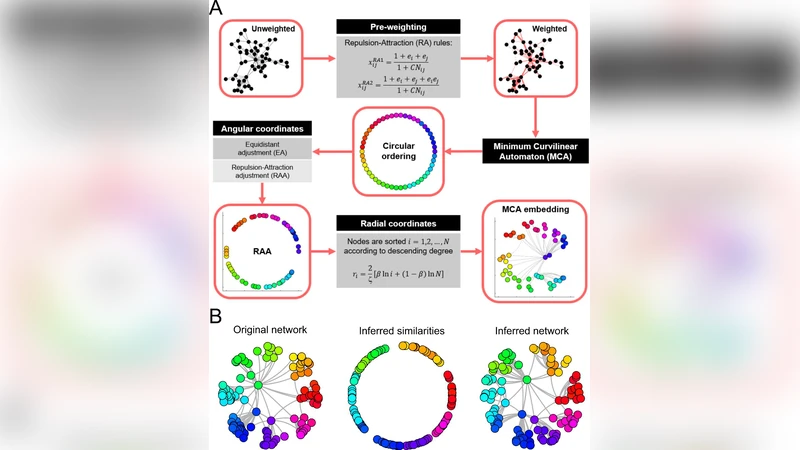
The algorithm proceeds in several stages. First, the unweighted network is pre‑weighted using a local repulsion‑attraction (RA) scheme. Two variants are proposed: RA1, a simple function of node degree and number of common neighbours, and RA2, a refined version that better captures pairwise similarity. The weighted graph is then fed to Prim’s algorithm, which grows an MST. Two automaton variants are defined: MCA1 always places the newly attached node on the same side of the circular ordering, while MCA2 chooses the side that is closer to the node it attaches to (or keeps the previous side in case of a tie). The order in which nodes are visited by the MST directly yields a circular ordering that approximates the angular coordinates of the nodes in the hyperbolic disk.
Angular coordinates can be assigned either equidistantly (EA) or proportionally to the RA‑derived distances (RAA). Radial coordinates are computed using the well‑known popularity‑fading formula from the Popularity‑Similarity‑Optimization (PSO) model, which maps higher‑degree nodes closer to the disk centre. The complete workflow is illustrated in Figure 2 of the paper.
The authors evaluate MCA on synthetic networks generated by the non‑uniform PSO (nPSO) model and on a diverse collection of real‑world networks (biological, social, technological). Performance is measured using three main metrics: (i) HD‑correlation, the Pearson correlation between true hyperbolic distances and those inferred by the embedding; (ii) GR‑score, the success rate of greedy routing performed on the inferred coordinates; and (iii) link‑prediction accuracy, assessed by removing 10 % of edges, re‑embedding, and ranking the missing links by increasing hyperbolic distance. MCA (specifically the RA2‑MCA1‑RAA configuration) consistently achieves higher HD‑correlation than HyperMap‑CN and slightly lower values than the state‑of‑the‑art coalescent embedding methods (ncISO and ncMCE). However, MCA’s GR‑score is markedly better than coalescent embedding, especially for low‑temperature (high‑clustering) nPSO networks, indicating superior navigability. Most strikingly, MCA outperforms all competing hyperbolic embedding techniques in link‑prediction tasks across the majority of real networks, delivering the highest precision and the lowest mean rank.
Regarding computational complexity, the MST construction dominates the runtime. Using an adjacency list together with a binary heap yields O(E log N) time, while a Fibonacci heap reduces the worst‑case to O(E + N log N). For sufficiently sparse graphs this approaches linear time O(E), making MCA scalable to large networks.
In conclusion, the study demonstrates that a simple, locally‑driven similarity‑attachment rule, combined with MST growth, can recover global hyperbolic coordinates with competitive angular accuracy, superior greedy routing performance, and unprecedented link‑prediction quality, all at near‑linear computational cost. The authors suggest that MCA could become a practical tool for a wide range of network‑science applications, from community detection to routing in communication systems, and they point to future extensions such as dynamic networks and integration with other generative models.
Comments & Academic Discussion
Loading comments...
Leave a Comment