User Pre-Scheduling and Beamforming with Imperfect CSI in 5G Fog Radio Access Networks
We investigate the user-to-cell association (or user-clustering) and beamforming design for Cloud Radio Access Networks (CRANs) and Fog Radio Access Networks (FogRANs) for 5G. CRAN enables cloud centralized resource and power allocation optimization …
Authors: Nicolas Pontois, Megumi Kaneko, Thi Ha Ly Dinh
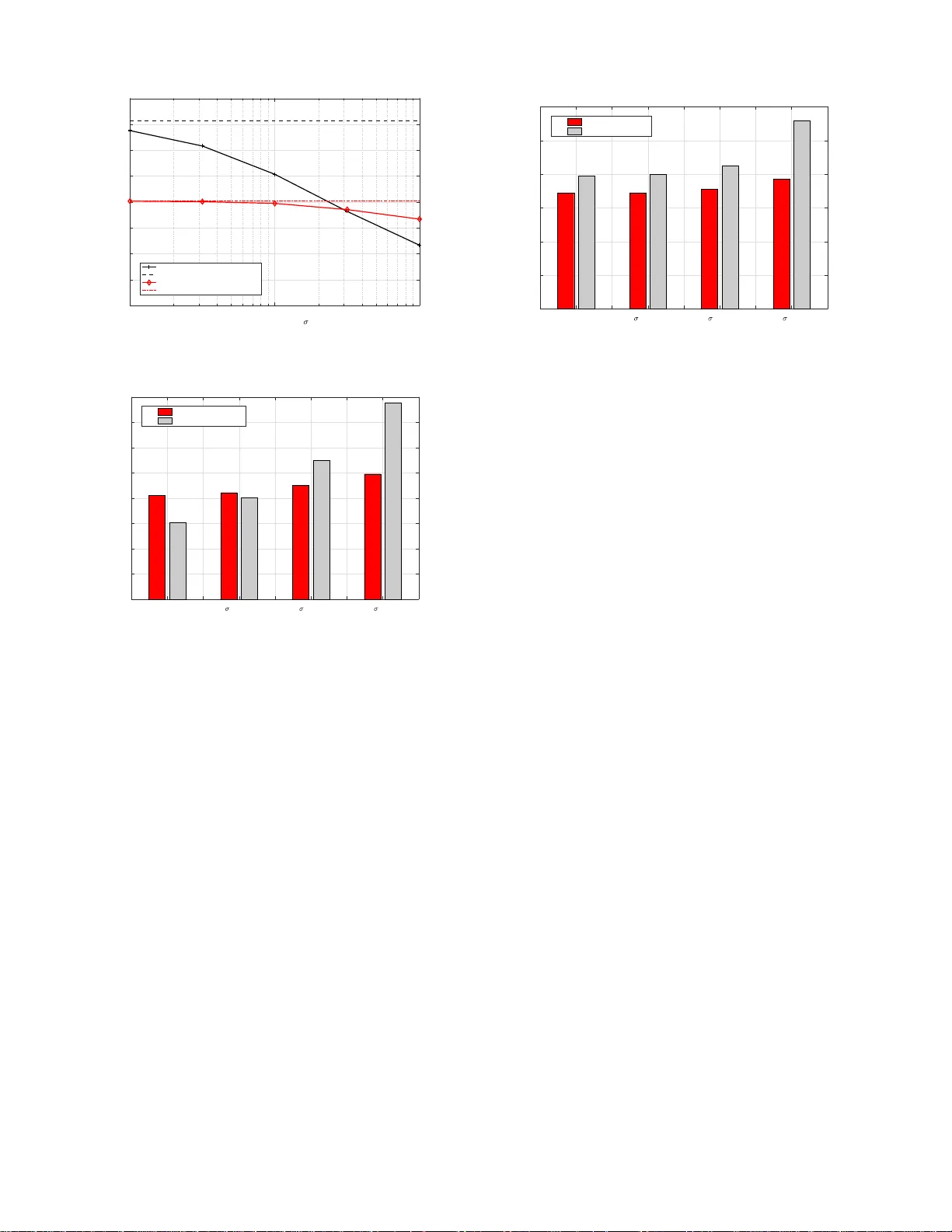
1 User Pre-Scheduling and Beamf orming with Imperfec t CSI in 5G F og Radio Acc ess Networks Nicolas Pontois, Megumi Kaneko Senior Member , IEEE , Thi H ` a L y Dinh, Lila Bou k hatem Member , IEEE Abstract —W e inv estigate the user -to-cell association (or user- clustering) and beamf orming design for Cloud Radio Access Networks (CRANs) and Fog Radio Access Networks (Fo gRANs) fo r 5G. CRAN enables cloud ce ntralized resour ce and power allocation optimization ov er all the small cells ser ved by multiple Access Points (APs). Ho wev er , th e fronthaul links connecting each AP to the cloud introduce d elays and cause outdated Channel State Information (CSI). By contrast, Fog RAN enables lo wer latencies and better CSI qualities, at the cost of lo cal optimization. T o alleviate these issues, we pr opose a hybrid a lgorithm exploiting both the cent ralized feature of the clou d f or globally-optimized pre-scheduling usin g outdated CSIs an d the distributed nature of Fog RAN for accurate beamf orming with hi gh q uality CSIs. The centralized phase enables to consider the interference p atterns ov er the global network, whil e the distributed ph ase allo ws fo r latency reduction. Si mulation results show that our hybrid algorithm fo r Fo gRAN outperforms the centralized algorithm under imperfect CSI, both in terms of t hroughput and delays 1 . Index T erms —5G, CRAN , FogRAN, user clustering, beam- fo rming, radio resourc e allocation I . I N T R O D U C T I O N The fifth generation (5G) commun ic a tion system is expected to suppo r t th e ev er increasing demand s for m obile data traffic under se vere sp ectrum d eficiencies, while satisfyin g more stringent user Quality of Service (QoS) levels. T o ach ie ve this, Cloud Radio Access Networks (CRANs) ar e considered as a key e n abling technology , by incorp orating clou d computing capabilities at the service of radio access [1]. A CRAN covers a lar ge co mmunicatio n ar ea divided into dense small cells served by Remote Rad io Heads ( RRHs), i.e., simple Acce ss Points (APs) with o n ly basic fu nctionalities such as Radio Fre - quency (RF) and A/D conversion. In CRAN, signal proc e ssing and radio access tasks ar e p erformed in a cen tralized m a nner by the cloud Baseband Units (BBUs) fo r ming a p owerful server referred as a BBU p o ol. Signals o f the mobile users in each small cell are transmitted b etween each AP and the cloud via th e fronthau l links. Alth ough th is fully centr alized architecture enables o ptimal joint baseba n d signal processing and radio resource allo cation/interfer ence m anagement, it im- poses h ea vy b ur den on the capa c ity /delay-limited fronth a ul links. T o cope with these issues, there has b e en tremen dous M. Kanek o and T .H. L . D inh are with the National Institute of Infor- matics, 2-1-2, Hitotsuba shi, Chiyoda-ku, T okyo, Japan 101–8430 (e-mail: { megka nek o,halydinh } @nii.ac.jp). N. Pontois and L. Boukhatem are wit h LRI, Paris-Sud Uni ve rsity , Orsay , France (e-mail: nicolas.pont ois@tel ecom-paristech.fr , lila.boukhat em@lri.fr). 1 This work is supported by the Grants-in-Aid for Scientific Research (Kake nhi) no. 17K06453 from the Ministry of Education , Science , Sports, and Culture of Japan, and by the CNRS-PICS proje ct betwe en LRI and NII. interest for optimizing user clustering and b eamformin g un d er fronth a u l constrain ts [ 2] [3]. Anoth er major drawback of this cen tralized architecture is the a d ditional network latency introdu c ed by fron thaul links, m aking it unsuited for the highly delay-sensitive app lications envisioned in 5G. Such delay also entails outdated Channel State I nformation (CSI) knowledge at the clo ud sid e of the links between all APs and users, causing importan t p erforman c e degradation of resou rce allocation and beamfor ming schemes in CRAN [4]. Thus, rec e n tly ther e has been the advent of m oving the intelligence towards the ed g e”, g i ving rise to Mo b ile Ed ge Computing (MEC) sy stem s also kn own as Clou d lets or Fog Radio Access Networks (FogRAN) [5 ]. T oward this en d, F o- gAPs are now equip p ed with more function alities compared to RRHs, e.g., c omputing and cac h ing cap abilities. This structur e is expe c ted to d rastically alleviate the burden on fronthau l links and to meet the stringent d elay requ irements of e d ge users [6] , but at the co st of lower network -wide optimality . Many works have exp loited th is edge proc essing to enh ance the perfo rmance o f various ap plications or analyzing the jo int optimization of cloud/edg e pro cessing [7 ]. Ho wev er , there have been few works o n the d esign of optim ized phy si- cal/MA C layers un der this novel FogRAN ar chitecture, in particular r egarding user clu ster ing and beamfo rming issues. This is a crucial problem since optimized lower lay ers will have a hug e impact on the actual p erforman ce of F ogRANs at the application level. Therefo re, in th is work we inv estigate the joint u ser clus- tering and b eamformin g p roblem in FogRANs. W e p ropose a resource allocation scheme that enables to exp lo it b oth the centralized processing cap abilities of the clou d and the distributed compu ting featu res of FogAPs. It first carries o ut a centralized u ser pre- scheduling that pr ovides th e optim a l user clustering to each FogAP , taking into acco unt all interferences based on global but outd ated CSI knowledge, similarly to the CRAN c a se. Then , the actual beamfo rming is computed at each FogAP fo r its own allo cated u sers by pre-scheduling , using accu r ate CSI k nowledge since the d elay of CSI fee dback is negligible com pared to the transport delay s due to fronthau l links. Our proposed sch eme provides an optimized trade-o f f between centralized cloud pr ocessing fo r large-scale user clus- tering and d istrib uted local beamform ing, giv en heterog eneous CSI qualities. This is because u ser clusterin g is not that sensi- ti ve to CSI a c c uracy , unlike beamfor ming whose perfo r mance crucially depends on it. Th e n umerical ev aluations show th at, compare d to the r eference centralized CRAN optimiza tio n, o ur propo sed metho d p rovides similar sum-rate p erforman c e f or 2 B a c k b o n e C o r e N e t w o r k M o b i l e U s e r F o g A P ! " # $ % & ' $ F r o n t h a u l l i n k C l o u d ( B B U p o o l ) B a s e b a n d S i g n a l P r o c e s s i n g R a d i o R e s o u r c e M a n a g e m e n t Backbone Core Networ k Mobile Use r Fog AP ! "#$ %&'$ Fronthau l l i n k Cloud (BBU pool) Baseband Signal Processing t Radio Resource Management n t R a d i o R e s o u r c e M a n a g e m e n t Fig. 1. CRAN/FogR AN arc hitec tures much redu c e d latencies, in the presen ce of outdated CSIs d u e to fronthau l delays. I I . S Y S T E M M O D E L A. CRAN/F ogRAN ar chitectures for cor e/ed ge intelligence W e consider two types of architectures refer r ed as CRAN and F ogRAN dep ending on the intelligence location either tow ards the core or edge, as depicted in Fig . 1. In the CRAN case, we assume a cen tralized system wher e all the signal processing an d resou rce managem ent tasks are perfo rmed at the cloud Baseband Unit (BB U) pool. R macro or pico RRHs (APs) in set R are connected to the cloud through fronth aul links of resp ecti ve capacities C r . Each AP r is equipped with M r transmit antennas. The set of a ll m obile users is denoted by K with cardinality K . Each user terminal is equ ipped with one antenna. W e denote by w r k ∈ C M r × 1 the b e amforming vector of AP r to user k . The concaten ated beamf orming vector o f all AP antennas is defined as w k = [ w H 1 k , w H 2 k , · · · , w H Rk ] H ∈ C M × 1 for user k , where M = P r ∈R M r is th e total number of transmit anten nas and ( . ) H denotes Hermitian transp o se. Similarly , h r k ∈ C M r × 1 is the chann el vector between AP r and user k and h k = [ h H 1 k , h H 2 k , · · · , h H Rk ] H ∈ C M × 1 the channel vector from all APs to u ser k . Then, the recei ved signal y k by user k is given by y k = h H k w k s k + h H k X k ′ ∈K k ′ 6 = k w k ′ s k ′ + n k , (1) where s k is th e transmit m essage for user k drawn ind epen- dently f rom the sig nal constellation with zero mean an d unit variance, and n k ∼ C N (0 , σ 2 n ) den otes the A WGN noise. The first term in (1) is the desired signal, a n d the second is the interfere nce resu lting from the other users’ signals. The beamfor ming vectors w k will be op tim ized at the cloud BBUs for all u ser s, an d any user may be served by any of the R APs. In th e FogRAN a r chitecture, the intelligence is pu shed tow ards the ed ge by enh a n cing traditional RRHs with higher processing capabilities, allowing basic signal processing tasks. Therefo re, for differentiation these RRHs will b e referred as FogAPs a s in Fig. 1. In our propo sed scheme, the beamform ing vectors will b e optimized locally at each FogAP r . The received signal of user k served by FogAP r is also g i ven by (1), but wh ere in w k = [ w H 1 k , w H 2 k , · · · , w H Rk ] H , only the beam f orming vector w r k correspo n ding to the Fog AP r associated to user k is non-ze r o 2 . The set of users associated to F ogAP r is den oted K r with cardinality K r . From (1), the Signal to Interference- plus-Noise Ratio (SINR) of u ser k is written as γ k = h H k w k 2 | P k ′ ∈K k ′ 6 = k h H k w k ′ | 2 + σ 2 n . (2) The achiev able rate for u ser k is thus log(1 + γ k ) . The Signal to Leakage-plus-No ise Ratio (SLNR) of u ser k is defined as ζ k = | h H k w k | 2 | P k ′ ∈K k ′ 6 = k h H k ′ w k | 2 + σ 2 n , (3) where in the de n ominator, we have the total power leak age tow ards a ll other users k ′ from FogAP r due to its sign a l transmitted to user k with beam forming vector w k . B. I mperfect Cha nnel S tate Information In centralized CRAN, optima l resou rce allocatio n can be perfor med usin g g lobal CSI knowledge, i.e., all channe l vec- tors h r k for all APs r a nd all user s k . Ho w ever , the f ronthaul links will introd uce no n -negligible delays as poin ted out in [5] causing ou tdated CSI. The stochastic er ror model will be assumed as in [4] [8] , where th e imper fect chann el vector is giv en b y e h r k = h r k + e r k , (4) where e r k ∼ C N ( 0 , σ 2 e I M r ) . Then, the conc a tenated imper- fect CSI is defined as e h k = [ e h H 1 k , e h H 2 k , · · · , e h H Rk ] H ∈ C M × 1 . Thus, o nly these outdated ch a nnels e h k for all users k will be available at th e BBUs, i. e ., glob al but imperfect CSI . By contrast, in the FogRAN ca se, perfect kn owledge of CSI h r k will be assumed at each F ogAP r , but only for its associated users and with o ut any knowledge of interferen ce ch a nnels, i.e., perfect b ut local CSI . I I I . R E F E R E N C E C E N T R A L I Z E D A L G O R I T H M F O R C R A N W e focu s on th e weighted sum-rate maximization problem subject to fronthau l co nstraints as in [2] . Op timal user cluster- ing and be a m forming vector s a re determined at the BB U pool using global CSI. Th e optimization pr oblem is f ormulated a s max w rk X k ∈K α k R k (5) s.t. X k ∈K r || w r k || 2 2 ≤ P r , ∀ r ∈ R (6) X k ∈K r R k ≤ C r , ∀ r ∈ R (7) R k ≤ log(1 + γ k ) , ∀ k ∈ K (8) 2 The proposed scheme also works if each user is associa ted to more than one FogAP . Such intermediat e solutions will be furthe r e xplore d. 3 where α k are weigh t parameters to achieve dif f erent fairness lev els amo ng users. The first con stra int is g i ven b y th e maximum power for each AP r , the second one is th e per- AP fro n thaul rate constrain t, and the th ird o ne expre sses the achiev able rate for each user k . This is a non-c o n vex optimization pro b lem fo r which a weighted MMSE-ba sed algo rithm was pro posed [2 ] [3 ]. Th e case with perfect CSI represents the ideal scenario in terms of system p erforman ce, but r equires f ull CSI feedbac k for all users from ea c h AP , resulting into a significant burden over b andwidth- lim ited fron thaul links. In reality , the CSI used for this optim ization will be n ecessarily ou td ated due to th e delays introdu c ed by fronthau l links. Th erefore, this ref erence algorithm for CRAN will be ev aluated un der different levels of CSI imperfectness. I V . P RO P O S E D H Y B R I D A L G O R I T H M F O R F O G R A N In the prop osed scheme, we split the joint resource allo- cation tasks: the user per-scheduling carried ou t centrally a t the cloud BBUs, and the beam forming optim ization carr ied out locally at each FogAP . The p re-schedulin g consists in a user clustering, where the BBU pool decides to which FogAP each user should be assigned fo r gi ven tim e frames. This p re- scheduling is perfor med perio dically , every T fram es, based on outdated CSI du e to fron thaul delays. Gi ven the r esulting u ser clustering, each FogAP perf orms b eamformin g in each fr ame, using per fect CSI. Sinc e F ogAPs are uncoordinated d uring this beamformin g p hase, th e pr e-scheduling n eeds to determ ine optimal user clusterings form ing a partition ( K r ) r ∈R of the set of all users. This is in contrast with the CRAN user clusterin g in Section I I I, where each u ser m ay be served by any AP . Note that some subsets K r may be emp ty , i.e., some FogAPs may not have any scheduled user for given fra m es. The details of each phase are gi ven below . A. Pre-Scheduling For pre- scheduling, we so lve a m odified version of the weighted sum-rate optimization in CRAN (5) , form ulated as max w rk X k ∈K α k R k (9) s.t. X k ∈K r || w r k || 2 2 ≤ P r , ∀ r ∈ R (10) X k ∈K r R k ≤ C r , ∀ r ∈ R (11) R k ≤ log(1 + γ k ) , ∀ k ∈ K (12) X r ∈R || w r k || 0 = 1 , ∀ k ∈ K (13) where the last additional co nstraint en forces that each user is associated to only one FogAP , i.e., it ensures the partition ing mentioned above. This zero -norm con straint makes the op- timization p roblem difficult b y its d iscrete nature. T o solve this pro blem, we use our solu tion in [9 ] w h ich is ba sed on a relaxation tech nique similar to that in [3 ]. The obtaine d solutions give an implicit schedu lin g, so we can retrieve the user clustering as f ollows: k ∈ K r if w r k 6 = 0 . B. Lo cal B eamforming In or d er to efficiently optimize the local b e amforming , we propo se to maxim ize the SLNR of each user at each FogAP . SLNR optimization is especially suited in this case since FogAPs are unab le to coor dinate among themselves and d o not have access to th e global SINR lev els expe r ienced b y their associated users. In ad dition, this optimization req uires very low complexity which is vital for FogAPs, u nlike the weighted sum-rate optimization s in (5 ) or (9) which r equire th e high processing capabilities of clou d BB Us. Thus, each FogAP r solves the f ollowing optimization problem for each associated user k ∈ K r . Moreover , here we assume equal power allocation o f th e FogAP p ower among its associated u sers. No te th a t in the follow-up work, we will propo se to reuse the pre-sch eduling solution obtain ed from (9) fo r optimized power allocation as well. Th e optimization problem is thus max w rk ζ r k s.t. || w r k || 2 2 ≤ P r K r , (14) for which the clo sed-form so lu tion is g iven in [10 ] w opt r k = r P r K r max eig X k ′ 6 = k h r k ′ h H r k ′ + K r σ 2 n P r I − 1 h r k h H r k , (15) where max eig ( A ) gi ves the eigenv ector correspond in g to the largest eig en value of matrix A . V . N U M E R I C A L R E S U LT S W e consider a 7 -cell wrap -around two-tier CRAN/F ogRAN to ev alu ate the ref erence an d p roposed alg orithms. T here are 3 macro-RRHs/FogAPs and 9 pico-RRHs/F ogAPs, where the transmit power o f macro and pico -RRHs a r e 43 and 30 dBm respectively , an d their fro nthaul capacities C r are set to (690,10 7) Mbps a s in [3]. All channels are sub ject to Rayleigh fading an d lo g-norm al shadowing. The noise power spectral den sity is assum ed to be σ 2 n = − 16 9 dBm/Hz, a n d the bandwidth 10 MHz. Other system p arameters also follow that of [3]. In Fig . 2, we ev aluate the system sum-rate for K = 60 users for the ref erence centra lized weigh te d sum-rate o ptimization for CRAN in Section I II, de n oted CRAN (ref .) , an d the propo sed pre-scheduling and local beamfor ming algorithm for FogRAN in Section I V, denoted F ogRAN (pr op.) . For the p roposed meth od, the p re-schedulin g period was fixed to T = 1 0 . Fig. 2 shows the sum-r ate degrad ation for different lev els of CSI im perfectness given b y the CSI error variance σ 2 e defined in Section I I-B compared to th e perfe c t CSI case. Clearly , the centralized algorith m offers very high throughp u t for near-perfect CSI, but degrad es rapidly as the err or variance grows. By contrast, the proposed algorithm fo r FogRAN shows a throughp ut loss due to the d istributed beamfo rming for high quality CSI, but also a m u ch higher robustness aga in st CSI errors and even a close to optimal p erforman ce fo r σ 2 e = 1 . For realistic levels of CSI imp erfectness where σ 2 e ≥ 0 . 1 as pointed out in [8], o ur proposed algorithm for FogRAN even outperf orms the centralized reference a lg orithm. 4 10 -4 10 -2 1 CSI error variance e 2 0 0.2 0.4 0.6 0.8 1 1.2 1.4 1.6 Sum-rate [Gbps] CRAN (ref.) with Imperfect CSI CRAN (ref.) with Perfect CSI FogRAN (prop.) with Imperfect CSI FogRAN (prop.) with Perfect CSI Fig. 2. Sum-rate performance of reference CRAN and proposed Fog RAN algorit hms, dif ferent le vels of CSI imperfectne ss Perfect CSI e 2 =0.01 e 2 =0.1 e 2 =1 0 5 10 15 20 25 30 35 40 Average Delay (ms) Fog-RAN (prop.) C-RAN (ref.) Fig. 3. Delay performance of reference and propose d algo rithms, dif ferent le vels of CSI imperfectne ss, 12 kbits packet Next, we ev aluate th e a verage delay perf ormance of these algorithm s, one of the main motivations fo r FogRANs and edge com putation. The d elay is defined as the time required for receiving a packet of P b its, a veraged over all users. Fig. 3 shows the dela y perfo rmance fo r a re lati vely large packet size of 1 2 kb its. The reference centralized alg orithm fo r CRAN is better fo r p erfect and near-perfect CSI, but is ou tperform e d b y the pro posed scheme as the CSI error grows. Howe ver, for a smaller p acket size of 1 k b it in Fig. 4, the p roposed algor ithm always outper forms the referen ce one, even fo r perfect CSI. This is bec a u se even tho ugh the propo sed scheme ach ie ves lower total throu ghput, it enab les to serve high enoug h rates throug h the distributed but acc urate beamform in g, so that small packets are recei ved efficiently . On the con trary , the centralized scheme allows to boost the thr oughpu t by globally concentr a ting the resources towards the users with best channel condition s, at the detrim ent of users in lo wer condition s. But the thro ughput of the best users diminishes drastically as the CSI errors inc rease, ther eby degrad ing the de lay per formance. Observing all figures, we can conclude tha t th e p roposed scheme allows to im prove the system thro u ghput and delays for large and small p ackets simultaneously , in the range of realistic CSI imperfectness. V I . C O N C L U S I O N W e pr oposed a hybrid semi-distributed r e source allocation algorithm suited f or FogRANs with centralized user pre- Perfect CSI e 2 =0.01 e 2 =0.1 e 2 =1 0 2 4 6 8 10 12 Average Delay [ms] FogRAN (prop.) CRAN (ref.) Fig. 4. Delay performance of refere nce and proposed algo rithms, dif ferent le vels of CSI imperfect ness, 1 kbit packet scheduling carried out per iodically at cloud BBUs an d dis- tributed lo cal beamformin g at each FogAP in each frame. Although optimal, the centralized algo rithm that jo intly solves the user cluster in g and bea mforming in CRANs can o nly make use of im perfect CSIs due to th e inevitable transport delays on f ronthaul links. Therefore , our algorithm takes ad vantage of bo th the large-scale cloud p r ocessing to o ptimize the user pre-sched uling despite imperfect CS Is, and the a vailability of perfect CSIs at FogAPs for accurate beamfor ming, despite lo- cal optimization. The simulatio n results show the effecti veness of the pro p osed method fo r realistic levels of imp erfect CSI, both in term s of system thro u ghput and delays. In par ticular , the delay improvements for small packets sug gest that o ur approa c h is well-suited to support future IoT app lications th a t typically generate a large amount of very small packets. This work h a s opened up key issues to inv estigate, among which the optimized design o f pre-sche d uling/beam f orming and CSI acquisition un der h igh user mobility . R E F E R E N C E S [1] A. Checko et al., “Cloud RAN for Mobile N etworksA T echnology Overvi e w , ” IEEE IEEE Commun. Surve ys & T utorials , vol. 17, no. 1, pp. 405–426, Sept. 2014. [2] B. Dai and W . Y u, “Sparse beamforming and user-ce ntric clustering for do wnlink cloud radi o acce ss netw ork, ” IEEE Access , vol. 2, pp. 1326– 1339, Oct. 2014. [3] ——, “Bac khaul-a ware multicell bea mforming for do wnlink cloud radio access network, ” in IEEE ICC W orkshops (ICCW) , Sept . 2015. [4] D. W ang et al., “Rob ust CRAN Precoder Design for W irele ss F ronthaul with Imperfect Channel State Informat ion, ” in IEEE WCNC , Mar . 2017. [5] M. Peng, S. Y an, K. Zhang and C. W ang, “Fog-co mputing-ba sed radio access networks: issues and challenge s, ” IEEE Network , vol. 30, no. 4, pp. 46–53, July 2016. [6] Y .Y . Shih et al., “Enabling Low-Latenc y Applicati ons in Fog-Radi o Access Networks, ” IEE E Network , vol. 31, no. 1, pp. 52–58, Jan. 2017. [7] J. H. Park, O. Simeone and S. Shamai, “Joint Optimizatio n of Cloud and Edge Processing for Fog Radio Access Networks, ” IEE E T rans. on W ire l. Commun. , vo l. 15, no. 11, pp. 7621–7632, Nov . 2016. [8] H. Du and P .J. Chung, “A probabi listic approach for robust leakag e- based MU-MIMO downli nk beamformin g with imperfect chann el state informati on, ” IEEE Tr ans. W irel . Commun. , vol. 11, no. 3, pp. 1239– 1247, Mar . 2012. [9] R. Katsuki, M. Kane ko, K. Haya shi, “A Study on beamformi ng methods in CRAN with frontha ul link constraints , ” IEICE T ec hnical Report CQ2016-58 , vol. 116, no. 202, pp. 57–62, Aug. 2016. [10] M. Sadek, A. T arighat and A. Sayed, “ Acti ve antenna select ion in multiuser MIMO communicati ons, ” IEEE T rans. Signal Proc . , v ol. 55, no. 4, pp. 1498– 1510, Apr . 2007.
Original Paper
Loading high-quality paper...
Comments & Academic Discussion
Loading comments...
Leave a Comment