On the Energy Efficiency of Rate and Transmission Power Control in 802.11
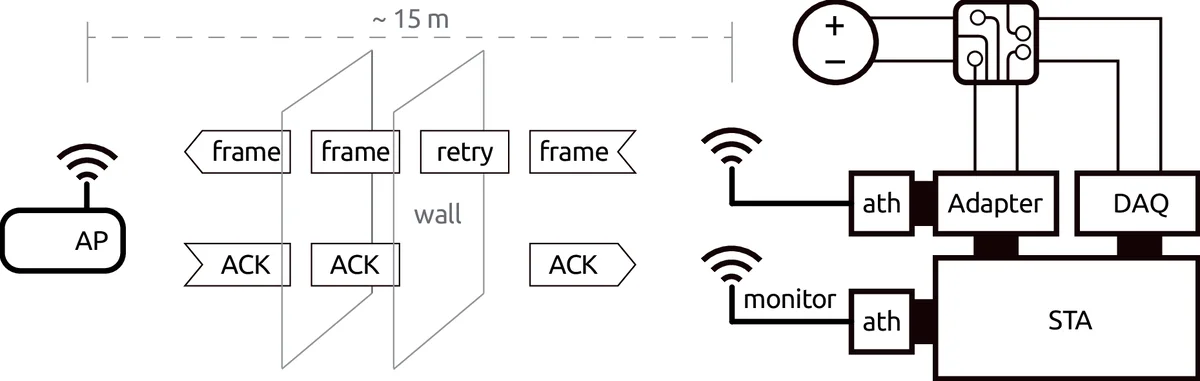
Rate adaptation and transmission power control in 802.11 WLANs have received a lot of attention from the research community, with most of the proposals aiming at maximising throughput based on network conditions. Considering energy consumption, an implicit assumption is that optimality in throughput implies optimality in energy efficiency, but this assumption has been recently put into question. In this paper, we address via analysis, simulation and experimentation the relation between throughput performance and energy efficiency in multi-rate 802.11 scenarios. We demonstrate the trade-off between these performance figures, confirming that they may not be simultaneously optimised, and analyse their sensitivity towards the energy consumption parameters of the device. We analyse this trade-off in existing rate adaptation with transmission power control algorithms, and discuss how to design novel schemes taking energy consumption into account.
💡 Research Summary
The paper investigates the relationship between throughput maximisation and energy efficiency in IEEE 802.11 wireless LANs, focusing on the two widely studied mechanisms of rate adaptation (RA) and transmission power control (TPC). While most prior work optimises these mechanisms solely for maximal goodput, the authors question the implicit assumption that the configuration that yields the highest throughput also minimises energy consumption. To answer this, they develop a joint analytical framework that combines a well‑established goodput model for the 802.11 Distributed Coordination Function (DCF) with a comprehensive power‑consumption model that accounts for both the wireless interface and the host platform.
The goodput model, based on Qiao et al., expresses the expected delivered payload as the product of the success probability (which depends on packet length, retry limit, channel state, and modulation‑coding scheme) and the packet length, divided by the expected transmission time. The transmission time incorporates back‑off, data transmission, ACK, SIFS, DIFS and waiting periods, and it is derived under the assumption of a static AWGN channel without external interference.
The power‑consumption model, derived from the authors’ previous measurements, represents the average power as a sum of five terms: (i) a device‑specific idle power ρ_id, (ii) a transmission‑related term ρ_tx·τ_tx that scales linearly with the fraction of airtime spent transmitting, (iii) a reception‑related term ρ_rx·τ_rx that scales linearly with reception airtime, (iv) a generation cross‑factor γ_xg·λ_g that captures per‑frame processing overhead on the transmitter, and (v) a reception cross‑factor γ_xr·λ_r for the receiver. Crucially, the coefficients ρ_tx and ρ_rx are shown to depend linearly on the selected MCS and on the transmit power (TXP) in milliwatts, a relationship validated through linear regression on measurements from five devices (three AP‑class platforms and two handhelds).
By merging the two models, the authors define energy efficiency μ as the ratio of expected delivered bits to expected energy per frame (bits per joule). They then explore numerically how μ varies with SNR, MCS, and TXP. The results reveal a non‑monotonic behaviour: at low TXP the system suffers many retransmissions, causing high energy consumption; once TXP is increased enough to push the SNR above the threshold for a given MCS, retransmissions disappear and energy consumption drops sharply, even though the radio itself draws more power. Beyond that point, further TXP increases raise energy use again, but the slope is modest compared with the savings from eliminating retransmissions.
The study also demonstrates that device‑specific parameters (especially the idle power ρ_id and the processing cross‑factor γ_xg) have a strong impact on the trade‑off. For mobile devices, the per‑frame processing overhead can account for 20‑30 % of total power, meaning that simply lowering TXP does not guarantee better energy efficiency.
Finally, the authors evaluate several representative RA‑TPC algorithms (e.g., Minstrel‑HT, SampleRate, ARF, RRAA) under the same conditions. Most of these schemes prioritize maximal goodput and therefore select high MCS and high TXP, which leads to sub‑optimal μ values—often 10‑40 % lower than configurations that would be chosen if energy efficiency were explicitly considered. The paper argues that this discrepancy is not merely an artifact of specific algorithm designs but stems from an inherent trade‑off dictated by the power‑consumption characteristics of 802.11 radios.
In conclusion, the paper provides a rigorous analytical and experimental demonstration that throughput optimality and energy‑efficiency optimality are generally not aligned in 802.11 networks. It highlights the importance of jointly considering both objectives when designing RA‑TPC mechanisms and proposes a high‑level design guideline: real‑time measurement of channel conditions and device power profiles, followed by a weighted multi‑objective optimisation that can adapt its emphasis between throughput and energy savings depending on application requirements (e.g., battery‑constrained devices versus throughput‑critical services). This work lays a solid foundation for future “green” WLAN protocols that can balance performance and power consumption in a principled manner.
Comments & Academic Discussion
Loading comments...
Leave a Comment