Physical-Layer Cryptography Through Massive MIMO
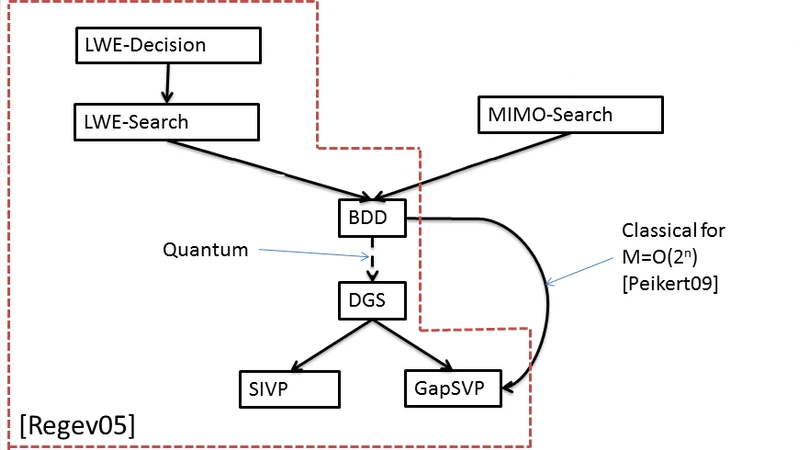
We propose the new technique of physical-layer cryptography based on using a massive MIMO channel as a key between the sender and desired receiver, which need not be secret. The goal is for low-complexity encoding and decoding by the desired transmitter-receiver pair, whereas decoding by an eavesdropper is hard in terms of prohibitive complexity. The decoding complexity is analyzed by mapping the massive MIMO system to a lattice. We show that the eavesdropper’s decoder for the MIMO system with M-PAM modulation is equivalent to solving standard lattice problems that are conjectured to be of exponential complexity for both classical and quantum computers. Hence, under the widely-held conjecture that standard lattice problems are hard to solve in the worst-case, the proposed encryption scheme has a more robust notion of security than that of the most common encryption methods used today such as RSA and Diffie-Hellman. Additionally, we show that this scheme could be used to securely communicate without a pre-shared secret and little computational overhead. Thus, by exploiting the physical layer properties of the radio channel, the massive MIMO system provides for low-complexity encryption commensurate with the most sophisticated forms of application-layer encryption that are currently known.
💡 Research Summary
The paper introduces a novel physical‑layer cryptographic scheme that leverages the inherent randomness of a massive MIMO channel as a shared “key” between a legitimate transmitter (Alice) and receiver (Bob). Unlike traditional wiretap models that aim for information‑theoretic secrecy, this work focuses on computational hardness: the legitimate pair can encode and decode with linear‑time operations, while an eavesdropper (Eve) who observes a different channel faces a decoding problem that is provably as hard as standard lattice problems such as the Closest Vector Problem (CVP) or the Shortest Vector Problem (SVP).
System Model
The authors consider a real‑valued MIMO system with n transmit antennas and m receive antennas (m is polynomial in n). The channel matrix A ∈ ℝ^{m×n} has i.i.d. Gaussian entries (distribution Ψ_k). The transmitted vector x ∈ ℤ^n is drawn from an M‑PAM constellation (equivalently, integers in
Comments & Academic Discussion
Loading comments...
Leave a Comment