Non integrability of a self-gravitating Riemann liquid ellipsoid
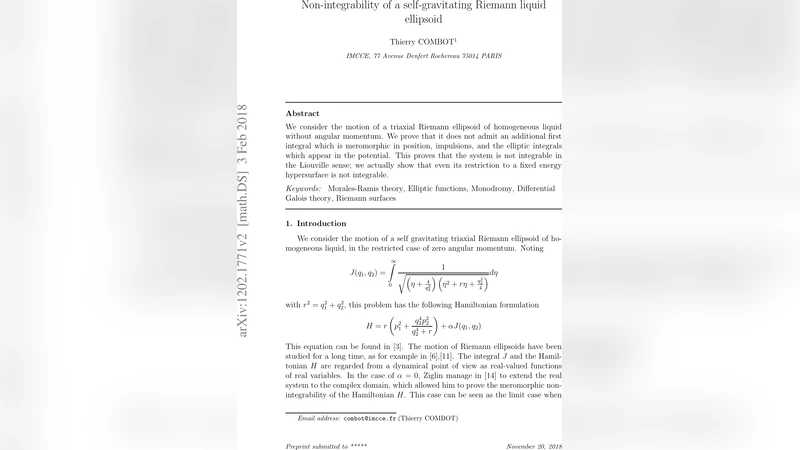
We prove that the motion of a triaxial Riemann ellipsoid of homogeneous liquid without angular momentum does not possess an additional first integral which is meromorphic in position, impulsions, and the elliptic functions which appear in the potential, and thus is not integrable. We prove moreover that this system is not integrable even on a fixed energy level hypersurface.
💡 Research Summary
The paper addresses the long‑standing problem of integrability for the classical Riemann ellipsoid – a homogeneous liquid mass whose shape is described by a triaxial ellipsoid and whose dynamics are governed solely by self‑gravity and internal deformation energy. The authors focus on the most generic situation: the ellipsoid carries no net angular momentum, so the only conserved quantity a priori is the total energy. The central claim is that, under these conditions, the system does not admit any additional first integral that is meromorphic in the phase‑space variables (positions and momenta) and in the elliptic functions that appear in the gravitational potential. Consequently, the system is non‑integrable in the Liouville sense, both on the full phase space and when restricted to a fixed‑energy hypersurface.
Mathematical formulation.
The configuration of the ellipsoid is encoded by a time‑dependent linear map (Q(t)\in GL(3,\mathbb{R})) which transforms a unit sphere into the ellipsoid with semi‑axes (a_1(t),a_2(t),a_3(t)). The Lagrangian consists of a kinetic term quadratic in the generalized velocities (the deformation kinetic energy) and a potential term (V(a_1,a_2,a_3)) that represents the self‑gravitational energy. The latter is obtained by integrating the Newtonian potential over the volume of the ellipsoid; it can be expressed in terms of complete elliptic integrals and, after suitable normalization, in terms of Weierstrass elliptic functions (\wp,\zeta,\sigma). Passing to Hamiltonian form yields a six‑dimensional phase space with coordinates ((q_i,p_i)_{i=1}^3) and Hamiltonian
\