Compressive Sensing: Performance Comparison Of Sparse Recovery Algorithms
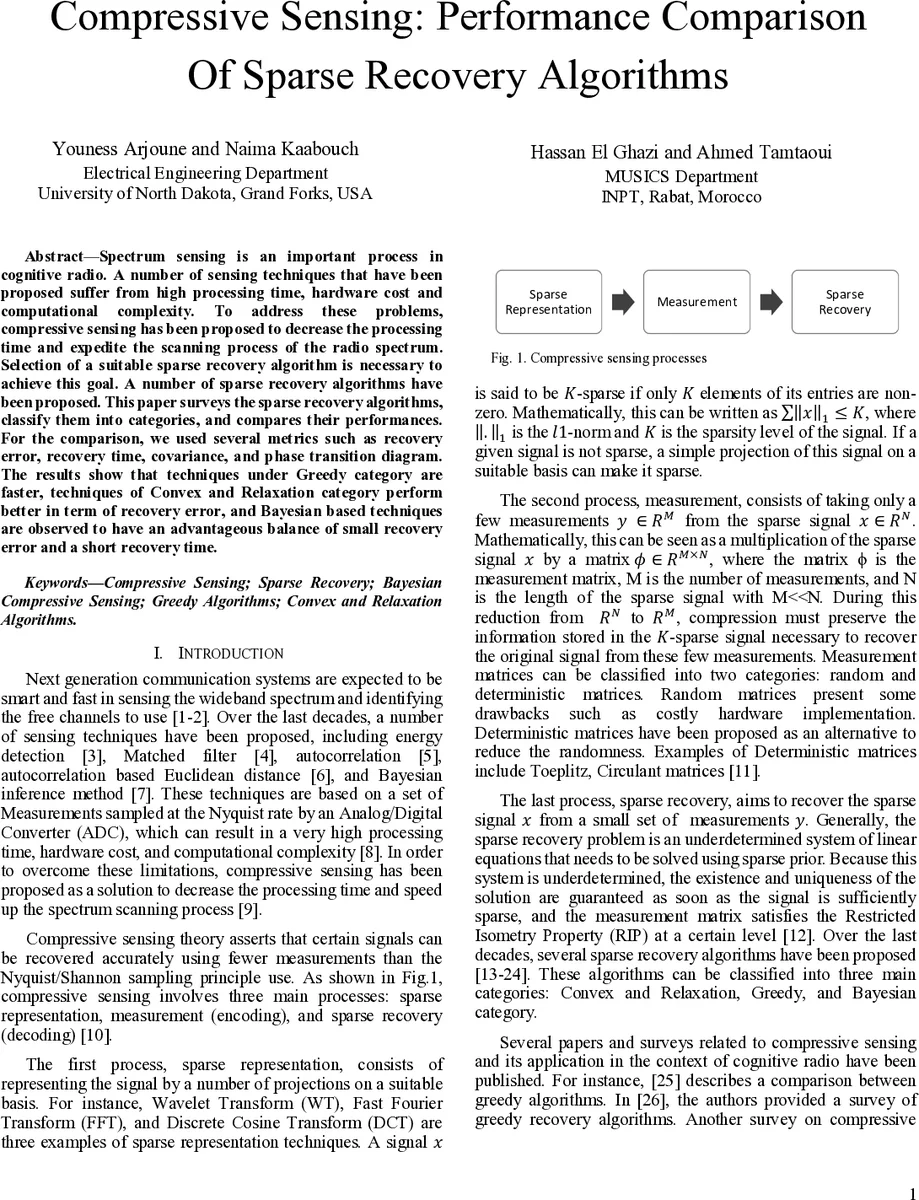
Spectrum sensing is an important process in cognitive radio. A number of sensing techniques that have been proposed suffer from high processing time, hardware cost and computational complexity. To address these problems, compressive sensing has been proposed to decrease the processing time and expedite the scanning process of the radio spectrum. Selection of a suitable sparse recovery algorithm is necessary to achieve this goal. A number of sparse recovery algorithms have been proposed. This paper surveys the sparse recovery algorithms, classify them into categories, and compares their performances. For the comparison, we used several metrics such as recovery error, recovery time, covariance, and phase transition diagram. The results show that techniques under Greedy category are faster, techniques of Convex and Relaxation category perform better in term of recovery error, and Bayesian based techniques are observed to have an advantageous balance of small recovery error and a short recovery time.
💡 Research Summary
The paper addresses a critical bottleneck in cognitive radio—real‑time spectrum sensing—by investigating how compressive sensing (CS) can reduce the number of required measurements and accelerate the scanning process. While CS theory guarantees that a sparse signal can be reconstructed from far fewer samples than dictated by the Nyquist rate, the practical performance of a CS‑based spectrum scanner hinges on the choice of sparse recovery algorithm. The authors therefore conduct a systematic survey, classification, and empirical comparison of a broad set of sparse recovery methods.
First, the authors categorize existing algorithms into three major families: (1) Greedy algorithms (e.g., Orthogonal Matching Pursuit, Stagewise OMP, Compressive Sampling Matching Pursuit), which iteratively select the most correlated atoms and are known for low computational complexity; (2) Convex Optimization and Relaxation methods (e.g., Basis Pursuit, Total Variation minimization, Dantzig Selector), which formulate the recovery as an L1‑regularized convex problem and can achieve global optimality at the cost of higher runtime; and (3) Bayesian approaches (e.g., Sparse Bayesian Learning, Expectation‑Maximization based schemes, Variational Bayesian inference), which embed sparsity through prior distributions and infer posterior statistics, offering a principled trade‑off between accuracy and speed.
The experimental framework is carefully controlled. The same measurement matrices—both random Gaussian and structured Toeplitz types—are used across all tests, while signal sparsity levels range from 10 % to 50 % of the ambient dimension. Four performance metrics are evaluated: (i) recovery error measured by the L2‑norm (mean‑squared error), (ii) recovery time measured as CPU seconds, (iii) covariance of the reconstruction error to assess statistical reliability, and (iv) phase‑transition diagrams that map the probability of successful recovery as a function of sparsity and measurement ratio. Each algorithm is run over 100 independent trials to obtain statistically meaningful averages and standard deviations.
Results show a clear separation of strengths. Greedy methods are the fastest; OMP and StOMP often complete in under 0.01 s, making them attractive for ultra‑low‑latency hardware. However, their error grows sharply when the measurement ratio falls below the theoretical threshold, and the phase‑transition curves reveal a narrow region of guaranteed recovery. Convex‑optimization methods achieve the lowest reconstruction error (L1‑minimization reaches MSE ≈ 10⁻³) and exhibit broad phase‑transition regions, but their average runtime ranges from 0.2 to 0.5 s, which may be prohibitive for real‑time scanning. Bayesian techniques strike a balance: Sparse Bayesian Learning attains an MSE around 3 × 10⁻³—comparable to convex methods—while requiring only 0.05–0.1 s per reconstruction. Moreover, the error covariance for Bayesian algorithms is the smallest among all families, indicating higher reliability and less variance across runs.
The authors discuss practical implications. For systems where latency and power consumption dominate (e.g., handheld or IoT radios), Greedy algorithms are recommended, possibly with hardware acceleration. When the primary goal is maximal detection fidelity—such as in military or emergency‑response scenarios—Convex methods are preferable despite their higher computational load. Bayesian approaches are advocated for most commercial cognitive radios because they provide an advantageous compromise: acceptable latency, robust error statistics, and adaptability through hyper‑parameter learning. The paper also suggests future directions, including hybrid schemes that combine the speed of Greedy selection with the statistical rigor of Bayesian inference, and the exploration of FPGA/ASIC implementations to further shrink processing time.
In summary, the study delivers a comprehensive benchmark of sparse recovery algorithms for compressive spectrum sensing, quantifies the trade‑offs among speed, accuracy, and statistical confidence, and offers concrete guidance for engineers designing next‑generation cognitive radio front‑ends.
Comments & Academic Discussion
Loading comments...
Leave a Comment