A model of orbital angular momentum Li-Fi
Twisted light has recently gained enormous interest in communication systems. Thus far, twisted light has not yet been utilized for visible light communication to transmit data. Here, by exploiting the color and orbital angular momentum (OAM) degrees of freedom simultaneously, we construct a much higher-dimensional space spanned by their hybrid mode basis, which further increases the information capacity of twisted light. We build a new visible light communication system using a white light emitting diode, with red, green and blue (RGB) colors serving as independent channels and with OAM superposition states encoding the information. We connect our conceptually new RGB-OAM hybrid coding with the specially designed two-dimensional holographic gratings based on theta-modulation. After indoor free-space transmission, we decode the color information with an Xcube prism and subsequently decode the OAM superposition states with a pattern recognition method based on supervised machine learning. We succeed in demonstrating the transmission of color images and a piece of audio with the fidelity over 96%. Our point-to-point scheme with hybrid RGB-OAM encoding, not only increases significantly the information capacity of twisted light, but also offers additional security that supplements the traditional broadcasting visible light communications, e.g., Li-Fi.
💡 Research Summary
The paper presents a novel visible‑light communication (VLC) scheme that simultaneously exploits two independent degrees of freedom of light—wavelength (color) and orbital angular momentum (OAM)—to dramatically increase the information capacity of Li‑Fi. A white light‑emitting diode (LED) serves as the broadband source. Its three primary colors—red, green, and blue (RGB)—are treated as three parallel data channels, while each color is further modulated with OAM superposition states (ℓ and –ℓ combined). The authors design a two‑dimensional holographic grating based on θ‑modulation that can generate the desired OAM modes for each wavelength in a single optical path.
At the transmitter, digital data (images, audio) are first converted into binary streams. These streams are mapped onto the RGB channels and onto a set of OAM superposition states, creating a hybrid “RGB‑OAM” symbol set. Because OAM theoretically offers an infinite set of integer topological charges (ℓ), the symbol alphabet can be expanded far beyond the binary or M‑ary intensity modulation traditionally used in VLC. The θ‑modulated hologram imprints the appropriate azimuthal phase profile on each color component, producing the required OAM beams without the need for separate spatial light modulators for each channel.
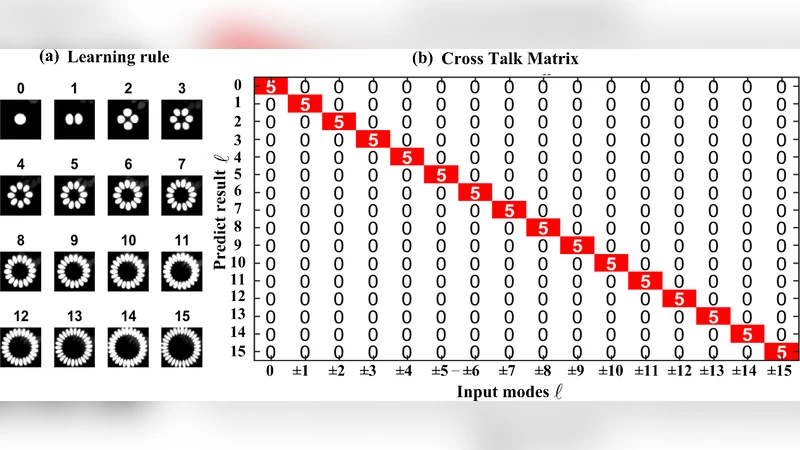
The free‑space indoor link is a simple line‑of‑sight path of a few tens of centimeters to a few meters. At the receiver, an X‑cube prism spatially separates the three colors, preventing inter‑channel crosstalk. Each color is then captured by a CMOS/CCD sensor that records the intensity pattern of the OAM beam. Because OAM superposition states generate characteristic spiral interference patterns, they can be distinguished by pattern‑recognition algorithms. The authors train a convolutional neural network (CNN) on a large dataset of simulated and experimentally recorded OAM patterns under varying noise levels. After training, the CNN classifies the received patterns with >96 % accuracy, effectively decoding the OAM symbol for each color channel.
Experimental validation includes the transmission of a full‑color image and a short audio clip. The image is decomposed into RGB components, each component is encoded with a sequence of OAM superpositions, transmitted, and then reconstructed by recombining the decoded color channels. The reconstructed image retains more than 96 % structural similarity to the original. Similarly, the audio data, after compression and binary mapping, is recovered with high fidelity, demonstrating that the hybrid scheme can handle both visual and auditory information.
Security benefits arise from the spatial complexity of OAM. An eavesdropper who intercepts only the intensity of the light without knowledge of the specific OAM topological charge cannot correctly reconstruct the data. Moreover, because successful decoding requires simultaneous knowledge of both the color channel and the OAM state, the system adds a two‑factor physical layer of encryption that is difficult to breach with conventional optical sniffing techniques.
The authors acknowledge current limitations: OAM beams are susceptible to diffraction, turbulence, and misalignment over longer distances, and the X‑cube prism’s separation efficiency may degrade if the spectral bandwidth of the LEDs overlaps significantly. Future work is suggested in three areas: (1) adaptive optics or digital pre‑distortion to preserve OAM integrity over longer links, (2) integration of high‑speed electronic drivers to increase symbol rates, and (3) scaling the architecture to multi‑user MIMO VLC networks where each user can be assigned a distinct RGB‑OAM code.
In summary, the study demonstrates that by marrying wavelength division multiplexing with OAM‑based spatial multiplexing, a point‑to‑point VLC link can achieve substantially higher data throughput and intrinsic physical‑layer security. The experimental results, with fidelity exceeding 96 % for both image and audio transmission, provide a compelling proof‑of‑concept for next‑generation Li‑Fi systems that leverage the full vectorial nature of light.
Comments & Academic Discussion
Loading comments...
Leave a Comment