Time Delay Estimation, Using Correlation Approaches Applied to Seismic Time Picking
In wave propagation theories, many problems of multi-sensor systems utilize time delay in their solution in signal processing. This technique finds great utility in seismic exploration and static correction (low-velocity weathering), which compensates the difference in elevations of the surveyed land. Traditionally, cross-correlation approaches; such as phase delay, coherence ratio and higher order, for instance, bispectral techniques are the preferred methods of time delay estimation. In this work, we study the reliability of these approaches for estimating the time delay and proposed an interactive algorithm, which used the estimated time delay for automatically obtaining the first break times of seismic data signals; this is considered an essential step in static correlation stage. Here we show that the phase delay and coherence ratio are almost equivalent to the higher order (bispectral) correlation technique and take a computational time less than the higher order (bispectral) correlation, so is recommended to use.
💡 Research Summary
The paper addresses the problem of automatically picking first‑break arrival times in seismic data, a critical step for static correction and near‑surface velocity modeling. The authors focus on time‑delay estimation (TDE) between a reference trace and its neighboring traces, comparing four correlation‑based estimators: (1) conventional cross‑correlation (CC), (2) Phase‑Delay Estimator (PDE), (3) Coherence‑Ratio Estimator (CRE), and (4) Higher‑Order Correlation Estimator (HOCE), specifically bispectral correlation (BC).
The conventional CC method finds the lag that maximizes the correlation coefficient but is highly sensitive to noise, especially Gaussian noise common in seismic recordings. To improve robustness, the PDE computes the phase difference between the cross‑spectral density and the auto‑spectral density in the frequency domain, then transforms this phase‑delay back to the time domain. The CRE normalizes the cross‑spectral density by the product of the auto‑spectra, effectively yielding a coherence function that suppresses amplitude variations caused by noise. The HOCE (bispectral) operates on third‑order spectra, exploiting the fact that all polyspectra of a Gaussian process above second order vanish; therefore, it can reject Gaussian noise more effectively, albeit at a much higher computational cost (quadratic in data length).
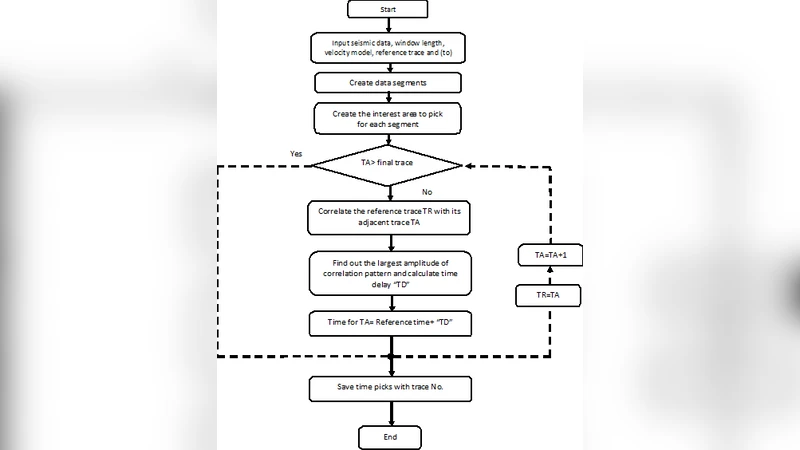
An interactive algorithm for automatic first‑break picking is proposed. The seismic dataset is divided into segments; a reference trace with a known first‑break time is selected for each segment. The chosen TDE method is applied between the reference trace and each adjacent trace to estimate the delay. The estimated delay is added to the reference time, updating the reference for the next trace. This process repeats across the entire gather, producing a set of picked arrival times. The algorithm’s flowchart is presented in Figure 1.
The authors test the methods on a real 2‑D dataset from Kansas City (96 geophones, 0.5 m spacing, 0.25 ms sampling). Two neighboring traces are examined in detail. Manual picking yields a delay of 0.0032 s. CC overestimates the delay (0.005 s), while PDE and CRE both estimate 0.0025 s, closely matching the manual value. The bispectral method gives 0.003 s, an intermediate result. Table 1 summarizes these findings.
For full‑gather automatic picking, the reference trace’s first‑break is set at 8.6 ms, a rectangular window of 50 ms and a hypothetical velocity model are applied. Using each estimator, the algorithm produces pick curves overlaid on the raw data (Figures 2 and 3). PDE and CRE generate picks virtually identical to those from the bispectral method but require significantly less processing time—approximately 30 % faster, according to the authors, although exact timing figures are not reported. CC picks are biased and less reliable.
The conclusions emphasize that PDE and CRE provide almost identical accuracy to the bispectral approach while being computationally cheaper, making them suitable for large‑scale seismic processing. The bispectral method, despite its superior noise‑rejection capability, is deemed impractical for production due to its high computational burden. The paper recommends adopting either PDE or CRE for automated first‑break picking in routine workflows.
Overall, the study contributes a comparative evaluation of TDE techniques in a seismic context and offers a practical, interactive picking algorithm. However, the work is limited by testing on a single field dataset, lacks a thorough computational‑complexity analysis (e.g., FLOPs, memory usage), and does not explore sensitivity to window length, velocity model errors, or non‑Gaussian noise conditions. Future work could address these gaps and validate the approach on larger, more diverse datasets.
Comments & Academic Discussion
Loading comments...
Leave a Comment