A Novel Contourlet Domain Watermark Detector for Copyright Protection
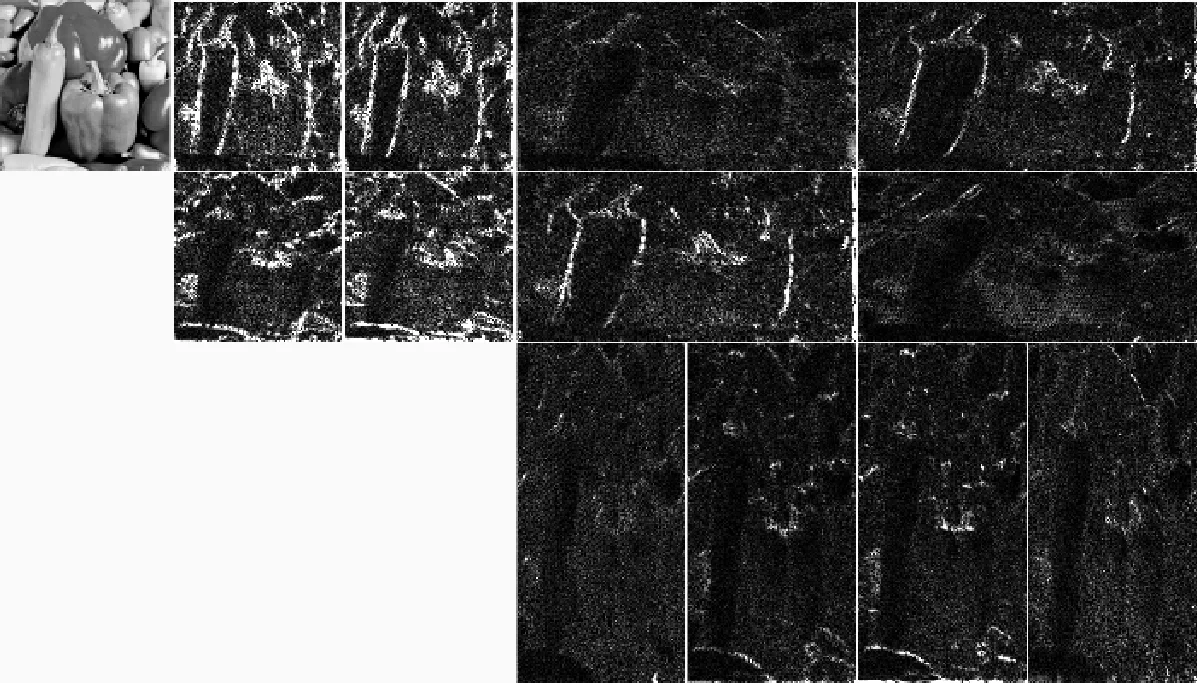
Digital media can be distributed via Internet easily, so, media owners are eagerly seeking methods to protect their rights. A typical solution is digital watermarking for copyright protection. In this paper, we propose a novel contourlet domain image watermarking scheme for copyright protection. In the embedding phase, we insert the watermark into the image using an additive contourlet domain spread spectrum approach. In the detection phase, we design a detector using likelihood ratio test (LRT). Since the performance of the LRT detector is completely dependent on the accuracy of the employed statistical model, we first study the statistical properties of the contourlet coefficients. This study demonstrates the heteroscedasticity and heavy-tailed marginal distribution of these coefficients. Therefore, we propose using two dimensional generalized autoregressive conditional heteroscedasticity (2D-GARCH) model that is compatible with the contourlet coefficients. Motivated by the modeling results, we design a new watermark detector based on 2D-GARCH model. Also, we analyze its performance by computing the receiver operating characteristics. Experimental results confirm the high efficiency of the proposed detector. Since a watermark detector for copyright protection should be robust against attacks, we examine the robustness of the proposed detector under different kinds of attacks.
💡 Research Summary
**
The paper presents a novel image watermark detection scheme that operates in the contourlet transform domain and leverages a two‑dimensional Generalized Autoregressive Conditional Heteroscedasticity (2D‑GARCH) statistical model. The authors first investigate the statistical characteristics of contourlet coefficients and demonstrate that they exhibit heavy‑tailed marginal distributions and significant heteroscedasticity—i.e., the conditional variance of the coefficients varies across spatial locations. This observation is validated through Lagrange‑multiplier (LM) tests, both the classic Engle test applied to horizontal, vertical, and diagonal scans and a dedicated two‑dimensional LM test, which consistently reject the null hypothesis of homoscedasticity for all directional sub‑bands in a set of natural images.
To capture these properties, the authors adopt a 2D‑GARCH(p₁,p₂,q₁,q₂) model. In this model each coefficient fᵢⱼ is expressed as fᵢⱼ = √hᵢⱼ εᵢⱼ, where εᵢⱼ is i.i.d. standard normal and the conditional variance hᵢⱼ is a linear combination of past squared coefficients and past variances. Model parameters (α₀, αₖℓ, βₖℓ) are estimated by maximum likelihood. Empirical fitting shows that the 2D‑GARCH density aligns far better with the observed histograms than Gaussian or Generalized Gaussian (GGD) models, especially in the tails.
For watermark embedding, the original image is first transformed by the contourlet filter bank (using a 9‑7 biorthogonal multiscale filter and PKVA directional filters). The sub‑band with the highest energy in the finest scale is selected, and an additive spread‑spectrum watermark wᵢⱼ = γ sᵢⱼ is added, where sᵢⱼ ∈ {‑1, +1} is a pseudo‑random sequence generated from a secret key and γ controls the watermark‑to‑distortion ratio (WDR). The watermarked sub‑band becomes gᵢⱼ = fᵢⱼ + wᵢⱼ.
Detection is formulated as a binary hypothesis test:
H₀: gᵢⱼ = fᵢⱼ (no watermark)
H₁: gᵢⱼ = fᵢⱼ + wᵢⱼ (watermark present).
Using the 2D‑GARCH model, the likelihood of each observation under both hypotheses can be written analytically, leading to a simple likelihood‑ratio (LR) test:
Λ = ∏ᵢⱼ exp
Comments & Academic Discussion
Loading comments...
Leave a Comment