An Efficient Data-aided Synchronization in L-DACS1 for Aeronautical Communications
L-band Digital Aeronautical Communication System type-1 (L-DACS1) is an emerging standard that aims at enhancing air traffic management (ATM) by transitioning the traditional analog aeronautical communication systems to the superior and highly efficient digital domain. L-DACS1 employs modern and efficient orthogonal frequency division multiplexing (OFDM) modulation technique to achieve more efficient and higher data rate in comparison to the existing aeronautical communication systems. However, the performance of OFDM systems is very sensitive to synchronization errors. L-DACS1 transmission is in the L-band aeronautical channels that suffer from large interference and large Doppler shifts, which makes the synchronization for L-DACS more challenging. This paper proposes a novel computationally efficient synchronization method for L-DACS1 systems that offers robust performance. Through simulation, the proposed method is shown to provide accurate symbol timing offset (STO) estimation as well as fractional carrier frequency offset (CFO) estimation in a range of aeronautical channels. In particular, it can yield excellent synchronization performance in the face of a large carrier frequency offset.
💡 Research Summary
The paper addresses the critical problem of timing and frequency synchronization in L‑DACS1, a next‑generation OFDM‑based aeronautical communication system operating in the crowded L‑band. Existing synchronization techniques either rely on coarse autocorrelation, which cannot provide fine timing accuracy, or on cross‑correlation, which suffers from secondary peaks and severe degradation under large carrier frequency offsets (CFO). To overcome these limitations, the authors propose a novel data‑aided synchronization scheme that fully exploits the specific preamble structure defined in the L‑DACS1 standard.
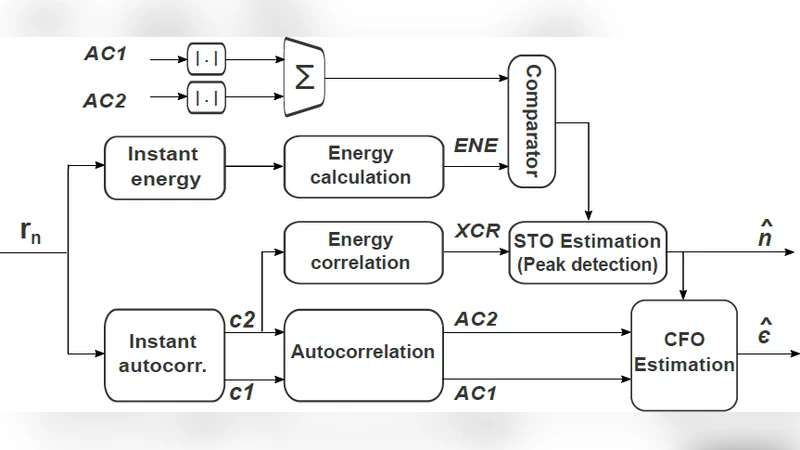
Two autocorrelation metrics are defined: AC1, based on the quarter‑repetition of the first preamble symbol, and AC2, based on the half‑repetition. Both metrics capture the phase rotation induced by CFO (Φ1 = 2π ε L/N and Φ2 = 2π ε 2L/N) and thus enable fractional CFO estimation. In addition, an energy metric (ENE) is used to detect the presence of the preamble. The core of the timing estimation is a newly introduced energy‑correlation metric (XCR) that operates on real‑valued quantities |c2(m,n)|, making it insensitive to CFO‑induced phase shifts and reducing secondary peaks that normally cause false timing detections.
The synchronization flow proceeds as follows: (1) preamble detection by comparing the sum of |AC1| and |AC2| with ENE; (2) fine STO estimation by locating the maximum of XCR within a predefined search window; (3) fractional CFO estimation using the angles of AC1 and AC2. The combination of AC1 (wide estimation range, ±2 sub‑carrier spacings) and AC2 (higher accuracy, ±1 sub‑carrier spacing) yields a CFO estimator that is both robust to large offsets and precise. Integer CFO correction, while mentioned, is left for future work.
Extensive Monte‑Carlo simulations (10 000 trials) are performed in MATLAB for both AWGN and realistic aeronautical channels, including terminal‑maneuvering area (TMA) and en‑route (ENR) scenarios, with and without DME interference. Performance metrics are STO failure rate (the proportion of trials where the estimated timing falls outside the required 1/11 cyclic‑prefix length) and CFO mean‑square error (MSE). In AWGN, the proposed method maintains a near‑zero failure rate for SNR ≥ 5 dB even with a large CFO of 1.5 sub‑carrier spacings, outperforming the state‑of‑the‑art (SoA) scheme that requires additional processing time (up to 0.25 s) for fine timing. CFO MSE using AC2 matches or exceeds SoA performance, and the method remains stable when CFO exceeds one sub‑carrier spacing.
In aeronautical channels, the scheme shows only modest degradation. In ENR without DME, accurate STO and CFO are achieved for SNR > 8 dB. With DME interference, a performance loss of about 10 dB (STO) and 4 dB (CFO) is observed, requiring SNR ≈ 20 dB for reliable operation. In TMA conditions, the method’s performance is comparable to AWGN for SNR < 8 dB, with CFO estimation saturating above 10 dB and STO reaching excellent accuracy above 22 dB.
Overall, the paper presents a computationally efficient, hardware‑friendly synchronization solution that delivers fine timing and accurate fractional CFO estimation within the duration of the L‑DACS1 preamble (≈240 µs). By leveraging both autocorrelation and energy‑correlation metrics, it achieves robustness against large frequency offsets and challenging multipath/DME environments, making it a strong candidate for real‑time implementation in future aeronautical communication systems.
Comments & Academic Discussion
Loading comments...
Leave a Comment