Threshold Digraphs
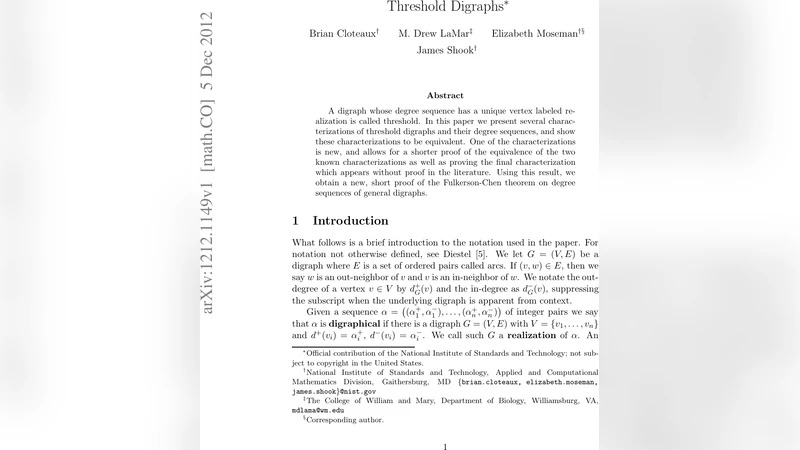
A digraph whose degree sequence has a unique vertex labeled realization is called threshold. In this paper we present several characterizations of threshold digraphs and their degree sequences, and show these characterizations to be equivalent. One of the characterizations is new, and allows for a shorter proof of the equivalence of the two known characterizations as well as proving the final characterization which appears without proof in the literature. Using this result, we obtain a new, short proof of the Fulkerson-Chen theorem on degree sequences of general digraphs.
💡 Research Summary
The paper investigates directed graphs whose degree sequences admit a unique labeled realization, termed threshold digraphs. After introducing the concept, the authors review two classical characterizations that have appeared in the literature. The first characterization states that a degree sequence ((d^+,d^-)) is threshold if the out‑degree and in‑degree sequences are each non‑decreasing and satisfy the cross‑inequality (d^+_i \ge d^-_j \Rightarrow i \ge j). The second characterization asserts that a threshold digraph must be a complete order digraph: for every unordered pair of vertices exactly one of the two possible arcs is present, and the resulting orientation is transitive. While both conditions are known to be equivalent to the uniqueness property, the existing proofs are rather involved, relying on auxiliary lemmas and intricate combinatorial arguments.
The central contribution of the paper is a new third characterization based on a special 0‑1 matrix, called a threshold matrix. After sorting the vertices so that the out‑degree vector (d^+) and the in‑degree vector (d^-) are non‑decreasing, the adjacency matrix of a threshold digraph can be rearranged into a Ferrers‑type diagram: the 1‑entries form a left‑justified, top‑aligned rectangle that respects the row and column sums. In other words, there exists a binary matrix (M) whose row sums equal (d^+) and column sums equal (d^-), and whose pattern is monotone in both dimensions. The authors prove that this matrix condition is equivalent to the two classical characterizations. The proof proceeds in three steps:
- (3) ⇒ (1) – monotonicity of the sorted rows and columns directly yields the cross‑inequality.
- (3) ⇒ (2) – the Ferrers shape guarantees that the underlying orientation is a complete order; any two vertices are comparable, and the monotone pattern enforces transitivity.
- (1) & (2) ⇒ (3) – given a degree sequence satisfying the cross‑inequality and a transitive complete order, one can construct the Ferrers matrix by a simple greedy placement of 1‑entries, essentially an exchange argument that respects the prescribed row and column sums.
Having established the equivalence, the paper leverages the matrix viewpoint to give a concise proof of the Fulkerson‑Chen theorem, which characterizes degree sequences of arbitrary digraphs. The classic theorem states that a pair ((d^+,d^-)) is digraphic iff the sum of out‑degrees equals the sum of in‑degrees and a certain majorization condition holds for every prefix of the sorted sequences. Using the threshold matrix, the authors show that checking the Ferrers condition for the sorted sequences is sufficient: after sorting, one computes cumulative sums of (d^+) and (d^-) and verifies that for each (k) the inequality (\sum_{i=1}^k d^+i \le \sum{i=1}^n \min(k, d^-_i)) holds. This reduces the original proof, which involved network‑flow constructions, to a straightforward linear scan after an (O(n\log n)) sort. Consequently, the existence test for a digraphic sequence becomes both conceptually simpler and algorithmically faster.
The final sections explore structural consequences of the three characterizations. Threshold digraphs are always transitively closed; they admit a unique topological ordering, and each strong component is itself a complete order. The paper also notes that vertices with zero out‑degree or zero in‑degree appear as sinks or sources, respectively, but they do not disrupt the overall transitive structure. Moreover, the authors discuss connections to order theory: the set of vertices together with the arc relation forms a total preorder, and the Ferrers matrix corresponds to the Hasse diagram of a finite distributive lattice. These observations open pathways to apply lattice‑theoretic tools to problems involving threshold digraphs.
In summary, the article provides:
- Three equivalent characterizations of threshold digraphs—two classical and one novel matrix‑based condition.
- A streamlined proof that the matrix condition implies the classical ones and vice versa.
- A short, elegant derivation of the Fulkerson‑Chen theorem using the matrix perspective.
- Insightful discussion of the structural properties of threshold digraphs and their links to order and lattice theory.
- Indications of algorithmic benefits: degree‑sequence validation can be performed in (O(n\log n)) time, and the matrix representation suggests efficient random generation and dynamic update algorithms.
Overall, the work unifies previously disparate results under a single, intuitive framework and paves the way for both theoretical extensions and practical applications in network design, data ordering, and combinatorial optimization.
Comments & Academic Discussion
Loading comments...
Leave a Comment