The bordism version of the h-principle
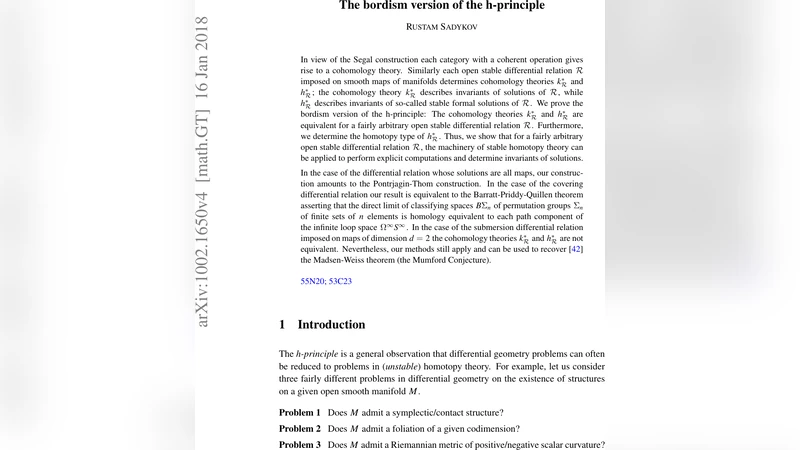
In view of the Segal construction each category with a coherent operation gives rise to a cohomology theory. Similarly each open stable differential relation $R$ imposed on smooth maps of manifolds determines cohomology theories $k^$ and $h^$; the cohomology theory $k^$ describes invariants of solutions of $R$, while $h^$ describes invariants of so-called stable formal solutions of $R$. We prove the bordism version of the h-principle: The cohomology theories $k^$ and $h^$ are equivalent for a fairly arbitrary open stable differential relation $R$. Furthermore, we determine the homotopy type of $h^$. Thus, we show that for a fairly arbitrary open stable differential relation $R$, the machinery of stable homotopy theory can be applied to perform explicit computations and determine invariants of solutions. In the case of the differential relation whose solutions are all maps, our construction amounts to the Pontrjagin-Thom construction. In the case of the covering differential relation our result is equivalent to the Barratt-Priddy-Quillen theorem asserting that the direct limit of classifying spaces $B\Sigma_n$ of permutation groups $\Sigma_n$ of finite sets of n elements is homology equivalent to each path component of the infinite loop space $\Omega^{\infty}S^{\infty}$. In the case of the submersion differential relation imposed on maps of dimension $d=2$ the cohomology theories $k^$ and $h^*$ are not equivalent. Nevertheless, our methods still apply and can be used to recover the Madsen-Weiss theorem (the Mumford Conjecture).
💡 Research Summary
The paper establishes a “bordism version of the h‑principle” for a very general class of differential relations. Starting from Segal’s construction, the author recalls that any category equipped with a coherent operation gives rise to a cohomology theory via the associated Γ‑space and its associated spectrum. In this framework the author introduces an open stable differential relation R on smooth maps between manifolds. Openness means that the space of solutions of R is an open subset of the C⁰‑topology, while stability guarantees that the relation behaves well under suspension (dimension increase). Typical examples include the relation of being an arbitrary smooth map, the covering relation, submersions, immersions, etc.
Two cohomology theories are defined:
-
k⁎ – the “geometric” theory obtained from the bordism groups of genuine solutions of R. Concretely one builds a Thom‑type spectrum whose homotopy groups classify bordism classes of maps satisfying R. This theory captures the classical invariants of the geometric objects (e.g., surface bundles for submersions of dimension 2).
-
h⁎ – the “formal” theory obtained from stable formal solutions of R, i.e. sections of the appropriate jet bundle that satisfy the linearized version of R. Because formal solutions are defined at the level of tangent bundles, they are stable under suspension and admit a description purely in terms of stable homotopy theory. The associated spectrum is constructed directly from the Γ‑space of formal solutions.
The central result, called the bordism h‑principle, asserts that for any open stable differential relation R the two spectra are equivalent, hence the cohomology theories k⁎ and h⁎ coincide. The proof proceeds in two main stages:
-
Parametric h‑principle on the level of bordism – Using the openness of R, the author adapts Gromov’s convex integration techniques to produce a homotopy, parametrized over a compact parameter space, that deforms any formal solution into a genuine solution while preserving the bordism class. The deformation is performed in a way that respects the bordism operation (disjoint union, gluing along boundaries), which is why the result is called a bordism h‑principle.
-
Spectral equivalence – The parametric deformation yields a natural transformation between the Γ‑spaces of formal and genuine solutions. By checking that this transformation is a weak equivalence on each level, the induced map of associated spectra is a stable homotopy equivalence. Consequently the cohomology theories derived from them are isomorphic.
Beyond the abstract theorem, the author explicitly identifies the homotopy type of the formal spectrum h⁎ for several important relations:
-
All smooth maps – The formal spectrum is equivalent to the infinite loop space Ω^∞S^∞. This recovers the classical Pontrjagin–Thom construction: bordism classes of maps into a manifold correspond to stable homotopy classes of maps into spheres.
-
Covering maps – The formal spectrum coincides with the colimit of classifying spaces BΣ_n of symmetric groups. The equivalence with Ω^∞S^∞ reproduces the Barratt–Priddy–Quillen theorem, which states that the direct limit of BΣ_n is homology equivalent to each path component of Ω^∞S^∞.
-
Submersions of dimension 2 – Here the geometric and formal theories diverge: k⁎ (the bordism theory of surface bundles) is not equivalent to h⁎. Nevertheless, the machinery still applies: the formal spectrum is identified with the Madsen–Tillmann spectrum, and the comparison map recovers the Madsen–Weiss theorem (the proof of the Mumford conjecture). This illustrates that even when the full bordism h‑principle fails, the formal side still provides a powerful computational tool.
The paper concludes with several directions for future work. One is to relax the openness condition, allowing relations with controlled singularities, and to investigate whether a modified bordism h‑principle can still be proved. Another is to incorporate other coefficient systems (e.g., twisted or equivariant coefficients) into the construction, which could lead to new invariants for families of maps. Finally, the author suggests exploring connections with higher‑category theory and factorization homology, where bordism categories already play a central role.
In summary, the work unifies a broad spectrum of classical results—Pontrjagin–Thom, Barratt–Priddy–Quillen, Madsen–Weiss—under a single homotopy‑theoretic principle. By showing that for any open stable differential relation the geometric bordism theory of solutions coincides with the stable homotopy theory of formal solutions, the paper opens the door to systematic computations of geometric invariants using the well‑developed machinery of stable homotopy theory.
Comments & Academic Discussion
Loading comments...
Leave a Comment