The DCS Theorem
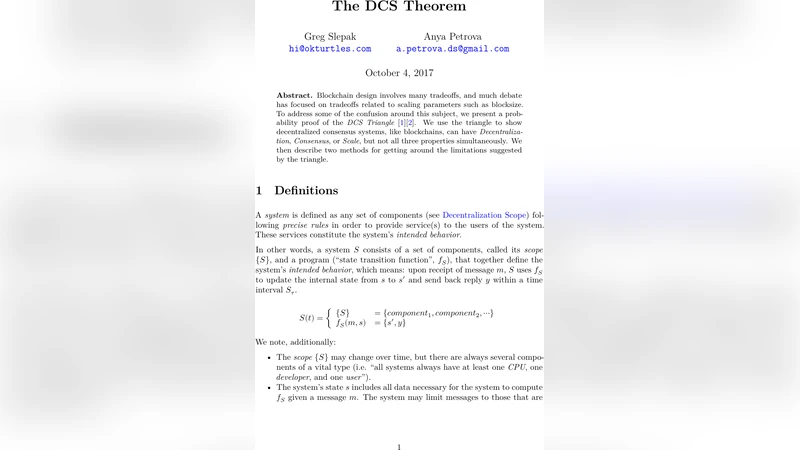
Blockchain design involves many tradeoffs, and much debate has focused on tradeoffs related to scaling parameters such as blocksize. To address some of the confusion around this subject, we present a probability proof of the DCS Triangle. We use the triangle to show decentralized consensus systems, like blockchains, can have Decentralization, Consensus, or Scale, but not all three properties simultaneously. We then describe two methods for getting around the limitations suggested by the triangle.
💡 Research Summary
The paper introduces the DCS Theorem, a formal statement that a decentralized consensus system cannot simultaneously achieve Decentralization, Consensus, and Scale. After defining a system as a set of components together with a state‑transition function, the authors delineate the three properties: Consensus (all participants share and update a common state), Scale (the ability to handle the transactional load of a global user base), and Decentralization (no single point of failure). They restrict “full consensus” to the strongest form where every participant maintains a complete copy of the entire state and can verify it independently.
Three axioms underpin the proof: (1) computational power is roughly evenly distributed across a large population, (2) average user demand grows proportionally with system size, and (3) most users lack the resources to store and process the full state at scale. From these axioms the authors derive three lemmas. Lemma 1 shows that when throughput exceeds average participant power, the system’s throughput grows faster as the user base expands, effectively sidelining slower nodes. Lemma 2 argues that coordination cost, approximated by the number of consensus participants, falls as the system scales because fewer nodes are needed to form a quorum. Lemma 3 links the decreasing coordination cost to an increasing probability of a colluding cartel, which constitutes a single point of failure and thus centralizes the system.
Combining the lemmas yields Theorem 1: as a decentralized consensus system grows, the likelihood that it becomes centralized (through cartel formation) rises, meaning the three goals cannot be met together.
To “get around” the triangle, the authors propose two practical approaches. The first couples a Decentralized‑Consensus (DC) chain with a Decentralized‑Scaling (DS) layer; the DS layer handles most transactions off‑chain and only occasionally interacts with the DC layer for final settlement. The Lightning Network is cited as a real‑world example. The second approach shards multiple DC groups, each maintaining full consensus within its shard while relying on cryptographic proofs (e.g., Merkle trees) to reduce inter‑shard trust. OmniLedger exemplifies this method.
The paper concludes with acknowledgments and a bibliography that includes the original DCS triangle posts, the Bitcoin whitepaper, the Lightning Network paper, and the OmniLedger sharding paper. While the theorem offers an intuitive framework for understanding blockchain scalability trade‑offs, its reliance on simplified axioms and a coordination‑cost model that ignores network latency, economic incentives, and governance dynamics limits its rigorous applicability. Nonetheless, the two mitigation strategies align with current industry practice and provide a useful lens for evaluating future protocol designs.
Comments & Academic Discussion
Loading comments...
Leave a Comment