Quadrature compressive sampling SAR imaging
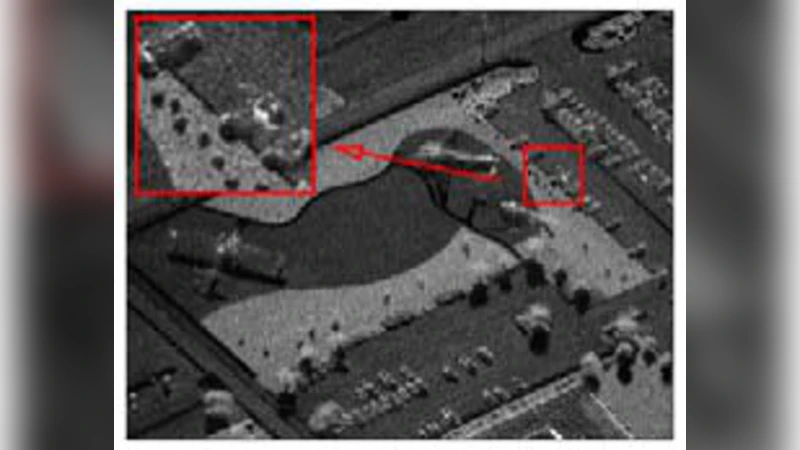
This paper presents a quadrature compressive sampling (QuadCS) and associated fast imaging scheme for synthetic aperture radar (SAR). Different from other analog-to-information conversions (AIC), QuadCS AICs using independent spreading signals sample the SAR echoes due to different transmitted pulses. Then the resulting sensing matrix has lower correlation between any two columns than that by a fixed spreading signal, and better SAR image can be reconstructed. With proper setting of the spreading signals in QuadCS, the sensing matrix has the structures suitable for fast computation of matrix-vector multiplication operations, which leads to the fast image reconstruction. The performance of the proposed scheme is assessed using real SAR image. The reconstructed SAR images with only one-fourth of the Nyquist data achieve the image quality similar to that of the classical SAR images with Nyquist samples.
💡 Research Summary
The paper introduces a novel analog‑to‑information conversion (AIC) scheme called Quadrature Compressive Sampling (QuadCS) for synthetic aperture radar (SAR) imaging, together with a fast reconstruction algorithm that exploits the special structure of the resulting sensing matrix. Traditional compressive SAR approaches typically employ a single, fixed pseudo‑random spreading waveform for all transmitted pulses. While this simplifies hardware, it yields a sensing matrix with high mutual coherence, which degrades the Restricted Isometry Property (RIP) and consequently limits reconstruction quality. Moreover, the lack of structure in the matrix forces each iteration of an ℓ₁‑based recovery algorithm to perform dense matrix‑vector multiplications, leading to prohibitive computational cost for large‑scale SAR scenes.
QuadCS departs from this paradigm by assigning two independent quadrature spreading signals, (s_{1,n}(t)) and (s_{2,n}(t)), to each pulse (n). These signals are designed to be orthogonal and randomly generated per pulse. The received echo (e_n(t)) is mixed with each spreading signal, low‑pass filtered, and sampled at a sub‑Nyquist rate, producing measurement vectors (y_n = \Phi_n x), where (x) denotes the vectorized SAR reflectivity map and (\Phi_n) is the pulse‑specific random matrix. Stacking all pulses gives a global sensing matrix (\Phi =
Comments & Academic Discussion
Loading comments...
Leave a Comment