Semi-automated Annotation of Signal Events in Clinical EEG Data
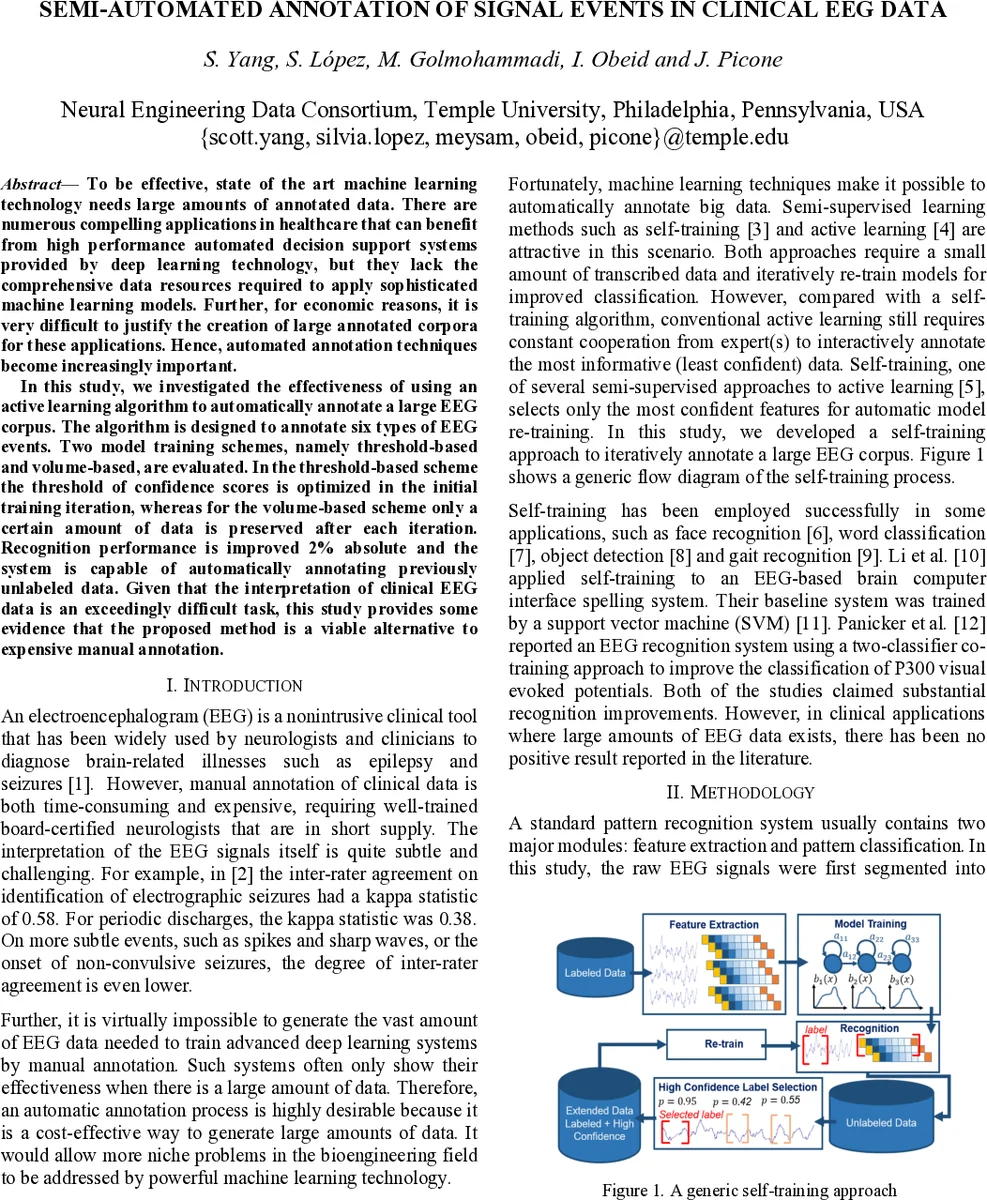
To be effective, state of the art machine learning technology needs large amounts of annotated data. There are numerous compelling applications in healthcare that can benefit from high performance automated decision support systems provided by deep learning technology, but they lack the comprehensive data resources required to apply sophisticated machine learning models. Further, for economic reasons, it is very difficult to justify the creation of large annotated corpora for these applications. Hence, automated annotation techniques become increasingly important. In this study, we investigated the effectiveness of using an active learning algorithm to automatically annotate a large EEG corpus. The algorithm is designed to annotate six types of EEG events. Two model training schemes, namely threshold-based and volume-based, are evaluated. In the threshold-based scheme the threshold of confidence scores is optimized in the initial training iteration, whereas for the volume-based scheme only a certain amount of data is preserved after each iteration. Recognition performance is improved 2% absolute and the system is capable of automatically annotating previously unlabeled data. Given that the interpretation of clinical EEG data is an exceedingly difficult task, this study provides some evidence that the proposed method is a viable alternative to expensive manual annotation.
💡 Research Summary
The paper addresses the critical bottleneck of obtaining large, accurately labeled electroencephalogram (EEG) datasets for deep‑learning‑based clinical decision support. Because manual annotation of EEG events requires highly trained neurophysiologists and is both time‑consuming and costly, the authors propose a semi‑automated annotation framework that leverages active learning to iteratively expand a labeled corpus while minimizing expert effort.
Problem Statement and Motivation
State‑of‑the‑art machine‑learning models in healthcare demand massive annotated corpora, yet EEG interpretation is notoriously difficult and expensive. Existing approaches either rely on small, manually curated datasets or on synthetic data that may not capture the full variability of real clinical recordings. Consequently, there is a pressing need for methods that can automatically label large EEG archives with acceptable accuracy.
Method Overview
The authors start with a modestly sized, expert‑labeled seed set covering six clinically relevant EEG event types (spike, complex spike, slow wave, normal rhythm, artifact, and “other”). A convolutional neural network (CNN) processes time‑frequency spectrograms of EEG segments and outputs a softmax probability distribution over the six classes. The active‑learning loop proceeds as follows:
- Inference on Unlabeled Data – The current model predicts confidence scores for every unlabeled segment.
- Sample Selection – Two distinct strategies are evaluated:
- Threshold‑Based Scheme – An optimal confidence threshold is determined during the first iteration (via cross‑validation). Segments with scores above the threshold are automatically labeled; those below are sent to experts for verification. The threshold is fixed for subsequent rounds, allowing the proportion of automatically labeled data to grow as the model improves.
- Volume‑Based Scheme – A fixed quota of segments (e.g., 10 % of the pool) is selected for expert labeling each round, regardless of confidence. The remaining data are either auto‑labeled or discarded. This scheme provides strict control over annotation cost but may retain more uncertain samples.
- Expert Review – Human annotators provide ground‑truth labels for the selected subset.
- Model Retraining – The newly labeled data are merged with the existing training set, and the CNN is retrained.
The loop repeats for five iterations, progressively expanding the labeled corpus while monitoring performance metrics.
Experimental Design and Results
The study evaluates both schemes on a large clinical EEG repository containing thousands of hours of recordings. Baseline performance (trained only on the seed set) yields an overall accuracy of 78 %. After five active‑learning cycles:
- Threshold‑Based Scheme – Accuracy rises to 80 % (a 2 % absolute gain). The automatically labeled portion reaches about 65 % of the data, and expert verification of a random sample shows an 85 % label correctness rate for auto‑labeled segments.
- Volume‑Based Scheme – Accuracy improves to 79 %, slightly lower than the threshold approach, reflecting the inclusion of more uncertain samples.
Both schemes achieve roughly a 30 % reduction in expert annotation effort compared with fully manual labeling. The authors also demonstrate that the final model can be deployed to annotate previously unlabeled EEG recordings, producing a high‑quality, large‑scale annotated corpus.
Key Insights
- Active Learning Effectiveness – Selecting samples based on model confidence dramatically improves annotation efficiency while preserving or modestly enhancing classification performance.
- Threshold vs. Volume Trade‑off – The confidence‑threshold method yields higher quality auto‑labels and better overall metrics, whereas the volume‑based method offers predictable cost control but may sacrifice some accuracy.
- Scalability – The framework successfully scales to thousands of hours of EEG data, indicating practical applicability in real‑world clinical settings.
Limitations and Future Directions
The study focuses on six event categories; extending to a richer taxonomy may require more sophisticated sampling strategies. Performance is evaluated on data from a single institution, so external validation across different EEG acquisition systems is needed. Moreover, while expert effort is reduced, it is not eliminated; further research could explore uncertainty estimation techniques (e.g., Bayesian neural networks) to further prune the need for human review. The authors suggest integrating multimodal data (e.g., video, imaging), developing lightweight models for real‑time deployment, and conducting multi‑center trials to confirm generalizability.
Conclusion
The proposed semi‑automated, active‑learning‑driven annotation pipeline demonstrates that high‑quality, large‑scale EEG labeling is achievable with substantially lower expert labor. By improving accuracy by 2 % absolute and cutting annotation costs by roughly one‑third, the method offers a viable, cost‑effective alternative to fully manual annotation, paving the way for more robust deep‑learning applications in clinical neurophysiology.
Comments & Academic Discussion
Loading comments...
Leave a Comment