Multipath interference analysis of IR-UWB systems in indoor office LOS environment
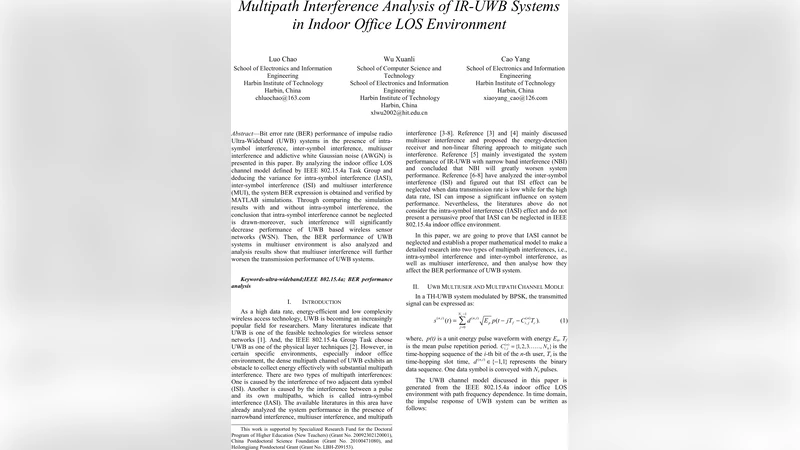
Bit error rate (BER) performance of impulse radio Ultra-Wideband (UWB) systems in the presence of intrasymbol interference, inter-symbol interference, multiuser interference and addictive white Gaussian noise (AWGN) is presented in this paper. By analyzing the indoor office LOS channel model defined by IEEE 802.15.4a Task Group and deducing the variance for intra-symbol interference (IASI), inter-symbol interference (ISI) and multiuser interference (MUI), the system BER expression is obtained and verified by MATLAB simulations. Through comparing the simulation results with and without intra-symbol interference, the conclusion that intra-symbol interference cannot be neglected is drawn-moreover, such interference will significantly decrease performance of UWB based wireless sensor networks (WSN). Then, the BER performance of UWB systems in multiuser environment is also analyzed and analysis results show that multiuser interference will further worsen the transmission performance of UWB systems.
💡 Research Summary
This paper presents a comprehensive analytical and simulation study of impulse‑radio ultra‑wideband (IR‑UWB) systems operating in the indoor office line‑of‑sight (LOS) environment defined by the IEEE 802.15.4a channel model. The authors first describe the channel in both time and frequency domains, modeling cluster arrivals as a Poisson process with rate Λ and ray arrivals within each cluster as a mixture of two Poisson processes with rates λ₁ and λ₂. Because λ₁ is negligible in the office LOS scenario, the ray arrival process is approximated by a single Poisson process with rate λ₂. The mean inter‑ray interval is calculated to be about 0.34 ns, which is shorter than typical pulse durations (0.5–2 ns), indicating that multiple rays from the same transmitted pulse can overlap and cause intra‑symbol interference (IASI). The mean inter‑cluster interval is about 62.5 ns, so the dominant interference originates from the first cluster.
A BPSK‑modulated pulse‑train transmission model is adopted, with each user employing a time‑hopping sequence. The received signal consists of the desired first‑ray component, IASI, inter‑symbol interference (ISI) from previous symbols, multi‑user interference (MUI) from other users, and additive white Gaussian noise (AWGN). By assuming Nakagami fading for ray amplitudes and using the autocorrelation function of the transmitted pulse, the authors derive closed‑form expressions for the variance of each interference term. IASI variance is obtained by integrating the product of the pulse autocorrelation and the ray arrival density over the first cluster. ISI variance is derived similarly, replacing the energy of the desired ray with the sum of energies of the first rays of all interfering symbols (ΣΩ). MUI variance follows the same pattern, with an additional delay term uₜ representing the relative offset of other users.
The signal‑to‑interference‑plus‑noise ratio (SINR) is expressed as
SINR = E_b / (σ²_IASI + σ²_ISI + σ²_MUI + σ²_AWGN)
and the bit error rate (BER) for BPSK is given by the Q‑function:
BER = Q(√(2·SINR)).
Simulation settings use a second‑order Gaussian pulse with 0.5 ns duration (10 dB bandwidth 5.6 GHz), hop width equal to the pulse duration, and 16 hops per symbol. Two data rates (1 Mbps and 15 Mbps) and four user counts (1, 2, 4, 8) are evaluated. Results show that neglecting IASI leads to a significant under‑estimation of BER, especially at the higher data rate where IASI dominates and pushes BER to the order of 10⁻⁴. ISI has negligible impact at 1 Mbps, behaving almost like an AWGN channel. Multi‑user scenarios reveal that MUI further degrades performance, with BER increasing sharply as the number of simultaneous users grows. The analytical curves match the simulated ones closely, confirming the validity of the derived expressions. The slight discrepancy (analysis predicting slightly worse BER) is attributed to two simplifications: (1) the use of an infinite‑duration Gaussian pulse in the derivations, which introduces more interference than the truncated pulse used in simulation; and (2) modeling ray arrivals with a single Poisson process (λ₂) rather than the true mixture, which overestimates ray density.
The study’s key contributions are: (i) a rigorous proof that IASI cannot be ignored in IEEE 802.15.4a indoor office LOS channels; (ii) closed‑form variance formulas for IASI, ISI, and MUI; (iii) validation of the analytical BER model against extensive MATLAB simulations; and (iv) insight that system designers of UWB‑based wireless sensor networks must consider pulse width, transmission rate, and user density to mitigate IASI and MUI, possibly through pulse shaping, equalization, or optimized time‑hopping strategies.
Comments & Academic Discussion
Loading comments...
Leave a Comment