Core-exsolved SiO$_2$ dispersal in the Earths mantle
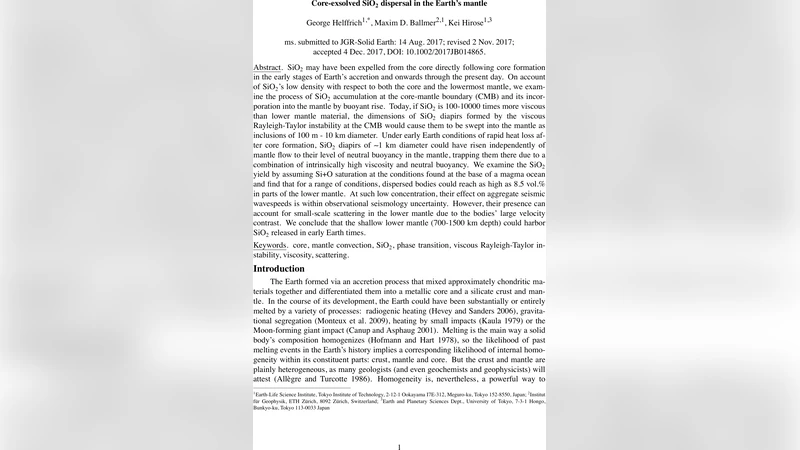
SiO$_2$ may have been expelled from the core directly following core formation in the early stages of Earth’s accretion and onwards through the present day. On account of SiO$_2$’s low density with respect to both the core and the lowermost mantle, we examine the process of SiO$_2$ accumulation at the core-mantle boundary (CMB) and its incorporation into the mantle by buoyant rise. Today, if SiO$_2$ is 100-10000 times more viscous than lower mantle material, the dimensions of SiO$_2$ diapirs formed by the viscous Rayleigh-Taylor instability at the CMB would cause them to be swept into the mantle as inclusions of 100 m - 10 km diameter. Under early Earth conditions of rapid heat loss after core formation, SiO$_2$ diapirs of ~1 km diameter could have risen independently of mantle flow to their level of neutral buoyancy in the mantle, trapping them there due to a combination of intrinsically high viscosity and neutral buoyancy. We examine the SiO$_2$ yield by assuming Si+O saturation at the conditions found at the base of a magma ocean and find that for a range of conditions, dispersed bodies could reach as high as 8.5 vol.% in parts of the lower mantle. At such low concentration, their effect on aggregate seismic wavespeeds is within observational seismology uncertainty. However, their presence can account for small-scale scattering in the lower mantle due to the bodies’ large velocity contrast. We conclude that the shallow lower mantle (700-1500 km depth) could harbor SiO$_2$ released in early Earth times.
💡 Research Summary
The paper investigates a previously under‑explored source of heterogeneity in Earth’s lower mantle: the exsolution of silica (SiO₂) from the cooling metallic core. Recent high‑pressure experiments have shown that silicon can dissolve appreciably in liquid iron at core‑forming conditions, and as the core cools it becomes supersaturated in Si. The excess Si then incorporates dissolved oxygen and precipitates as solid SiO₂, which is less dense than both liquid iron and the surrounding silicate mantle. Consequently, SiO₂ accumulates in a thin layer at the core‑mantle boundary (CMB).
Using a three‑dimensional formulation of the Rayleigh‑Taylor (RT) instability (Ribe 1998) the authors calculate the critical layer thickness (b_crit) at which the SiO₂ layer becomes buoyantly unstable and detaches as diapirs. The growth rate depends on the rate of SiO₂ production, which is linked to the core cooling rate (≈100 K Gyr⁻¹) and the temperature derivative of Si concentration in the core (dc/dT≈4.1×10⁻⁵ kg kg⁻¹ K⁻¹). For present‑day conditions, assuming SiO₂ viscosity 10²–10⁴ times that of the lower mantle, the instability produces diapirs ranging from 100 m to 10 km in diameter. In the early Earth, with faster cooling and higher Si production, the characteristic diapir size is about 1 km.
Once detached, diapirs rise according to Stokes flow, v = (2/9)Δρ g a²/μ_m, where Δρ is the density contrast, a the diapir radius, and μ_m the mantle viscosity. Because the viscosity contrast is large, the ascent speed is governed mainly by diapir size and density contrast, not by absolute mantle viscosity. Early‑Earth diapirs could ascend independently of mantle convection and become trapped at a neutral‑buoyancy depth of roughly 1500–1600 km, where their density matches that of the surrounding mantle.
The authors then estimate the total volume fraction of SiO₂ that could be dispersed throughout the lower mantle. By applying a third‑order Birch‑Murnaghan equation of state for SiO₂ and assuming Si+O saturation at the base of a magma ocean, they find that up to 8.5 vol.% SiO₂ could be present in localized regions. Such a concentration would alter bulk seismic velocities by less than 1 %, which lies within the uncertainty of current seismic models, explaining why the bulk mantle velocity structure does not reveal this component.
Nevertheless, the elastic contrast between SiO₂ (especially across the stishovite → CaCl₂ polymorphic transition, which softens the shear modulus) and the surrounding mantle is large enough to cause significant small‑scale scattering of seismic waves. Observational seismology has identified enhanced scattering in the 700–1500 km depth range, with characteristic heterogeneity scales of a few kilometers—precisely the size range predicted for SiO₂ diapirs. The paper therefore proposes that these scattered bodies are the physical manifestation of core‑derived SiO₂.
In summary, the study presents a coherent physical model linking core cooling, SiO₂ exsolution, Rayleigh‑Taylor instability, diapir ascent, and neutral‑buoyancy trapping to explain a plausible source of lower‑mantle heterogeneity. It suggests that the shallow lower mantle (700–1500 km depth) may host a dispersed population of SiO₂ bodies that, while not affecting bulk seismic velocities appreciably, are responsible for observed small‑scale seismic scattering. This mechanism provides an internal, non‑subduction‑related contributor to mantle heterogeneity and has implications for interpreting mantle dynamics, chemical reservoirs, and the long‑term evolution of Earth’s interior.
Comments & Academic Discussion
Loading comments...
Leave a Comment