Simple sampling clock synchronisation scheme for reduced-guard-interval coherent optical OFDM systems
A simple data-aided scheme for sampling clock synchronisation in reduced-guard-interval coherent optical orthogonal frequency division multiplexing (RGI-CO-OFDM) systems is proposed. In the proposed scheme, the sampling clock offset (SCO) is estimated by using the training symbols reserved for channel estimation, thus avoiding extra training overhead. The SCO is then compensated by resampling, using a time-domain interpolation filter. The feasibility of the proposed scheme is demonstrated by means of numerical simulations in a 32-Gbaud 16-QAM dual-polarisation RGI-CO-OFDM system.
💡 Research Summary
**
The paper addresses the critical issue of sampling‑clock synchronization in reduced‑guard‑interval coherent optical OFDM (RGI‑CO‑OFDM) systems, which are attractive for high‑capacity, long‑haul transmission because of their spectral efficiency and robustness to chromatic dispersion and polarization‑mode dispersion. A sampling‑clock offset (SCO) between the digital‑to‑analog converter (DAC) at the transmitter and the analog‑to‑digital converter (ADC) at the receiver introduces a linear phase rotation across both sub‑carriers and OFDM symbols, leading to amplitude loss, phase distortion, and inter‑carrier interference (ICI). Existing solutions either rely on manual hardware adjustments, a common external reference clock, or the transmission of a dedicated clock signal—approaches that are impractical for real‑world, physically separated transceivers. A prior DSP‑based method by Yi and Qiu suffers from large estimation errors (5 %–300 %).
The authors propose a simple data‑aided scheme that exploits the training symbols already reserved for channel estimation, thereby avoiding any extra training overhead. By analyzing the received training symbols after FFT, the linear phase rotation caused by SCO can be observed. A least‑squares (LS) fit of the phase versus sub‑carrier index yields the phase‑slope α, which is directly related to the SCO value. The estimated SCO is then fed back to a time‑domain interpolation filter that resamples the received waveform, effectively compensating the clock mismatch. Only a single feedback loop is required, keeping computational complexity low.
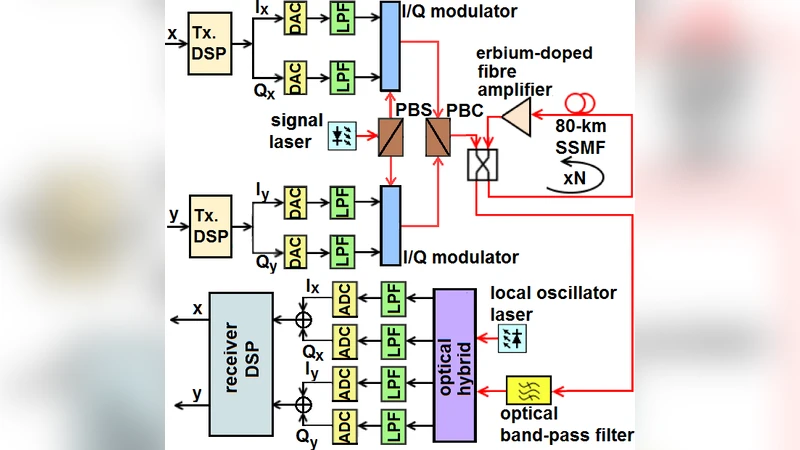
A comprehensive simulation environment was built: the optical link was modeled in VPI TransmissionMaker, while all digital signal processing (DSP) was performed in MATLAB. The transmitter generated a 32‑Gbaud dual‑polarization 16‑QAM RGI‑CO‑OFDM signal with 512‑point IFFT, 46‑sample cyclic prefix, and 412 data sub‑carriers. A de‑Bruijn sequence provided the data payload, and a pair of correlated training symbols were used for both channel estimation and SCO estimation. The link comprised 800 km of standard single‑mode fiber (SSMF) in a recirculating loop with a 16‑dB erbium‑doped fiber amplifier (EDFA) and a 0.8‑nm optical band‑pass filter. At the receiver, a local oscillator with 100 kHz linewidth and 5 GHz offset was used, and the ADC sampled at rates ranging from 39.992 GSa/s to 40.008 GSa/s, emulating SCO values from –200 ppm to +200 ppm (the industry‑standard limit).
Results show that the phase rotation indeed grows linearly with both symbol index and sub‑carrier index, confirming the theoretical model. The proposed LS‑based SCO estimator achieves a markedly lower estimation error than the Yi‑Qiu method across a wide OSNR range (18 dB–26 dB). When the estimated SCO is compensated via resampling, the bit‑error‑rate (BER) curves for all SCO values overlap, indicating virtually no OSNR penalty (≤0.1 dB). In contrast, without compensation, even a modest SCO of ±200 ppm leads to severe BER degradation due to increased ICI.
In conclusion, the paper introduces a practical, low‑complexity, and hardware‑free method for sampling‑clock synchronization in RGI‑CO‑OFDM systems. By leveraging existing training symbols, the scheme can correct up to the standard 200 ppm SCO with negligible OSNR impact, making it highly suitable for deployment in real coherent optical communication networks where separate transmitter and receiver clocks are the norm.
Comments & Academic Discussion
Loading comments...
Leave a Comment