Joint timing and frequency synchronization based on weighted CAZAC sequences for reduced-guard-interval CO-OFDM systems
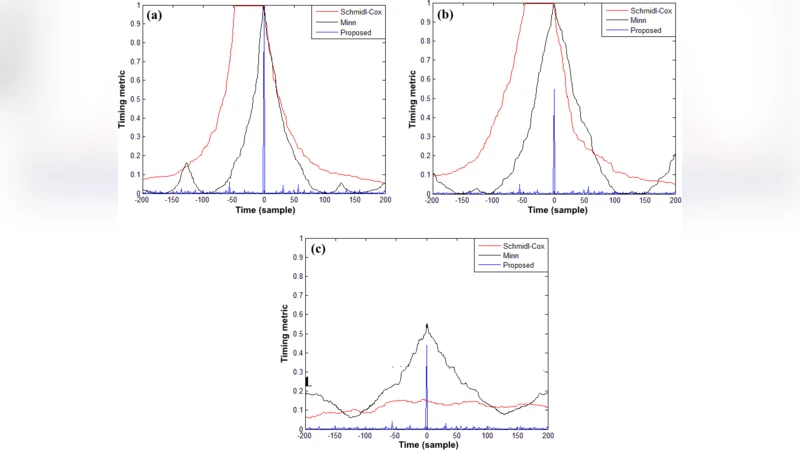
A novel joint symbol timing and carrier frequency offset (CFO) estimation algorithm is proposed for reduced-guard-interval coherent optical orthogonal frequency-division multiplexing (RGI-CO-OFDM) systems. The proposed algorithm is based on a constant amplitude zero autocorrelation (CAZAC) sequence weighted by a pseudo-random noise (PN) sequence. The symbol timing is accomplished by using only one training symbol of two identical halves, with the weighting applied to the second half. The special structure of the training symbol is also utilized in estimating the CFO. The performance of the proposed algorithm is demonstrated by means of numerical simulations in a 115.8-Gb/s 16-QAM RGI-CO-OFDM system.
💡 Research Summary
**
This paper addresses the critical problem of joint timing and carrier frequency offset (CFO) synchronization in reduced‑guard‑interval coherent optical OFDM (RGI‑CO‑OFDM) systems, which are increasingly important for high‑speed long‑haul fiber links. Conventional CO‑OFDM relies on a relatively long cyclic prefix (CP) to absorb inter‑symbol interference (ISI) caused by chromatic dispersion (CD) and polarization‑mode dispersion (PMD). In RGI‑CO‑OFDM the CP is dramatically shortened, and CD is compensated in the digital frequency domain at the receiver. While this improves spectral efficiency, the reduced guard interval makes the system far more sensitive to timing errors and CFO, which can cause severe inter‑carrier interference (ICI).
Training‑symbol design
The authors propose a novel training symbol consisting of two identical halves, each of length M samples. Both halves are generated by an M‑point inverse FFT of a constant‑amplitude zero‑autocorrelation (CAZAC) sequence. The first half (MA) is transmitted unchanged, while the second half (MB) is multiplied element‑wise by a real‑valued pseudo‑random noise (PN) sequence of ±1 values. This weighting scrambles the second half, destroying the flat plateau that appears in the classic Schmidl‑Cox timing metric, while still preserving the perfect autocorrelation property of the underlying CAZAC sequence. At the receiver the PN sequence is known and can be removed before further processing. Only a single training symbol is required, resulting in an overhead of roughly 2 % of the transmitted frame.
Timing synchronization
The timing metric is defined as
\
Comments & Academic Discussion
Loading comments...
Leave a Comment