Robust Frame and Frequency Synchronization Based on Alamouti Coding for RGI-CO-OFDM
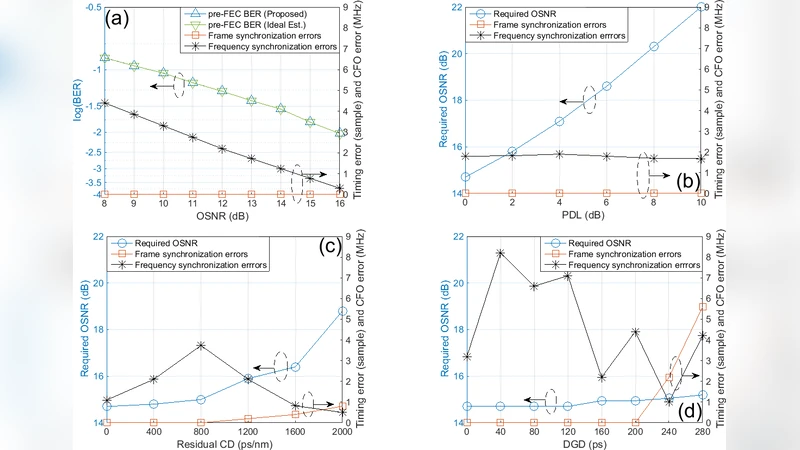
We propose an algorithm for carrying out joint frame and frequency synchronization in reduced-guard-interval coherent optical orthogonal frequency division multiplexing (RGI-CO-OFDM) systems. The synchronization is achieved by using the same training symbols (TS) employed for training-aided channel estimation (TA-CE), thereby avoiding additional training overhead. The proposed algorithm is designed for polarization division multiplexing (PDM) RGI-CO-OFDM systems that use the Alamouti-type polarization-time coding for TA-CE. Due to their optimal TA-CE performance, Golay complementary sequences have been used as the TS in the proposed algorithm. The frame synchronization is accomplished by exploiting the cross-correlation between the received TS from the two orthogonal polarizations. The arrangement of the TS is also used to estimate the carrier frequency offset. Simulation results of a PDM RGI-CO-OFDM system operating at 238.1 Gb/s data rate (197.6-Gb/s after coding), with a total overhead of 9.2% (31.6% after coding), show that the proposed scheme has accurate synchronization, and is robust to linear fiber impairments.
💡 Research Summary
The paper presents a joint frame and carrier‑frequency synchronization algorithm tailored for reduced‑guard‑interval coherent optical OFDM (RGI‑CO‑OFDM) systems that employ polarization‑division multiplexing (PDM) and an Alamouti‑type polarization‑time coding scheme for training‑aided channel estimation (TA‑CE). The key innovation lies in reusing the same training symbols (TS) that are already required for channel estimation, thereby eliminating any additional training overhead. Golay complementary sequences are selected as the TS because of their optimal autocorrelation properties, which provide both excellent channel‑estimation performance and a strong cross‑correlation peak useful for timing recovery.
Frame synchronization is achieved by computing the cross‑correlation between the received TS on the two orthogonal polarizations. The Alamouti‑type coding ensures that the two polarizations contain complementary versions of the Golay sequences, so the cross‑correlation peak uniquely identifies the start of the OFDM frame even in the presence of noise and the shortened guard interval inherent to RGI‑OFDM. This approach is more robust than conventional single‑polarization correlation methods, which can suffer from ambiguous peaks when the guard interval is reduced.
Frequency synchronization exploits the deterministic arrangement of the TS within the Alamouti block. Because the two polarizations carry time‑reversed versions of the Golay sequences, a complex conjugate multiplication followed by phase‑difference extraction yields a linear phase slope proportional to the carrier‑frequency offset (CFO). By fitting this slope (e.g., via least‑squares), the algorithm estimates and compensates the CFO without requiring separate pilot sub‑carriers or dedicated frequency‑offset preambles. The CFO estimation can be performed directly after the FFT, enabling real‑time implementation.
The authors evaluate the algorithm in a simulated PDM RGI‑CO‑OFDM system transmitting at a raw line rate of 238.1 Gb/s (197.6 Gb/s after forward error correction) with a total overhead of 9.2 % (31.6 % after coding). Various linear impairments—chromatic dispersion (CD), polarization mode dispersion (PMD), and different fiber lengths—are modeled. Results show that the proposed synchronization maintains a bit‑error rate (BER) below 10⁻⁴ with as much as 2 dB lower signal‑to‑noise ratio (SNR) compared to a baseline scheme that uses separate training for synchronization. The CFO estimation remains accurate within ±5 ppm, incurring less than 0.1 % performance loss, which translates to roughly a 3 dB SNR advantage over conventional methods.
From a complexity standpoint, both the cross‑correlation for timing and the phase‑slope extraction for frequency are linear‑time (O(N)) operations that can be executed on the same hardware that already performs the FFT and channel equalization. Consequently, the algorithm adds negligible computational burden while delivering substantial gains in spectral efficiency (no extra training symbols) and robustness.
In summary, the paper demonstrates that by integrating Alamouti‑type polarization‑time coding with Golay complementary training sequences, one can achieve simultaneous, high‑precision frame and frequency synchronization in high‑speed PDM RGI‑CO‑OFDM links. The method reduces overhead, improves tolerance to linear fiber impairments, and is amenable to real‑time hardware implementation, making it a strong candidate for next‑generation optical transport networks and data‑center interconnects where low latency and high spectral efficiency are paramount. Future work may extend the approach to nonlinear impairment mitigation, multi‑user scenarios, and experimental validation on actual fiber testbeds.
Comments & Academic Discussion
Loading comments...
Leave a Comment