Bandwidth-Efficient Synchronization for Fiber Optic Transmission: System Performance Measurements
In this article, we first provide a brief overview of optical transmission systems and some of their performance specifications. We then present a simple, robust, and bandwidth-efficient OFDM synchronization method, and carry out measurements to validate the presented synchronization method with the aid of an experimental setup.
💡 Research Summary
The paper addresses a critical challenge in modern coherent optical OFDM (CO‑OFDM) super‑channel systems: achieving reliable synchronization while preserving bandwidth efficiency. Conventional approaches often require separate training symbols for frame detection, carrier frequency offset (CFO) estimation, and sampling clock offset (SCO) compensation, leading to increased overhead, limited estimation ranges, and higher computational complexity. To overcome these limitations, the authors propose a unified synchronization scheme that uses the same Golay complementary sequences (GCS) as training symbols for all three tasks. The GCS are arranged in an Alamouti space‑time block coding fashion, providing two training symbols per polarization in a polarization‑division‑multiplexed (PDM) system. Because Golay pairs possess perfect complementary autocorrelation, the timing metric derived from their autocorrelation exhibits an impulse‑shaped peak with negligible sidelobes, enabling precise frame start detection.
Once the frame start is identified, fractional CFO is estimated using the standard method based on the phase of the autocorrelation peak, while integer CFO is obtained by cross‑correlating the frequency‑domain representation of the first received training symbol with the sum of the original Golay symbols. The total CFO estimate (fractional plus integer) is compensated by multiplying the received time‑domain samples with the inverse rotation factor.
SCO estimation exploits the linear phase rotation introduced by a sampling‑rate mismatch across OFDM subcarriers and symbols. By computing the phase difference between received and transmitted training symbols and performing a linear regression, the slope corresponding to SCO is extracted. This estimate feeds a time‑domain interpolation block that resamples the signal, effectively correcting the clock mismatch; residual SCO can be eliminated through iterative feedback.
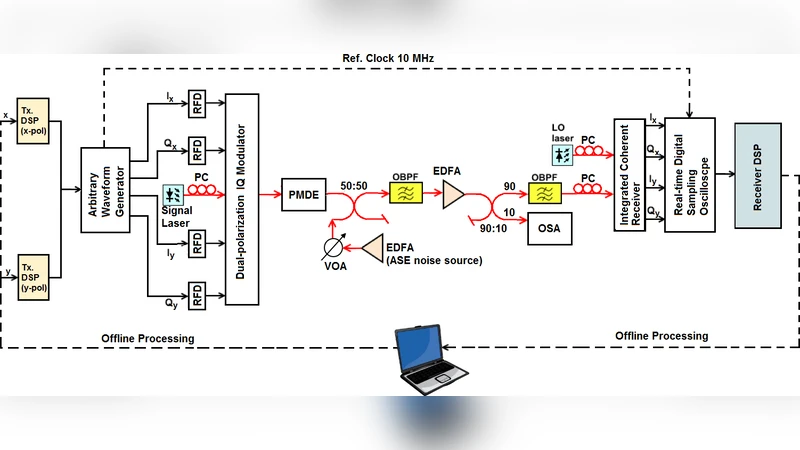
The authors validate the method experimentally on a PDM 16‑QAM CO‑OFDM testbed. The transmitter generates a 512‑point IFFT signal with a 46‑sample cyclic prefix; 416 subcarriers carry data, while the remaining are reserved for pilots, DC, and oversampling. The signal is uploaded to a Tektronix AWG (25 GSa/s, 9‑bit DAC), amplified, and modulated onto a 30‑GHz dual‑polarization IQ modulator driven by a narrow‑linewidth tunable laser (≈10 kHz). A PMD emulator introduces controlled polarization‑mode‑dispersion delays, and ASE noise is injected via an EDFA to vary the optical signal‑to‑noise ratio (OSNR). The received optical signal is detected by a coherent receiver with a 10‑kHz local oscillator, digitized by a 50 GS/s oscilloscope, and processed offline in MATLAB.
Key experimental conditions include a CFO of 2.5 GHz, an SCO of 160 ppm, OSNR values down to 15 dB, and PMD‑induced delays up to 280 ps. Results show that both the timing metric and the integer‑CFO metric retain sharp impulse shapes, delivering accurate peaks even under severe impairments. Frame synchronization exhibits zero errors across all OSNR levels, while the mean‑square error (MSE) of CFO estimation remains below 6.7 × 10⁻³ (≈4 MHz error). The OSNR penalty required to achieve a target BER of 1.8 × 10⁻² (compatible with forward error correction) increases by at most 0.5 dB for the largest PMD delay tested, demonstrating strong robustness to polarization effects.
Overall, the proposed joint synchronization approach achieves three major benefits: (1) it eliminates the need for multiple distinct training sequences, thereby preserving spectral efficiency; (2) it offers wide CFO estimation range and accurate SCO compensation with modest computational load; and (3) it maintains high performance in realistic impairment scenarios (ASE noise, CFO, SCO, PMD). The experimental validation confirms that the method is practical for deployment in next‑generation high‑capacity coherent optical networks, where bandwidth efficiency and low‑cost implementation are paramount. Future work may explore scaling to higher‑order modulation formats, longer transmission distances, and real‑time DSP implementation.
Comments & Academic Discussion
Loading comments...
Leave a Comment