Motifs in Temporal Networks
Networks are a fundamental tool for modeling complex systems in a variety of domains including social and communication networks as well as biology and neuroscience. Small subgraph patterns in networks, called network motifs, are crucial to understanding the structure and function of these systems. However, the role of network motifs in temporal networks, which contain many timestamped links between the nodes, is not yet well understood. Here we develop a notion of a temporal network motif as an elementary unit of temporal networks and provide a general methodology for counting such motifs. We define temporal network motifs as induced subgraphs on sequences of temporal edges, design fast algorithms for counting temporal motifs, and prove their runtime complexity. Our fast algorithms achieve up to 56.5x speedup compared to a baseline method. Furthermore, we use our algorithms to count temporal motifs in a variety of networks. Results show that networks from different domains have significantly different motif counts, whereas networks from the same domain tend to have similar motif counts. We also find that different motifs occur at different time scales, which provides further insights into structure and function of temporal networks.
💡 Research Summary
The paper addresses a fundamental gap in the analysis of dynamic systems: while static network motifs have been extensively studied and are known to reveal structural and functional properties of complex systems, there is no comparable framework for temporal networks, where edges carry timestamps and the order and timing of interactions matter. The authors introduce the notion of a δ‑temporal motif, defined as a sequence of l timestamped directed edges that (i) respects a strict temporal order (t₁ < t₂ < … < t_l), (ii) occurs within a bounded time window of length δ (t_l − t₁ ≤ δ), and (iii) induces a connected static subgraph on k nodes. This definition simultaneously captures edge ordering, concurrency, and the temporal scale of interaction patterns, extending the classic static motif concept.
The core technical contribution is a suite of algorithms for exactly counting the occurrences of any given δ‑temporal motif in a large temporal graph. The general framework proceeds in three steps: (1) identify all instances of the static skeleton H of the motif within the underlying static graph G; (2) for each static instance H₀, collect the temporally ordered edges between the involved node pairs into a single sequence S₀; (3) count all subsequences of S₀ that match the motif and lie inside a sliding window of length δ. The counting in step 3 is performed by a dynamic‑programming‑based sliding‑window algorithm that maintains auxiliary counters for every prefix of the motif. As the window advances, counters are incremented for new edges and decremented for edges that fall outside the window, guaranteeing that each edge is processed only once. Consequently, for motifs with a constant number of edges, the algorithm runs in O(m) time, where m is the total number of temporal edges, and uses space proportional to the number of distinct prefixes (which is modest for small l).
Beyond the general method, the authors design specialized, faster procedures for two important families of three‑node, three‑edge motifs: star motifs (one central node connected to two others) and triangle motifs (three nodes forming a directed triangle). For star motifs the algorithm remains linear in m by grouping edges incident to each potential center and applying the same sliding‑window technique. For triangle motifs, a naïve approach would enumerate each static triangle (τ of them) and apply the general algorithm, leading to O(τ·m) time. The paper’s novel triangle‑counting algorithm exploits the fact that many temporal edges belong to multiple triangles and aggregates counts across all triangles simultaneously, achieving a worst‑case bound of O(√τ·m). This represents a substantial theoretical improvement and translates into dramatic practical speedups.
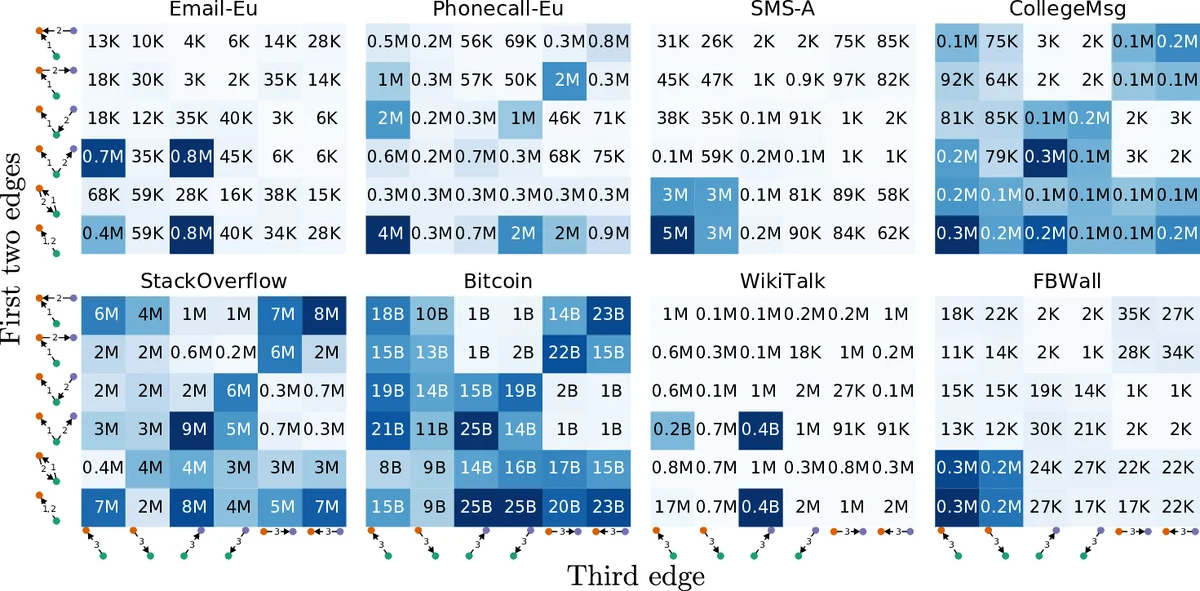
The experimental evaluation spans eight real‑world datasets, including email logs, SMS records, Facebook wall posts, Stack Overflow Q&A interactions, and private instant‑messaging streams. The authors first validate the correctness of their implementations against brute‑force baselines on small graphs, then demonstrate scalability on a massive network containing over two billion temporal edges. Their optimized triangle‑counting routine is up to 56.5× faster than a competitive baseline, completing in a few hours where the baseline would take days.
Analysis of motif frequencies reveals domain‑specific interaction styles. Text messaging and Facebook wall posting are dominated by “blocking” motifs, where a user communicates with a single partner at a time, whereas email exhibits “non‑blocking” motifs, reflecting the ability to send multiple messages to different recipients in rapid succession. Private instant‑messaging shows a mixture of both behaviors. By varying δ (30 minutes vs. 60 minutes), the authors uncover temporal scales at which certain patterns emerge: for instance, question‑answer motifs on Stack Overflow typically require at least 30 minutes to form, suggesting a characteristic response latency. Moreover, star motifs in private messaging increase in frequency from 1 to 20 minutes, peak, and then decline, indicating a bursty communication pattern.
In summary, the paper makes four major contributions: (1) a rigorous definition of δ‑temporal motifs that integrates ordering and time‑window constraints; (2) a general, linear‑time counting algorithm based on dynamic programming and sliding windows; (3) specialized, sub‑linear algorithms for star and triangle motifs that dramatically improve performance on realistic data; and (4) an extensive empirical study demonstrating that motif counts are discriminative across domains and informative about the temporal dynamics of interaction. The work opens new avenues for temporal network analysis, including anomaly detection, predictive modeling of dynamic processes, and the design of generative models that respect observed motif distributions. Future extensions could incorporate edge attributes (e.g., weights, colors), handle non‑unique timestamps, or adapt the framework to streaming settings where motifs must be counted in real time.
Comments & Academic Discussion
Loading comments...
Leave a Comment