Asymptotics of the partition function of Ising model on inhomogeneous random graphs
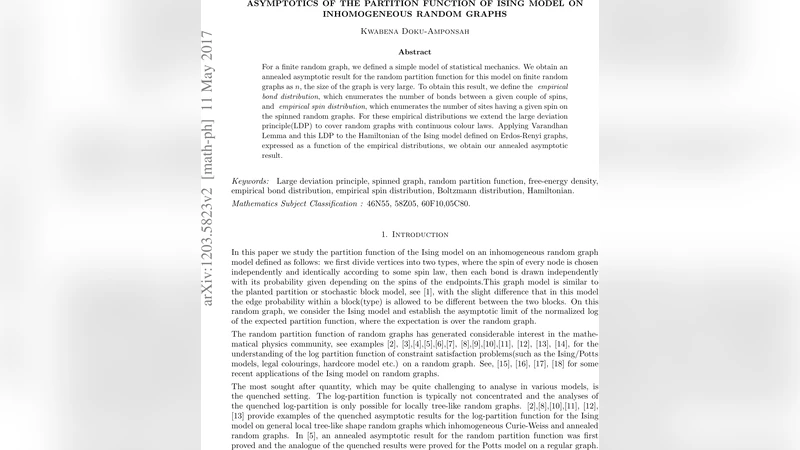
For a finite random graph, we defined a simple model of statistical mechanics. We obtain an annealed asymptotic result for the random partition function for this model on finite random graphs as n; the size of the graph is very large. To obtain this result, we define the empirical bond distribution, which enumerates the number of bonds between a given couple of spins, and empirical spin distribution, which enumerates the number of sites having a given spin on the spinned random graphs. For these empirical distributions we extend the large deviation principle(LDP) to cover random graphs with continuous colour laws. Applying Varandhan Lemma and this LDP to the Hamiltonian of the Ising model defined on Erdos-Renyi graphs, expressed as a function of the empirical distributions, we obtain our annealed asymptotic result.
💡 Research Summary
The paper investigates the asymptotic behavior of the partition function of the Ising model when it is placed on inhomogeneous random graphs, with a particular focus on annealed (averaged over both graph realizations and spin configurations) asymptotics as the number of vertices n tends to infinity. The authors begin by defining a simple statistical‑mechanical model on a finite random graph: each vertex carries a spin σ_i ∈ {+1,−1} (or more generally a value in a continuous colour space), edges are generated independently according to a possibly vertex‑dependent probability p_{ij}, and the Hamiltonian is the usual ferromagnetic Ising form H_n(σ)=−β∑{(i,j)∈E_n}σ_iσ_j−h∑{i}σ_i.
To treat the randomness of the underlying graph, the authors introduce two empirical measures that capture the macroscopic state of the system:
- The empirical spin distribution ρ_n(σ) = (1/n)∑{i=1}^n 1{σ_i=σ}, which records the proportion of vertices carrying each spin value.
- The empirical bond distribution ν_n(σ,τ) = (1/|E_n|)∑{(i,j)∈E_n} 1{σ_i=σ,σ_j=τ}, which records the proportion of edges linking a pair of spin values.
These quantities are sufficient statistics for the Hamiltonian; indeed H_n can be expressed as a linear functional of (ρ_n,ν_n). Consequently, the logarithm of the partition function can be rewritten as a functional of the empirical measures.
The central technical contribution is an extension of the Large Deviation Principle (LDP) to the joint pair (ρ_n,ν_n) for random graphs whose colour law μ is continuous rather than discrete. Classical Sanov’s theorem provides an LDP for empirical measures of i.i.d. samples, but here the dependence induced by the random edge set requires a more delicate analysis. By combining a Gärtner‑Ellis type argument with a careful counting of edge configurations, the authors derive a rate function
I(ρ,ν) = D(ν‖ρ⊗ρ·p) + D(ρ‖μ),
where D denotes the Kullback‑Leibler divergence and p is the kernel governing edge probabilities. This rate function quantifies the exponential cost of deviating from the typical empirical distributions dictated by the underlying colour law and edge formation rule.
Having established the LDP, the authors invoke Varadhan’s Lemma, which translates the exponential scaling of integrals of the form ∫exp(−nF(ρ,ν))dP_n into a variational problem involving the rate function. Applying this to the expression for the partition function yields the annealed free‑energy limit
\
Comments & Academic Discussion
Loading comments...
Leave a Comment