Power generation and distribution remains an important topic of discussion since the industrial revolution. As the system continues to grow, it needs to evolve both in infrastructure, robustness and its resilience to deal with failures. One such potential failure that we target in this work is the cascading failure. This avalanche effect propagates through the network and we study this propagation by Percolation Theory and implement some solutions for mitigation. We have extended the percolation theory as given in Mark Newman. Networks: an introduction,for random nodes to targeted nodes having high load bearing which is eliminated from the network to study the cascade effect. We also implement mitigation strategy to improve the network performance.
Deep Dive into Power Plexus: A network based analysis.
Power generation and distribution remains an important topic of discussion since the industrial revolution. As the system continues to grow, it needs to evolve both in infrastructure, robustness and its resilience to deal with failures. One such potential failure that we target in this work is the cascading failure. This avalanche effect propagates through the network and we study this propagation by Percolation Theory and implement some solutions for mitigation. We have extended the percolation theory as given in Mark Newman. Networks: an introduction,for random nodes to targeted nodes having high load bearing which is eliminated from the network to study the cascade effect. We also implement mitigation strategy to improve the network performance.
Power Plexus: A network based analysis
Malvika Singh
DA-IICT
Gandhinagar, India.
20140 142 8@ daiict.ac.in
Sneha Mandan
DA-IICT
Gandhinagar, India
20140 142 2@ daiict.ac.in
Smriti Sharma
DA-IICT
Gandhinagar, India
20140 100 3@ daiict.ac.in
Abstract—Power generation and distribution remains an im-
portant topic of discussion since the industrial revolution. As the
system continues to grow, it needs to evolve both in infrastructure,
robustness and its resilience to deal with failures. One such
potential failure that we target in this work is the cascading
failure. This avalanche effect propagates through the network and
we study this propagation by Percolation Theory and implement
some solutions for mitigation. We have extended the percolation
theory as given in [1] for random nodes to targeted nodes having
high load bearing which is eliminated from the network to study
the cascade effect. We also implement mitigation strategy to
improve the network performance.
I.
INTRODUCTION
Cascading failures have tremendous impact on power grid
networks. When the failure of a few nodes triggers the failure
of other nodes which in turn cause the failure of other large
number of nodes, it results in complete failure of power
system. While some of such failures are smaller in magnitude
because their growth is checked, in other cases it causes
avalanche mechanisms. This was evident in the power failure
mishap of 10th August 1996 [2], [3], when a 1300 Mega
Watts electrical line in Oregon had failed and a chain reaction
started which culminated in loss of power to more than 4
million people in 11+ states. This is also suspected to be
the reason behind the last major power failure in the United
States on August 14, 2003. Moreover, the redistribution of the
power after failure of certain nodes leads to congestion and
bottlenecks in the network as has been in the case of Internet
congestion collapse, first recorded officially in October 1986,
when the speed of connection between Lawrence Berkeley
Laboratory and the University of Berkeley, two spots separated
by a distance of 200m suffered a decline by a factor of
100 [2]. There have been works regarding the mitigation of
such blackouts by considering inter-dependent networks of
communication and network topology [4]. Other works include
studying actual electromagnetic constructions and applications
that go in power generation and transmission. However, such
detailed analysis are extremely difficult to scale to networks
of sizes having thousands of nodes. In our analysis, we have
followed two approaches (i) Network performance based on
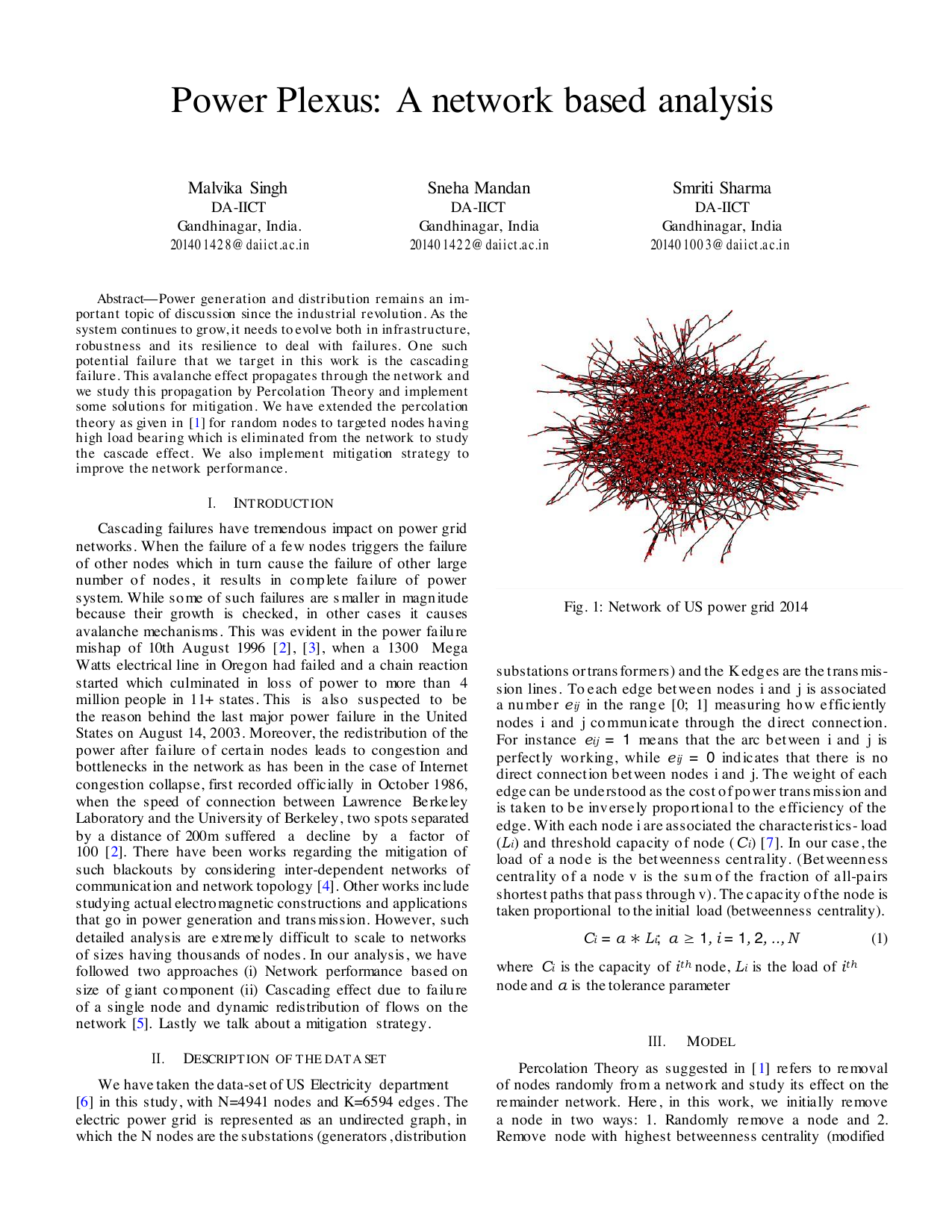
Fig. 1: Network of US power grid 2014
substations or transformers) and the K edges are the transmis-
sion lines. To each edge between nodes i and j is associated
a number eij in the range [0; 1] measuring how efficiently
nodes i and j communicate through the direct connection.
For instance eij = 1 means that the arc between i and j is
perfectly working, while eij = 0 indicates that there is no
direct connection between nodes i and j. The weight of each
edge can be understood as the cost of power transmission and
is taken to be inversely proportional to the efficiency of the
edge. With each node i are associated the characteristics- load
(Li) and threshold capacity of node (Ci) [7]. In our case, the
load of a node is the betweenness centrality. (Betweenness
centrality of a node v is the sum of the fraction of all-pairs
shortest paths that pass through v). The capacity of the node is
taken proportional to the initial load (betweenness centrality).
Ci = α ∗ Li; α ≥ 1, i = 1, 2, .., N
(1)
where Ci is the capacity of ith node, Li is the load of ith
size of giant component (ii) Cascading effect due to failure
of a single node and dynamic redistribution of flows on the
network [5]. Lastly we talk about a mitigation strategy.
II.
DESCRIPTION OF THE DATA SET
We have taken the data-set of US Electricity department
[6] in this study, with N=4941 nodes and K=6594 edges. The
electric power grid is represented as an undirected graph, in
which the N nodes are the substations (generators, distribution
node and α is the tolerance parameter
III.
MODEL
Percolation Theory as suggested in [1] refers to removal
of nodes randomly from a network and study its effect on the
remainder network. Here, in this work, we initially remove
a node in two ways: 1. Randomly remove a node and 2.
Remove node with highest betweenness centrality (modified
i
percolation) and then after that the system is left to study
the cascading effect on the remainder of the network as
the threshold capacity of the remaining nodes exceeds its
maximum capacity.
A. Assumptions
In this work, the load of a node is taken to be the measure
of the metric - betweenness centrality. This is done because
the load a node can carry is determined by the sho
…(Full text truncated)…
This content is AI-processed based on ArXiv data.