Algebraic Addition Theorems
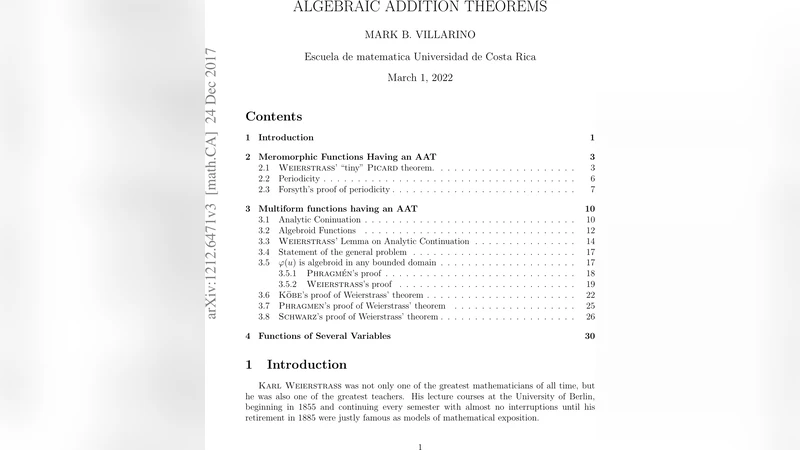
We present a self-contained development of the Weierstrass theory of those analytic functions (single-valued or multiform) which admit an algebraic addition theorem. We review the history of the theory and present detailed proofs of the major theorems.
💡 Research Summary
The paper offers a self‑contained exposition of the classical Weierstrass theory of analytic functions that satisfy an algebraic addition theorem (AAT). It begins by defining an AAT: a function f(z) (single‑valued or multiform) is said to have an algebraic addition theorem if there exists a non‑trivial polynomial P in three variables such that P(f(u), f(v), f(u+v)) ≡ 0 for all complex arguments u and v where the expressions are defined. This condition encodes the idea that the value of the function at the sum of two arguments is algebraically dependent on the values at the individual arguments.
The historical section traces the development from early observations by the Bernoulli family and Gauss on exponential and elliptic addition formulas, through Riemann’s foundational work on analytic continuation, to Weierstrass’s decisive classification in the late 19th century. Weierstrass proved that any meromorphic function possessing an AAT must belong to one of three families: (i) rational functions, (ii) exponential functions (or rational functions of an exponential), and (iii) Weierstrass ℘‑functions (or rational functions of ℘). The paper reproduces this classification with modern language and rigor.
A central technical contribution is a detailed analysis of the minimal polynomial P that relates f(u), f(v), and f(u+v). By examining the degree of P, the authors recover the three cases. If deg P = 1, f is rational; if deg P = 2, differentiating the relation yields f′/f = constant, leading to the exponential form f(z)=Ae^{αz}+B. When deg P ≥ 3, one can differentiate twice and eliminate the auxiliary variables to obtain the differential equation
f′(z)^2 = 4 f(z)^3 − g₂ f(z) − g₃,
where g₂ and g₃ are complex constants. This is precisely the Weierstrass equation of an elliptic curve. Its general solution is the ℘‑function associated with a lattice Λ⊂ℂ, together with its derivative ℘′. Consequently, any AAT‑function of degree ≥3 is a rational combination of ℘ and ℘′, i.e., a meromorphic function on the corresponding elliptic curve.
The paper then extends the discussion to multiform (branched) functions. By employing monodromy theory, the authors show that the minimal polynomial P can be chosen globally on the universal covering surface, even when f has branch points. They treat the case where the monodromy group is finite (leading to algebraic functions on compact Riemann surfaces) and the case of infinite monodromy (which reduces to the elliptic situation). In particular, functions that are square‑roots of ℘, or more generally rational functions of ℘ evaluated at torsion points, also satisfy an AAT, illustrating how the group law on the elliptic curve manifests algebraically.
A substantial portion of the manuscript is devoted to modern reinterpretations. The authors explain that an AAT reflects the existence of a group law on the underlying algebraic curve: the exponential case corresponds to the additive group of ℂ, the rational case to the trivial group, and the elliptic case to the complex torus ℂ/Λ. From this viewpoint, the classification theorem becomes a statement about which complex Lie groups admit a meromorphic uniformization by a single function with an algebraic addition law.
Finally, the paper surveys contemporary extensions. Multivariate AATs, where a function of several complex variables satisfies an algebraic relation under component‑wise addition, are linked to higher‑dimensional abelian varieties. The authors also mention ongoing work on “super‑algebraic addition theorems” for functions on super‑Riemann surfaces and on connections with modular forms, L‑functions, and arithmetic geometry.
In conclusion, the article not only reproduces Weierstrass’s classical results with complete proofs but also situates them within the broader landscape of modern complex analysis, algebraic geometry, and number theory, highlighting both the elegance of the original theory and its relevance to current research directions.