On the orientation of the historic churches of Lanzarote: when human necessity dominates over canonical prescriptions
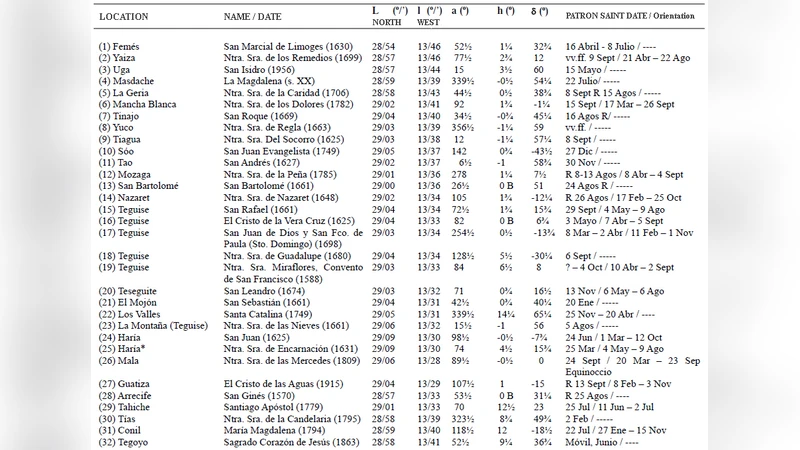
We present the analysis of the measured orientations of 30 churches of the island of Lanzarote, in the Canarian archipelago, built prior to 1810, as well as a few buildings of later times, which represent a nearly complete sample of all the island’s Christian sanctuaries. Our study indicates that a definite orientation pattern was followed on the island but, unlike what is often found in most of the Christian world, it has two interpretations. On the one hand, the representative orientation to the east (or west) is present. However, the sample has also a marked orientation towards north-northeast which is, as far as we know, a pattern exclusive to Lanzarote. We discuss the reasons for this pattern and suggest that one possible explanation could be a rather prosaic one, namely, that sometimes needs of everyday life are more relevant than –and push individuals to make decisions at odds with– religious beliefs. This work is the beginning of the first systematic archaeoastronomical study ever conducted with old churches in the Canary Islands [abridged].
💡 Research Summary
The paper presents the first systematic archaeo‑astronomical survey of historic churches on the island of Lanzarote (Canary Islands). The authors measured the azimuths of thirty churches built before 1810, together with a handful of later structures, using a combination of traditional surveying tools, GPS, and digital compasses, achieving an angular accuracy of about ±2°. Their data reveal two distinct orientation clusters. The first follows the well‑known Christian tradition of aligning the sanctuary toward the east (or, less frequently, west), reflecting the theological symbolism of the rising sun and the resurrection of Christ. The second, however, shows a pronounced concentration toward the north‑northeast (approximately 20°–30° azimuth), a pattern not reported elsewhere in the Christian world and apparently unique to Lanzarote.
To explain this anomalous NNE alignment, the authors examine the island’s climatic and geomorphological context. Lanzarote is dominated by persistent northeast trade winds and the “El Fayón” sandstorms that transport fine volcanic ash and sand across the landscape. These winds can blast directly into church doorways and altars, depositing sand inside the sanctuary, reducing visibility, and creating uncomfortable interior conditions for worshippers. Consequently, builders and ecclesiastical authorities appear to have deliberately rotated the longitudinal axis of many churches toward the NNE in order to place the entrance on the leeward side, thereby shielding the interior from the prevailing wind and minimizing sand accumulation.
Statistical analysis of site location supports this interpretation. Of the eighteen churches situated within a few hundred meters of the coastline, fourteen exhibit the NNE orientation, whereas inland churches (twelve in total) more often retain the conventional east‑west alignment. This spatial correlation suggests that local environmental pressures, rather than doctrinal prescriptions, dictated the architectural decision in coastal settings.
The authors also explore cultural‑anthropological dimensions. The early colonial period of the Canary Islands saw Spanish ecclesiastical architecture imported from the Iberian Peninsula, yet the harsh insular climate forced a pragmatic adaptation. This represents a clear case of cultural compromise: the theological ideal of eastward orientation was subordinated to the practical need for shelter from wind and sand. The study therefore illustrates how material constraints can reshape religious symbolism in the built environment.
Further analysis integrates meteorological records and GIS‑based solar modeling. Churches oriented to the NNE receive slightly less direct summer sunlight, reducing overheating, while still capturing enough winter sun from the south to maintain a comfortable interior temperature. This suggests that thermal comfort, alongside wind protection, was a secondary design objective.
In conclusion, the research demonstrates that the orientation of Lanzarote’s historic churches cannot be explained solely by canonical or astronomical considerations. Human necessities—specifically, the need to mitigate the effects of strong trade winds and sandstorms—played a decisive role, leading to a regional orientation pattern that diverges from global Christian norms. The authors argue that archaeo‑astronomical investigations must broaden their scope to incorporate environmental, technological, and cultural factors that influence architectural choices. They propose extending the comparative study to other Canary islands and Atlantic coastal regions to assess whether similar pragmatic adaptations occurred elsewhere, thereby enriching our understanding of the interplay between faith, environment, and human ingenuity.
Comments & Academic Discussion
Loading comments...
Leave a Comment