Comparing Topology of Engineered and Natural Drainage Networks
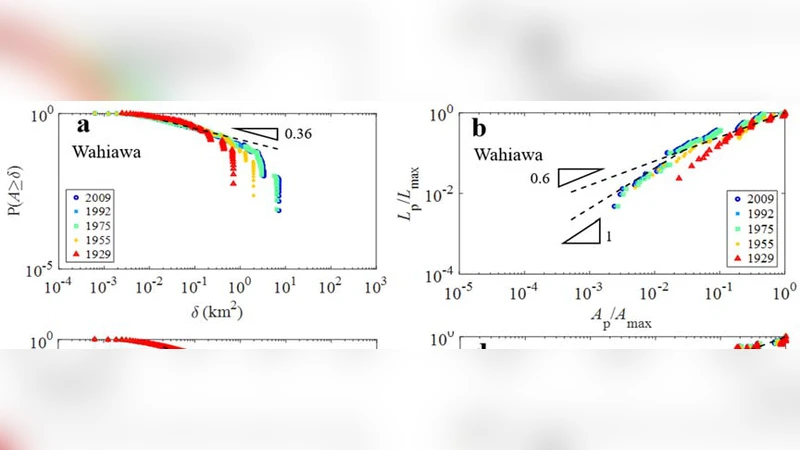
We investigated the scaling and topology of engineered urban drainage networks (UDNs) in two cities, and further examined UDN evolution over decades. UDN scaling was analyzed using two power-law characteristics widely employed for river networks: (1) Hack’s law of length ($L$)-area ($A$) scaling [$L \propto A^{h}$], and (2) exceedance probability distribution of upstream contributing area $(\delta)$ [$P(A\geq \delta) \sim a \delta^{-\epsilon}$]. For the smallest UDNs ($<2 >\text{km}^2$), length-area scales linearly ($h\sim 1$), but power-law scaling emerges as the UDNs grow. While $P(A\geq \delta)$ plots for river networks are abruptly truncated, those for UDNs display exponential tempering [$P(A\geq \delta) >\text{=}> a \delta^{-\epsilon}\exp(-c\delta)$]. The tempering parameter $c$ decreases as the UDNs grow, implying that the distribution evolves in time to resemble those for river networks. However, the power-law exponent $\epsilon$ for large UDNs tends to be slightly larger than the range reported for river networks. Differences in generative processes and engineering design constraints contribute to observed differences in the evolution of UDNs and river networks, including subnet heterogeneity and non-random branching.
💡 Research Summary
The paper investigates how engineered urban drainage networks (UDNs) compare to natural river networks in terms of scaling relationships and topological structure. Using two classic power‑law descriptors—Hack’s law (L ∝ A^h) linking channel length to upstream area, and the exceedance probability of contributing area P(A ≥ δ) ∼ a δ^‑ε exp(‑cδ)—the authors analyze data from two metropolitan areas collected over several decades. For very small UDNs (catchments < 2 km²) the length‑area exponent h is close to 1, indicating a nearly linear relationship that reflects the predominance of straight, minimally branched pipe segments in early design stages. As the networks expand, h declines to values around 0.55–0.62, converging on the 0.57 ± 0.02 range typical of natural rivers. This shift suggests that larger drainage systems begin to emulate the self‑similar branching patterns observed in fluvial systems.
The area‑exceedance distribution further distinguishes UDNs from rivers. Natural rivers exhibit a pure power‑law tail that is abruptly truncated, whereas UDNs display an exponential tempering term, yielding P = a δ^‑ε exp(‑cδ). The tempering parameter c is high (≈ 0.12 km⁻¹) in early‑decade networks, causing a rapid decay of the tail, but it steadily declines (to ≈ 0.04 km⁻¹ in recent data) as the networks mature. This reduction indicates that larger sub‑catchments become more prevalent, making the overall distribution resemble that of rivers. The exponent ε for mature UDNs averages about 1.6, slightly larger than the 1.3–1.5 range reported for river basins. The authors attribute the higher ε to engineering design choices that increase branching density for safety, cost, and land‑use constraints.
Temporal analysis shows a clear evolutionary trajectory: initially, UDNs are dominated by engineered, linear layouts with high c and h≈1; over decades, as new pipes are added and existing segments are integrated, c diminishes, h approaches the river‑network value, and ε stabilizes at a modestly higher level. Nevertheless, complete convergence is never achieved because of two intrinsic differences. First, subnet heterogeneity: urban districts vary widely in topography, population density, and land‑use, producing sub‑networks with distinct scaling characteristics that coexist within the same overall system. Second, non‑random branching: unlike rivers, which evolve under a principle of minimal energy and exhibit stochastic, self‑similar bifurcations, UDNs are deliberately routed to meet specific engineering objectives (e.g., flood mitigation, cost minimization). These design constraints impose systematic deviations from pure power‑law behavior, manifested as the exponential tempering and a slightly larger ε.
The study concludes that while large‑scale UDNs develop scaling properties reminiscent of natural river networks, the imprint of engineering design and planning remains evident. This insight has practical implications for urban water management: planners should recognize that the resilience and efficiency of drainage infrastructure may benefit from mimicking natural branching patterns, yet must also accommodate the inevitable heterogeneity and deterministic routing inherent to built environments. Future work is suggested to extend the analysis to a broader set of cities across different climatic zones and land‑use regimes, testing the universality of the observed scaling trends and refining models that can predict UDN evolution under varying policy and environmental scenarios.
Comments & Academic Discussion
Loading comments...
Leave a Comment