Arnolds problem on paper folding
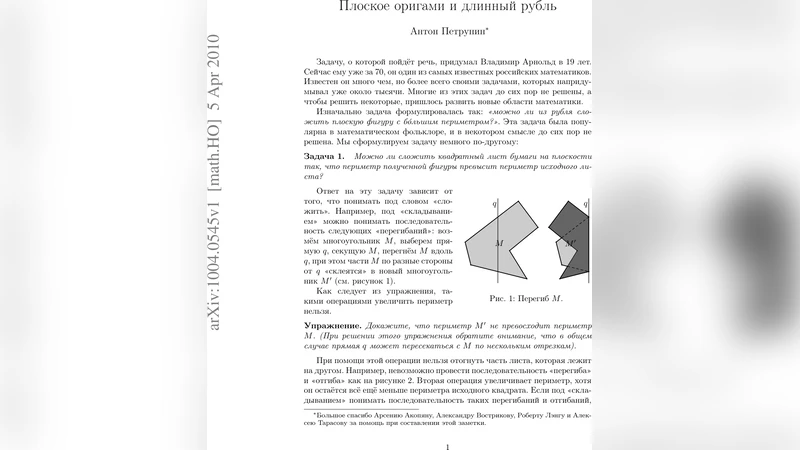
It is a story about the problem whether folding a square on the plane can increase its perimeter. The paper is written primary for school students.
💡 Research Summary
The paper revisits a classic question known as Arnold’s problem: can the perimeter of a flat square sheet of paper increase after folding it on the plane? While the area of a sheet remains unchanged by any folding operation, the perimeter is not a priori invariant because folding can create new boundary segments or hide existing ones. The author approaches the problem from a pedagogical perspective, aiming to make the investigation accessible to elementary and middle‑school students, yet the analysis is rigorous enough to satisfy a mathematically inclined audience.
The first section establishes the geometric model of paper folding. A fold is represented by a straight line (the crease) that acts as an axis of reflection: each point on one side of the crease is mirrored onto the other side. Because the reflection is an isometry, the lengths of all line segments are preserved; only their spatial arrangement changes. Consequently, any change in perimeter must arise from the way the original outer edges are rearranged relative to the crease. If a portion of an original edge becomes interior after folding, it no longer contributes to the outer boundary, while any newly exposed edge of the folded flap adds to the perimeter.
The second section classifies folds according to the position and orientation of the crease. Three representative families are examined in detail: (1) a diagonal crease, (2) a line joining the mid‑points of two opposite sides, and (3) a generic line intersecting the square at an arbitrary angle. For the diagonal case, the two resulting right‑isosceles triangles perfectly overlap, so the outer boundary is unchanged and the perimeter stays at 4a (where a is the side length). For the midpoint‑to‑midpoint crease, the folded triangle has one side equal to a/2; after folding the new boundary consists of two shorter segments and a portion of the original edge, yielding a net perimeter slightly smaller than 4a.
The most interesting behavior appears in the generic case. By letting the crease intersect the square at an angle θ with respect to a side, the author derives explicit formulas for the lengths of the exposed edges using elementary trigonometry (law of cosines). The total perimeter after folding, P(θ), can be expressed as
P(θ) = a ·
Comments & Academic Discussion
Loading comments...
Leave a Comment