Beyond Powers of Two: Hexagonal Modulation and Non-Binary Coding for Wireless Communication Systems
Adaptive modulation and coding (AMC) is widely employed in modern wireless communication systems to improve the transmission efficiency by adjusting the transmission rate according to the channel conditions. Thus, AMC can provide very efficient use o…
Authors: Zhe Yang, Lin Cai, Aaron Gulliver
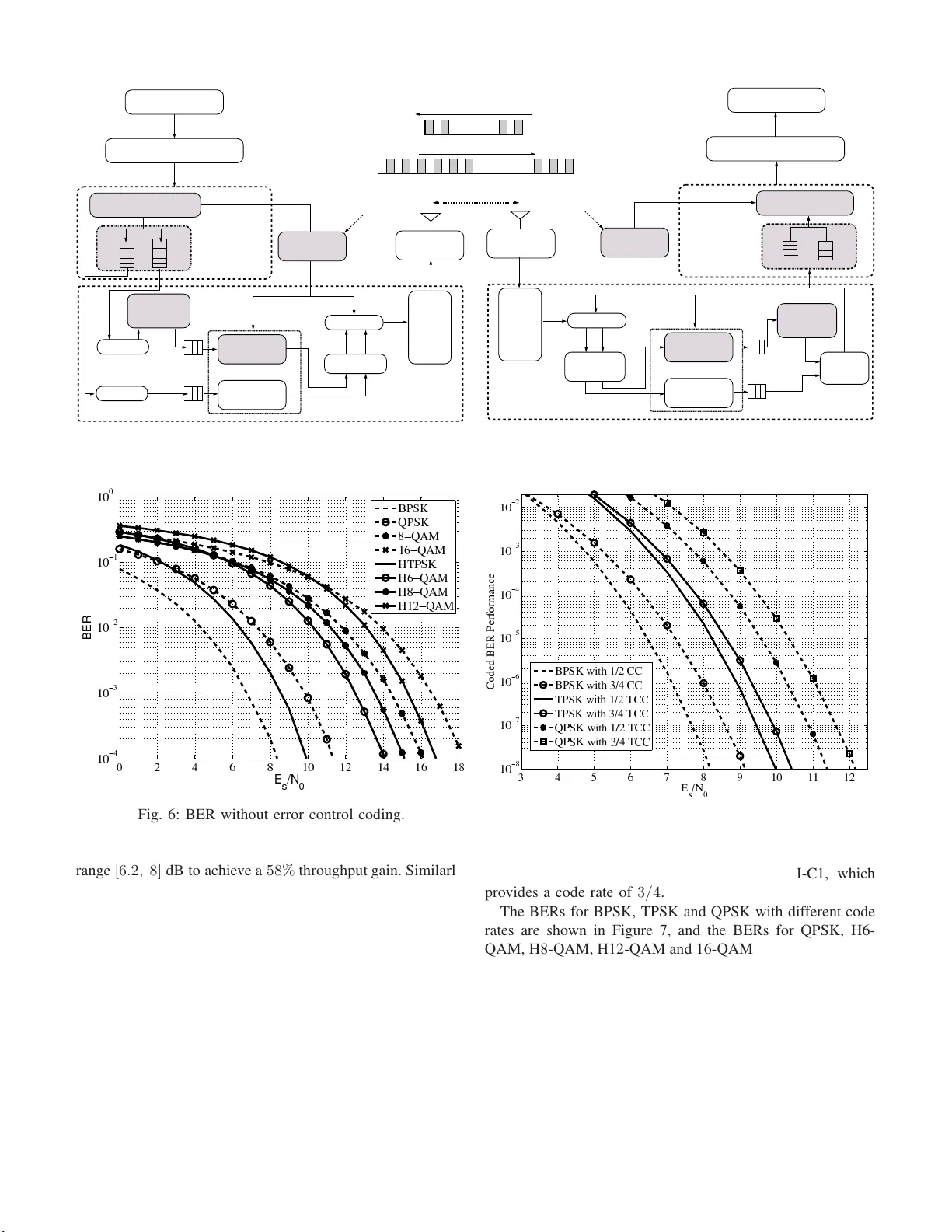
1 Be yond Po wers of T wo: He xagonal Mod ulation and Non-Binary Coding for W ireless Commun icati on Systems Zhe Y ang 1 , Lin Cai 2 , Aaron Gulli ver 2 , Liang He 3 and Jianping Pan 4 1 School of Computer Science and Engineering, Northwestern Polytechnical Uni versity , Xi’an, China 2 Dept. of Electrical and Computer Enginee ring, Univ ersity o f V ictoria, Cana da 3 Univ ersity o f Michiga n, Ann Arbor , MI, USA 4 Dept. of Computer Science , Univ ersity of V ictoria, Can ada Abstract —Adaptive modulation and coding (AMC) is widely employed in modern wireless communication systems to improv e the transmission efficiency by adjusting the transmission rate according to t h e channel condit ions. Thus, AMC can pr ovide very efficien t use of channel resources especially ov er fading channels. Quadrature Amplitude M odulation (QAM) is an ef- ficient and widely employed digital modulation technique. It typically employs a rectangular signal constellation. Th eref ore the decision regions of the constellation are square partitions of th e t wo-dimensional signal sp ace. Howev er , it is well k nown that hexagons rather than sq uares provide the most compact regular tiling in two d imensions. A compact tilin g means a dense packing of the constellation poin ts and t h us more energy efficient data transmission. Hexago nal modulation can be difficult to i mplement because it does not fit well wit h the usual power - of-two symbol sizes employed wi t h bin ary data. T o overc ome this pro blem, non-binary coding i s combined with hexagonal modulation in th is paper to pro vide a system which is compatible with binary data. The feasibilit y and efficien cy are ev aluated using a softwar e-defined radio (SDR) based prototype. Extensive simulation results are p resented which show t hat this approach can provide impro ved en ergy effi ciency and spectrum utilization in wireless communication systems. I . I N T RO D U C T I O N W ireless c ommunic a tions hav e beco me an essential co m po- nent of mod ern inform ation systems. Acco rding to the Cisco V isua l Networking Index and numerous studies b ased on market statu s and trends, mobile data traf fic has increased 18-fo ld fro m 20 1 1 to 2016 [ 1]. This ever -gr owing demand for mobile data creates sig n ificant d emands on th e scarce wireless spectru m and lim ited power o f mobile d e vices. Thu s, improving the spectral and energy efficiency o f wireless com- munication systems is an important challen ge for th e r esearch commun ity and industry . W ireless chann els ty pically suffer fro m path-lo ss and the effects of multipath fading and shad owing, r e sulting in wide variations in received sig nal quality . As a co nsequenc e , many modern digital commun ication systems employ adaptive mod- ulation and c o ding (AMC) to adju st th e transmission r a te accordin g to th e time-varying chann e l cond itions. AMC can Correspondi ng Author: Prof. Lin Cai, Dept. of Electrical and Computer Engineeri ng, U nive rsity of V ictoria , V ictoria, BC V8W 2Y2, Canada, Em ail: cai@e ce.uvic.ca. efficiently utilize th e av ailable bandwidth while meeting the bit-error-rate (BER) requirem e nts. Quad rature amplitude mod - ulation (QAM) is widely employed to transmit mo re than one bit per modu lation symbo l. The most common QAM signal constellations are QPSK an d 1 6 -, 64- and 256-QAM, which carry 2, 4, 6 and 8 bits per sym b ol, respectively [ 1 2]. QAM demo dulation conv erts the received signal, which may b e affected by fading, noise an d interference, to bits. The signal space is p artitioned into decision regions for th is purpo se, and demo dulation is ach ieved b y determining the region that contains the receiv ed signal. Wi th conventional QAM, the signal space is partitioned in to rectangu lar decision regions; ho wever , it is well k nown that a two-dimensional regular tiling with h exagons is the most efficient pack in g in terms of co mpactness [ 7]. Therefore, if hexagon al decision regions are employed to pa rtition the sign a l space, r e ferred to as h exagonal qu a drature amplitud e mod ulation (H- QAM), the spectrum and/o r en e rgy efficiency can be im proved. H-QAM maximizes the m inimum distance b etween sign als in the con- stellation and th us m inimizes the symb ol error pr obability fo r a given average signal en ergy as well as the peak-to -av erag e power ratio, wh ich is im portant for OFDM systems [2], [ 8 ], [17], [2 4]. In [27], a hexagon al lattice was employed in the time-freq uency domain to e n hance system p e r forman ce. Howe ver , there has b e en little inter est in H-QAM because of the inherent d iffi culty in using H-QAM with binary data. The number of co nstellation points may not be a power-of-two, while existing info r mation systems ar e based on binary data. A n u mber of appro a ches have been proposed to overcome this pr o blem [17], [24]. One solutio n is to convert th e bin ary data stream to non-b inary symbols, e.g. using a binary-inp ut and ternary-ou tput (BITO) code at the transmitter an d re verse the proc e d ure at the r eceiv er [8], [24]. Ano th er approach is to lea ve some symb o ls unused [17]. Both of these techniq ues cannot fully utilize the gains possible with H-QAM, especially when the size of the sign al con stellation is small. Thus, current H-QAM solutions alone cannot provide su fficient p erform a nce improvement for wireless commu nication systems, althou gh it has be en adopted in optical system s [26]. T o efficiently explore the potential of H- QAM for wire- less commun ication systems, we p ropose to go beyond the 2 conv ention al b in ary bit-m apping and co d ing. Th us, in this paper we employ H - QAM with ternar y dig its (tr its). T ern ary architecture s have p reviously been con sidered in com puting and storage systems d ue to their hig her radix econo my and the three usable states f or ce r tain electrom a gnetic materials [15], [16]. Although ternary commun ica tion and c omputing systems have not ye t r eached co mmercial viab ility , their future use has been pr edicted by Kn u th [13]. The main contributions of this paper are as follows. 1) New H-QAM modulation schemes a r e propo sed ba sed on hexago nal tiling and the co rrespond ing BER perfor- mance is ev aluated . These n ew schemes co ntain 3 , 6, 8, and 1 2 constellation po ints to represent 1 trit, 1 bit plus 1 trit, 3 b its, and 2 bits plus 1 trit, respectively . 2) T ernary con volutional codin g is used to p rotect the trits directly . For H- QAM with hy brid bit an d trit informa- tion, w e con sider a comb ination of binary and tern ary coding. The BER performan ce is e valuated for dif feren t modulatio n schemes, inclu ding co n ventional rectang ular QAM, with co de r ates 1 /2 and 3/4 to con form to the IEEE 80 2.11 standard [19]. These re sults show that the the new mod ulation and cod ing schemes n ot on ly provide finer gr anularity a djustment fo r AMC, but also can replac e some of th e existing schemes by achieving a higher throughp ut with a lo wer BER fo r the given SNR region. 3) A prototyp e H-QAM wireless c ommun ica tion system is presented wh ich employs non- binary in formation map- ping usin g GNU Rad io and USRP2, a c o mmonly used software-defined rad io (SDR) p latform [4]. T o the best of our knowledge, this is the first H-QAM based pro- totype com munication system which dem o nstrates the feasibility and efficacy of hexagonal signal c o nstellations with non-bin ary co ding. Further , extensive simu lation results ar e p r esented to demonstrate the efficiency of the prop osed scheme, which can pr ovide consider able perfor mance gains compare d to existing binary systems. In su m mary , this pape r demonstrates the efficiency of H- QAM with no n-binar y sym bol mapping and error control coding in wireless co mmunicatio n sy stem s. T his d eviates from conv ention al ap proache s th at employ rectang ular constella- tions with binary cod ing. The remainde r of this paper is organized as follows. I n Section II, we discuss the b ackgro u nd and related work . Sec- tion III presents the non -binary co mmunicatio n system, inc lu d- ing th e hexagonal symb ol con stellation structur e, inf o rmation- to-symbo l m apping, n on-bin ary erro r cor rection cod ing and interleaving, and the packetization in terface with the u pper layers. The system perfo rmance is inv estigated in Sectio n IV throug h extensive trace-d riv en simulation, an d the pro totype system and measurem ent re su lts are d escribed in Section V. Finally , some conclusions are given in Section VI alo ng with suggestions f o r future work. I I . B AC K G RO U N D A N D R E L A T E D W O R K A. He xagonal Sign al Constellations Modulation is the p rocess of conv erting a data stream to wa veforms suitab le for transmission through a comm u- nication chan nel by varying o n e or more of the wa veform proper ties, e.g. amplitude, p hase, or frequency . For ban d width limited band pass mod ulation, qu adrature amplitude mod ula- tion (QAM) is co m monly employed. T y pical QAM constel- lations can be consider ed as rectangular partitions of the two-dimension signal space. It is well known that regular hexagons provide the densest two-dimension packing, and this has m o tiv ated research into the p otential of H-QAM [8] , [9], [11], [1 7], [ 18], [2 4], [ 28]. Ex isting work on hexagonal modulatio n usually conside rs o ne of the following ap proach es. The first considers binary data so that each modulation symbol represents an integer nu mber of b its. H owever , this schem e requires tha t the n u mber of constellation po in ts b e a power - of-two. Sin c e th e number of H-QAM constellation p oints is not a power-of-two [ 8], so m e of the co nstellation p oints ar e not used, which is a waste of available resources. The second appro ach uses all po ints in th e hexagonal constellation for transmission to m aximize the per-symbo l throug hput. It h as been shown in [24] that h exagonal-18 QAM modulatio n (H18-QAM) require s less en ergy per -bit th a n 16- QAM. As 18 = 2 × 3 × 3 , one H18 -QAM sy m bol c a n be decomp o sed into o ne bit and two trits. T o acco m modate a binary data stream, bina ry symbols can be map ped to ternary symbols using binary-inpu t ter n ary-ou tput (BITO) c on volu- tional or tu rbo codes to also provide erro r cor rection [24]. Howe ver , th is conversion is not flexible and suffers from poor perfor mance sin ce it fails to offer adequate pro tection for th e ternary digits. Acc ording to th e simulation re sults, th e cod ed error per forman c e o f H18-QAM is 0 . 6 dB lower than th at of the co ded 16 - QAM, so in this case h exagonal mo dulation provides no imp rovement over rectangu la r mo dulation. From the existing literature, it can concluded th at using binary d ata with n on-bin ary m odulation may be su boptimal as some c o nstellation points are no t u sed, an d em ploying BITO codes for erro r correctio n leads to infle xib ility in multiplexing bits an d tr its. An altern ativ e ap p roach is to combin e H- QAM with non-bin ary , in particular tern ary , co ding, which is advocated in th is paper . The effectiv eness of H- QAM in multi-media transmission using H-QAM to transmit lay e red video has previously been demon strated [28]. B. T ernary Compu ting and Commun ica tions Radix econo my is u sed to measure the cost of sto ring or transmitting numb e rs in a gi ven b ase [ 10]. It is defin ed as the n umber o f dig its need e d to rep resent a numb er N in base b multip lied by the radix b . A base with a lower ra dix econom y has a higher efficiency . It h as b een proven that a radix of three pr ovides the lowest rad ix econ omy am o ng all integer bases. This implies that a ter nary base ou tp erform s the widely used binary base in terms of both storage and commun ications. T ernary based data reco rding/storin g systems have been investigated [15], [16], a n d the the cost of storin g number s can be minimized if a ternary base is used [10]. Computers using balanced ternary logic were imp lem ented in the late 195 0s and were shown to be more efficient compared with the binary ba sed computers. Knuth ha s predicted that the elegance and efficiency of ternary logic will result in its emergence in the f uture [13]. 3 0 Throughput Received SNR (dB) 16−QAM BPSK QPSK Channel capacity 0000000000000000000 0000000000000000000 0000000000000000000 0000000000000000000 0000000000000000000 0000000000000000000 1111111111111111111 1111111111111111111 1111111111111111111 1111111111111111111 1111111111111111111 1111111111111111111 0000000000000000 0000000000000000 0000000000000000 0000000000000000 0000000000000000 1111111111111111 1111111111111111 1111111111111111 1111111111111111 1111111111111111 00000000000000 00000000000000 00000000000000 00000000000000 11111111111111 11111111111111 11111111111111 11111111111111 00000000 00000000 00000000 00000000 11111111 11111111 11111111 11111111 000000 111111 Fig. 1: T he achiev able thro ughpu t with different mo dulation schemes. As discussed in Section II-A, the u se of ternary codes with hexagonal constellatio n s c an fu lly realize the p otential o f H- QAM and imp rove the per f ormance of wireless com munica- tion systems. Th u s, we have cond ucted an extensi ve literature survey to find the b est known ternary conv olutional c odes, and these co d es are pun ctured to ob ta in different co de r ates. The details will be given in Section III-C. C. Modulation vs. Codin g Gain The motivation of AMC is to combine different modu lation schemes and cod e r a tes to fully utilize th e c a pacity of the time-varying channel. Th e code ra te can be adjusted to cor rect different numbers of bits in error accor ding to the BER after d emodu latio n (uncode d BER). If this BER is b elow a giv en threshold , cod ing can be employed to redu ce it to a negligible level. Otherwise, it c an be very difficult to reduce the BER to an acceptable level even with a powerful coding scheme, and the BER with and withou t cod ing may actually be similar . T o overco m e this issue, for a given SNR at the receiver , an ap propriate m odulation scheme ca n be used to ensure that the uncode d BER after demo dulation is below a desired threshold (o ften 10 − 3 for wireless sy stem s), an d then error co n trol cod ing can be applied to fu r ther red uce the BER to an a c ceptable region (e.g., below 10 − 6 ). As erro r control c o ding may not be effecti ve unless the uncod ed BER is sufficiently lo w , a better mod ulation scheme can improve the overall system perfo rmance. For w ir eless co mmunicatio n systems emp loying AMC, several co mbination s o f modu lation and cod ing schemes are u sually adop ted to fit different channe l condition s. In th is paper, we also consider d ifferent code rates for H-QAM. In troducin g H-QAM mo dulation with coding can outperf orm and thu s replace som e of the existing rectan gular QAM ba sed AMC sche m es. In add ition, if the SNR gap betwee n two AMC schem es is large, e.g., QPSK with a r a te 3 /4 code and 16-QAM with a r ate 1/2 code as in 8 02.11 stan dard [6], this gap can be filled with an H-QAM based scheme. As illustrated in Figure 1, since the SNR at the receiver is contin uous, there is space (shad ed areas) fo r new modulatio n schem es (using new or existing coding schemes) to improve the system p erform ance, which motiv ates the work reported in this paper . I I I . S Y S T E M D E S I G N As m entioned in the previous section , the num ber of con- stellation po ints in the most co mpact hexago nal constellation s is not always an integer power -of -two. Th erefore, to fully utilize these con stellations fo r modu lation, both b its an d trits should be tran smitted. This req uires a reinves tigation of the modulatio n constellation geometry , the m a pping o f bits and trits to con stellation poin ts, th e erro r contro l coding , and the multiplexing of bits and trits. A. Constellation Geometry A signal can be represented in the signal space d omain using an in-p hase an d q uadratur e-phase (I/Q) co nstellation diagram. For a constellation with N points, the info rmation carried in each sy m bol equals log 2 N bits. The distance between a co nstellation po int to the o rigin, d , is pr oportion al to the square r oot o f the transmitted symbo l energy . In the absence of no ise, the received signal constellation has the same shape as the tran smitted constellation , except th a t, at the receiver , the distance fro m a constellation poin t to the orig in is propo rtional to the squ a re root of the r eceiv ed sym bol energy . In the following, constellation ref e rs to the constellation at the receiver u n less otherwise stated. In an additive white Ga u ssian noise ( A WGN) channel, a received symbol follows a two-dimen sional Gaussian dis- tribution center ed at the correspond ing constellation point. A V oronoi diagram can be u sed to determin e th e d e cision bound ary of each symbo l. The pro bability that a symbol is demodu lated in erro r is equal to the prob ability th at the re- ceiv ed sym bol lies outside th e decision region of the intended symbol. Giv en the fact that the Ga ussian distribution decays ex- ponen tially and the BER after demo dulation should be suf- ficiently low (e.g. , below 10 − 3 ), th e symb ol error prob ability for H-QAM can be app r oximated as S E R = 2 Q s 2 r 2 N 0 , (1) where Q ( · ) is the Q-fun ction, r is th e shortest distance from the con stellation point to its d ecision boun d ary , an d N 0 is the noise spectr a l density . As r is equal to half o f the minimum Euclidean distance in the signal space between two constellation poin ts, the BER is determ ined by the minimu m Euclidean distance between co nstellation points. A good mod u lation con stellation should conve y mo re in- formation under th e same av erag e power (symb ol en ergy) and BER constrain ts. Using (1), this can be c o n verted to the following geom e tr y p roblem. In a circle of rad ius √ E + r , p ack as many non- overlapping circle s with radiu s r as possible, where E is th e maximum received symbol en ergy and r is determined by th e BER constra int. For a sufficiently large radiu s, √ E , the optim al pack ing is a hexagon a l tiling. Comparin g this tiling with the rectangu lar tiling widely used in e xisting QAM schemes, a hexagonal tiling can cover the r egion mo re efficiently , which leads to approx imately a 0 . 6 dB g ain [5]. 4 ! !" ! #" ! $" Fig. 2 : TPSK, H6- QAM, and H 8 -QAM con stellatio n s. !"#$%$&'()&*'!+,-(.&,(/0"(/,$/ !"#$%$&'()&*'!+,-(.&,(/0"(1%/()$/ !"#$%$&'()&*'!+,-(.&,(/0"(2'!()$/ 333 313 311 233 213 231 211 113 133 111 131 331 Fig. 3 : Constellation and mapp in g for H12 -QAM. 1) The Pr oposed H-QAM Geometry: In this paper, we propo se TPSK, H6-QAM, H8-QAM, and H1 2-QAM schemes as d esign exam p les to de monstrate the ben efits of hexagon a l modulatio n c o mbined with ter nary coding . Conditioned on maximizing the minimum Euclidean distan c e, the ave rage symbol energy sho u ld be minim ize d. This is equivalent to minimizing the average of the squares of the d istances from the constellation p oints to the orig in unde r the condition that the minimum distance of ea c h constellation poin t to its d ecision bound ary is no smaller than r , i.e. min P i d 2 i M , (2) where d i is the distan c e of the i -th co nstellation point to the origin and M is the number of constellation points. Thus, th e points shou ld be as close to the origin as po ssible. For the TPSK c onstellation shown in Figure 2 (a) , each symbol repre sents o ne trit, or log 2 3 ≈ 1 . 585 bits of inf orma- tion. It is straigh tforward to arr ange the constellatio n points as the en d points of an equilater al triangle, and set the origin to the center o f the triang le. Th e minimum Euclidea n distan c e from each poin t to its decision bo undary is then r = p 3 E s / 4 , where E s equals the average sym b ol en e rgy . For H6 -QAM, each symbol carr ies one trit p lus o n e bit of informatio n, and the co nstellation arrang e ment is shown in Figur e 2 (b). The minimum E uclidean distance from a co nstellation p oint to its decision bo undar y is r = p 8 E s / 15 , wh ic h is much larger than th at of 6-PSK ( p E s / 4 ), an d thus the symb ol error p erform a n ce of H6- QAM is better . T hus, H6-QA M can transmit the same amoun t of infor mation as 6-PSK as they both contain 6 constellation po in ts, but with a lower symbo l error rate. For H8-QAM, each sym b ol carries three b its of information , and the constellation arr angemen t is shown in Figure 2 (c), where the or igin is located at the midp oint of an ed ge of a hexag o n. The minimum Eu c lidean distance fro m a con - stellation point to its decision bo u ndary is r = p 2 E s / 9 , which is larger than that of rectangular 8-QAM ( p E s / 6 ). For H12 -QAM, each symbol carries o n e tr it plus tw o bits of information, and the pr oposed co nstellation arrangemen t is shown in Figur e 3 (a), where the origin is the join t vertex of the center h exag ons. The m inimum Euclidean distance f rom a constellation point to its de cision boundary is r = p 3 E s / 19 . Note that TPSK, H6-QAM and H12-QAM are ro tationally symmetric by 12 0 ◦ , which pr ovid es add itio nal b e nefits a s will be shown in Sectio n V. B. Constellation Mapping Giv en the geometr y of the constellation points, the next step is to map th e bits and trits to the co nstellation poin t such that the BER is min im ized. Compared with th e con ventional rectangu la r mod u lation, ther e are more neighb o ring po ints (with the smallest distance to a co nstellation point) using hexagonal m odulation , so careful mappin g is r e quired to lim it the nu mber o f bit and/o r trit errors due to a symbol err or . It is not straightforward to obtain a Gray ty pe mapping (with on ly one b it/trit difference between neigh boring poin ts), becau se the number of neighbor in g c o nstellation points with h exagonal tiling often exceeds the numb e r of dig its (bits and/or trits) represented by each sym bol. The following design prin ciple is used he r e to obtain g ood mapping s. If startin g from a bit, the constellation points are divided into two clusters. Similarly , the con stellation p o ints are di vided into three clusters if starting from a trit. Then, ‘0 ’ and ‘1’ (for a bit) or ‘0’, ‘1’ an d ‘2’ (for a trit) ar e arbitrarily assigned to ea c h of the clusters. For the rem a in ing bits or trits, binary o r tern ary num bers are first a ssigned to the p oints in one cluster , and then in tu rn to the po in ts in the o ther clu sters. The same number is assign ed to neig hborin g poin ts in different clusters as much as possible. For example, with th e H12-QAM constellation in Figure 3 (b) , starting with a trit, the 12 points are divided into thr ee clusters, an d are a ssigned ‘0’, ‘1’ and ‘2’, respectively . W ithin the first clu ster , a Gra y-type m apping is used to assign ‘00’, ‘01 ’, ‘ 11’ and ‘10’ to th e fo ur poin ts. For the second cluster, ‘100’ and ‘101 ’ are assigne d to the p oints neighbo ring ‘0 00’ and ‘001 ’. Similarly , for the third cluster , ‘201’ and ‘2 11’ are assigned to th e points neighb oring ‘10 1’ and ‘11 1’. Althoug h this appro ach to con stellation mapping does no t in gen eral pro duce a Gr ay mapp ing, the results presented in Section IV show that it still leads to a significant perfor mance im provement. C. T ernary E rr or Contr ol Codin g and Interleaving Giv en a n o isy cha n nel, a receiv ed constellation po in t may differ from the tran smitted on e, which will result in bit/trit errors. Interleaving and er ror con trol coding can b e used to mitigate these er rors. 1) Non-binary Convolutional Codes: Con volutional cod ing has be en widely u sed in w ir eless systems su ch as 802.11 because of the relatively simple implem e ntation and g o od per- forman ce impr ovements [ 6]. A binary con volutional enco der can b e represented by the parameters ( n, k, m ) where k and n 5 0000 0000 0000 0000 0000 0000 0000 0000 1111 1111 1111 1111 1111 1111 1111 1111 00000 00000 00000 00000 00000 00000 00000 00000 11111 11111 11111 11111 11111 11111 11111 11111 00000 00000 00000 00000 00000 00000 00000 00000 11111 11111 11111 11111 11111 11111 11111 11111 0000 0000 0000 0000 0000 0000 0000 0000 1111 1111 1111 1111 1111 1111 1111 1111 1 1 2 2 1 2 1 1 2 input u output v2 output v1 Fig. 4: A tern ary conv olutiona l encoder [2 5]. are the n u mbers of input and ou tput bits, respectively , and m is the enco der memory size. Th e cor r espondin g code ra te is k /n . Thr ee code rates, 1 / 2 , 3 / 4 and 2 / 3 , are employed in the IEEE 802. 1 1 stand ard. At the receiv er, th e received coded bit stream is d ecoded to recover the original message bit stream. The V iterbi algo rithm provid es m aximum- likeliho od d ecoding is widely used in p ractice because of the low implementatio n complexity and satisfactory pe r forman ce. A ternary ( n, k , m ) conv olutional encoder ma p s k in p ut trits to n output trits [25]. A tern ary con volutional encod er can be simply im plemented using shift registers and mo d ulo-3 add ers, as shown in Figu re 4. In the fig u re, the shad ed squares ar e memory elements, the circled n umbers are the coefficients that the trits are multiplied by , and ⊕ represen ts a m odulo- 3 adder . As there is one in put trit stream u an d two ou tput trit streams v1 and v2 , the code rate is 1 / 2 . Similar to binary con volutional codes, pu ncturing can be employed to obtain different code rates to a d just the pro tection lev el accord in g to the m o dulation scheme, chan nel cond ition an d req uired BER. Without lo ss of generality an d to be co nsistent with the 8 02.11 stan d ard, a rate 3/4 p u nctured ternary conv olutio nal code is consider e d . The p uncturin g pa tter n is the same as that u sed fo r the binary conv olutional cod e , [1 1 1 0 0 1] , where 0 m e a ns the code d digit at that p osition is p unctured . The operation s in a ter nary V iterb i d ecoder are in the Galois field of th ree elements, GF (3) . The co mplexity associated with a convolutional cod e is primarily in the deco der . A ternary d ecoder u sing the V iterbi algorithm requires O (3 m L T ) memory space and O (3 2( m +1) L C ) computatio n time, where L T is the trace b ack len gth of the decoder and L C is the cod e block length, respectively . The computation al com p lexity of a ternary conv olutional deco der is comp arable to that of a b inary decoder with a similar num ber of states. 2) Interleaving: Many e rror co rrecting codes such as c on- volutional cod es can not tolerate b urst errors, so it is desirable to separate these erro rs u sing an in te r leav er . An inter leav er can also help mitigate errors when Gray mappin g is not employed. Bits or trits are interleaved within a packet as the perfor mance r esults show that this intra- packet in terleaving provides a p e rforman ce gain for fading channe l and do es not introdu c e significant delay . Remark: Sev eral er ror control coding design s exist in the literature that h av e bee n shown to provide near-capacity p er- forman ce, e.g. low-density pa rity check ( LDPC) codes [22], accumulate- repeat-accu mulate ( ARA) c odes [2 1], and rateless codes [ 3]. Fu rther researc h work is required to extend these designs to ternary cod es to further imp rove the perfor mance of H-QAM AM C sche mes. D. S ystem Arc hitecture Using the IE E E 802.1 1a standard as an example, Figure 5 shows the H-QAM sy stem architecture . Th e shaded blo cks in- dicate new m o dules or existing modu les that req uired updated. The messages are divided into two queues, one of which is conv erted to a trit stream an d the other is kept as a bit stream. The bits/trits conversion modu le con verts the bit sequen c e to a trit sequence (de ta ils o f this conversion will b e discussed later), and this is the in put to the tern ary conv olutio nal code (TCC) encoder . The cross-layer controller uses the ch annel state informa tio n (CSI) to d etermine th e m odulation an d c oding scheme to be used, and this is included in the Physical Layer Con vergence Procedure (PLCP) heade r [6]. The PL CP header cotains the phy sical layer contr ol inf o r- mation. The rate field of the PLCP header is used to in form th e receiver of the mod ulation and codin g scheme to be employed. There are 8 different adaptive modu la tio n and co ding (AMC) schemes in th e cur rent IEEE 802. 11a standard , wh ich is represented by a 4 -b it rate field. There is one reserved bit in the header which can be combined with th e 4 -bit rate field to represent up to 32 different mod ulation and coding sche m es. This is sufficient to include the new AMC sche m es based on H-QAM and ternary con volutional cod ing prop osed in this paper, as some o f new AMC schem es r eplace existing AMC schemes based o n rectangular QAM and binary co n volutional coding. Th e pro posed non-bin ary H-QAM commun ication system is compa tib le with co n ventional systems and does not require add itio nal co mmunicatio n overhead as will be shown later . I V . P E R F O R M A N C E E V A L UAT I O N A. Uncoded BER P erforman ce A key pe rforman ce indicator is the BER w .r .t the r eceiv ed SNR over an A WGN chann el. W e conside r a received SNR from 0 to 18 dB and examin e the uncod ed BER for d ifferent modulatio n schemes. Th e rece i ved signa l to n oise ratio is E s / N 0 where E s is the received energy per symbol and N 0 is the noise power spectral den sity . Monte Carlo simu lation with Matlab was used to ob tain the BER resu lts shown in Figure 6. Each H-QAM constellation po int has m o re neigh bors than w ith recta n gular QAM, so the resulting non- Gray code mapping will degrad e the BER perfo rmance o f H-QAM , but H-QAM is still an efficient m odulation design in terms of the symbol er ror rate. For example, H8-QAM o u tperfor ms rectangu la r 8- QAM by 0 . 8 dB at a BER of 10 − 3 , and this gap increases f or sm a ller BERs. This demon strates the a dvantage of using hexagona l constellations. Using 10 − 3 as the BER bench mark, the add ition of TPSK, H6-QAM, H8-QAM and H12-QA M provide s mo re cho ices to ada pt the m o dulation accordin g to the rec e ived SNR. For instance, TPSK can be used to replace BPSK in th e SNR 6 ... ... MAC (bits) Mod RF Frontend (trits) RF Frontend De−inter− leaver DeMod Digital PHY OFDM Module Rx ... ... ACK Data Frame Receiver De− CSI PLCP Header Trits/Bits Digital PHY Trits Bits TCP/IP Protocols Applications Fragmentation Transmitter MAC CC Encoder CC Encoder Interleaver Controller Cross−Layer Module OFDM Tx Cross−Layer Controller CC Decoder (trits) CC Decoder (bits) Conversion scramble Re−assembly TCP/IP Protocols Applications Q1 Q2 Q1 Q2 Scramble Scramble Bits/Trits Conversion Trits(Q2) Bits(Q1) Trits(Q2) Bits(Q1) Fig. 5 : The new system architectu r e based on I E EE 802 . 11a. ✵ ✷ ✹ ✻ ✽ ✶ ✵ ✶ ✷ ✶ ✹ ✶✻ ✶✽ ✶ ✵ ✲ ✶ ✵ ✲ ✁ ✶ ✵ ✲ ✂ ✶ ✵ ✲ ✄ ✶ ✵ ☎ ❊ s ✴✆ ✝ ❇ ✞ ✟ ✠✡☛☞ ◗ ✡☛☞ ✽ ✌ ◗ ✍✎ ✶✻ ✌ ◗ ✍✎ ❍✏✡☛☞ ❍ ✻ ✌ ◗ ✍✎ ❍ ✽ ✌ ◗ ✍✎ ❍ ✶ ✷ ✌ ◗ ✍✎ Fig. 6: BER withou t error c ontrol codin g. range [6 . 2 , 8 ] dB to a c hiev e a 58% throu ghpu t g ain. Similarly , H6-QAM, H 8 -QAM, an d H12- QAM can replace QPSK in the SNR range of [9 . 8 , 15 . 3] dB to achieve a 2 9% to 79% throug hput gain . Similarly , H-QAM constellation s such as H27-QAM an d H54-QAM sho uld provide thro ughpu t g ains when the received SNR is higher . B. Coded BER P erforman ce For the coded BER perfo rmance, an A WGN channel is considered with the rate 1 / 2 terna ry co n volutional cod e shown in Figure 4. This code has 3 4 = 8 1 states, so for a fair compariso n a r ate 1 / 2 b in ary con volutional code is u sed with 2 6 = 64 states. This binar y cod e is em ployed in the IE EE 802.1 1 standard [6]. T o ev aluate the perfo rmance of H- QAM based AMC, we also consider punc tu red conv olu tio nal coding ✸ ✹ ✺ ✻ ✼ ✽ ✾ ✶ ✶✶ ✶ ✁ ✶ ✲ ✂ ✶ ✲ ✄ ✶ ✲ ☎ ✶ ✲ ✆ ✶ ✲ ✝ ✶ ✲ ✞ ✶ ✲ ✟ ❊ s ✴✠ ✵ ❈ ✡ ☛ ☞ ☛ ✌ ✍ ✎ ✏ ☞ ✑ ✒ ✡ ✑ ✓ ✔ ✕ ✖ ☞ ❇✗✘✙ ✚✛✜✢ ✶ ✴ ✁ ✣✣ ❇✗✘✙ ✚✛✜✢ ✸ ✴ ✹ ✣✣ ❚✗✘✙ ✚✛✜✢ ✶ ✴ ✁ ❚✣✣ ❚✗✘✙ ✚✛✜✢ ✸ ✴ ✹ ❚✣✣ ◗✗✘✙ ✚✛✜✢ ✶ ✴ ✁ ❚✣✣ ◗✗✘✙ ✚✛✜✢ ✸ ✴ ✹ ❚✣✣ Fig. 7 : Coded BER with BPSK, TPSK, and QPSK modulation. with the punc ture pattern d iscussed in Sec . III-C1, which provides a code rate o f 3 / 4 . The BERs fo r BPSK, TPSK and QPSK with different code rates are shown in Figu re 7, and the BERs for QPSK, H 6 - QAM, H8-QAM, H12 -QAM and 16-QAM with different code rates are gi ven in Figure 8. Comparing Figures 6 and 7 , when the SNR is b elow 5 dB, th e BER for BPSK with or with out coding is similar ( 10 − 2 or above). In addition, wh en the SNR is b elow 6 dB, the BER fo r TPSK with or withou t coding is similar ( 10 − 2 or above). This in d icates that erro r correctio n coding is ef fective only when the uncod ed BER is sufficiently low . Figures 7 and 8 show tha t for a g i ven cod e rate and BER, the required SNR increases with respect to the number o f constellation p oints. Th is is beca u se the denser the constel- lation, the smaller the min imum Eu clidean distance . Howe ver , 7 ✹ ✻ ✽ ✶ ✶✁ ✶✹ ✶✻ ✶✽ ✶ ✲ ✂ ✶ ✲ ✄ ✶ ✲ ☎ ✶ ✲ ✆ ✶ ✲ ✝ ✶ ✲ ✞ ✶ ✲ ✟ ❊ s ✴✠ ✵ ❈ ✡ ☛ ☞ ☛ ✌ ✍ ✎ ✏ ☞ ✑ ✒ ✡ ✑ ✓ ✔ ✕ ✖ ☞ ◗ ✗✘✙ ✚✛ ✜ ✢ ✣✤ ✥ ✦✦ ◗ ✗✘✙ ✚✛ ✜ ✢ ✧ ✤ ★ ✦✦ ❍ ✩ ◗ ✪ ✫ ✚✛ ✜ ✢ ✣✤ ✥ ✦ ✦ ❍ ✩ ◗ ✪ ✫ ✚✛ ✜ ✢ ✧ ✤ ★ ✦ ✦ ❍ ✬ ◗ ✪ ✫ ✚✛ ✜ ✢ ✣✤ ✥ ✦ ✦ ❍ ✬ ◗ ✪ ✫ ✚✛ ✜ ✢ ✧ ✤ ★ ✦ ✦ ❍✣ ✥ ◗ ✪ ✫ ✚✛ ✜ ✢ ✣✤ ✥ ✦ ✦ ❍✣ ✥ ◗ ✪ ✫ ✚✛ ✜ ✢ ✧ ✤ ★ ✦ ✦ ✣ ✩ ◗✪ ✫ ✚ ✛ ✜ ✢ ✣✤ ✥ ✦✦ ✣ ✩ ◗✪ ✫ ✚ ✛ ✜ ✢ ✧ ✤ ★ ✦✦ Fig. 8: Coded BER with QPSK, H6 -QM, H8-QAM, H1 2- QAM, and 16-QAM m odulation . T ABLE I: Co mparison of Modulation and Coding Sch emes Modulation Code rate Throughput (b/sym) SNR (dB) BPSK* 1/2 0.5 > 7.12 BPSK* 3/4 0.75 > 7.97 TPSK 1/2 0.785 > 8.89 TPSK* 3/4 1.178 > 9.3 QPSK 1/2 1 > 10.2 QPSK* 3/4 1.5 > 11.04 H6-QAM 1/2 1.285 > 12.81 H6-QAM* 3/4 1.928 > 13.27 H8-QAM 1/2 1.5 > 13.78 H8-QAM* 3/4 2.25 > 14.58 H12-QAM 1/2 1.785 > 15.73 H12-QAM* 3/4 2.678 > 16.18 16-QAM 1/2 2 > 16.53 16-QAM* 3/4 3 > 17.35 some combinatio ns of H-QAM and coding outper f orm the rectangu la r QAM comb inations in terms of both throu ghput (bits per sym bol) an d BER. For in stan ce, th e BER perf ormance of T PSK with a rate 3 / 4 c ode is better than that o f QPSK with a rate 1 / 2 co de, with mor e than 0 . 9 d B improvement at a BER o f 10 − 6 . In addition , TPSK with a r ate 3 / 4 co de has a throug hput of 1 . 178 b/sym (b its per sym bol), which is h ig her than that of QPSK with a r ate 1 / 2 code, 1 b /sy m . Thus, H-QAM p rovides a 1 7 . 8% th rough put gain at a lo wer SNR, so TPSK with rate 3 / 4 coding can replace QPSK with rate 1 / 2 co d ing in AMC. Similarly , H12- QAM with rate 3 / 4 coding can replace 16 -QAM with rate 1 / 2 co d ing. Using 10 − 6 as the thresh old for code d BER, th e req uired SNR an d the correspo n ding throughpu t are given in T able I. Considering AMC, TPSK and H12-QAM with rate 3 / 4 coding can b e used to r eplace QPSK an d 1 6-QAM with r a te 1 / 2 coding, respectively , a nd H6 -QAM and H8 -QAM with rate 3 / 4 cod ing can b e used in th e SNR gap between QPSK with rate 3 / 4 codin g and 16-QAM with rate 1 / 2 codin g. This provides a fine r g rain set of ch o ices for AMC. Th ese n ew AMC schemes can b e indicated in the PLCP head er fo r prop er demodu lation and decoding at the recei ver . W e next study ✽ ✶✶ ✶ ✶ ✁ ✵ ✵✂✄ ✶ ✶ ✂✄ ✷ ✷✂✄ ❆☎✆✝ ✞✟ ✆ ✠✡☛ ❚ ☞ ✌ ✍ ✎ ✏ ☞ ✑ ✎ ✒ ✓ ✔ ✕ ✒ ✖ ✗ ✖ ✘ ✙ ✚ ❈✛✜✢✣ ✜✤✥ ✛✜✦ ✧ ★✩❈ ✪✥ ✤✫ ✬✣ ✭ ✮ ✣ ✯ ✤ ❈✰✱ ❍✲ ✳ ★✩ ★ ✴✸✹ ✣ ✜✤ ✣ ✺ ★✩❈ ✪✥ ✤ ✫ ✬✣ ✭ ✮ ✣ ✯ ✤ ❈✰✱ ❈✛✜✢✣ ✜✤✥ ✛✜✦ ✧ ★✩❈ ✪✥ ✤✫ ✱ ✹ ✻✣ ✭ ✮ ✣ ✯ ✤ ❈✰✱ ❍✲ ✳ ★✩ ✦ ✴✸✹ ✣ ✜✤✣ ✺ ★✩❈ ✪✥ ✤✫ ✱ ✹ ✻✣ ✭ ✮ ✣ ✯ ✤ ❈✰✱ Fig. 9 : Single lin k throu ghput comparison. these new mod ulation and cod ing schemes in terms of sy stem throug hput and efficiency . C. Sin gle Link Thr oughp u t The new modu la tio n and cod ing combin a tio ns are now considered in an AMC system. A Rician fading ch annel with Rician factor K = 6 dB is considered fo r a single commun ications lin k. The con ventional A M C set co ntains BPSK, QPSK and 16 -QAM with rate 1 / 2 and 3 / 4 coding accordin g to th e IEEE 802.1 1 standard [6]. The aug mented AMC set includes the existing QAM and new H-QAM based transmission schemes marked b y * in T able I. For a fair compariso n , we u se the same symb ol rate and energy for all the m o dulation and coding schem es. In the simulations, d ata packets of size 1 kB are transmitted, and 1 , 00 0 packets are transmitted to obtain the average perf ormance . Separate intra- packet in te r leaving is u sed for the bits an d trits. The tr ansmitter and rece iver structures are as given in Figure 5. A practical issue with AMC is the imp erfect estimation of channel con ditions. If the received SNR is un derestimated, the send er may select a m odulation an d codin g scheme with a lower thr oughp ut ( number of bits p er re c ei ved symbo l) . Con versely , if the received SNR is overestimated, it may resu lt in a high e r BER than the requ ir ed thr eshold, which is even more undesirable. Th e impact o f channel estimation err ors on the system perf ormance is th us of critical impor tance. T o examine this impact, channel estimation errors are m odeled as a Gaussian rand om variable with zero mea n an d unit variance. T o reduce the prob ability that the received SNR is overes- timated ( w h ich ma y severely degrade system per forman ce), the transmitter uses the estimated SNR minu s its standard deviation to select th e modu lation and coding schem e. Figure 9 com p ares the link thro ughpu t using AMC with and without the proposed H-QAM schemes for a n average r e ceiv ed SNR of 8 , 1 1 , 14 and 17 dB. The average throu ghput was obtained for 10 00 Monte Carlo iteratio ns to average the effects 8 of fading. W ith perfe ct chann el estimation , the pro p osed non - binary commu nication system outperform s th e conventional system by 13 . 7% , 14 . 5 % , 24 . 1% and 14 . 9% wh en th e average SNR is 8 , 11 , 14 and 1 7 dB, respectively . T he per forman ce of both co n ventional QAM and H-QAM degrad e s with impe rfect channel estimation, but the prop osed system still ach iev es throug hput gain s o f 13 . 1% , 13 . 5% , 23 . 6% an d 17% f or an av erag e SNR of 8 , 11 , 14 and 17 dB, respectively . T h ese results show that the proposed H- Q AM AMC can p rovide better BER p erforma nce and also hig her thro ughpu t. Further , it h as a finer gr anularity th an conventional QAM AMC w .r .t. the SNR. D. Network Thr oug hput The system performa nce is now ev aluated in an infrastructu re-based n etwork wher e an access po int (AP) is centrally located to serve all users in the network, e.g. a W iFi network, and the mob ile users are rando m ly d istributed. Th e wireless chan nels suffer from indep endent Rician block fading. The path-loss exponen t is α = 3 , and all tran smitted symbols have the same average energy . W e c o nsider the downlink perfor mance where the AP transmits packets (with size 1 kB) to all mobile u sers in a ro und-r o bin manner . It is a ssum ed th at the AP has all c hannel inf ormation which is u sed to select the AMC scheme for each packet accor ding to the estimate d SNR. The average SNR is set to 7 dB when users are at the bou n dary of the network. The system p e rforman ce w as ev aluated using Monte Carlo simulation with different node d e nsities. For each density , 1000 simulation s we re ru n using r a n dom topolo gies, an d the av erag e network thro ughpu t was deter m ined in term s o f bits per symbol. Figure 10 pr esents th e results fo r 5 and 30 users, which cor respond to sparse an d dense n etworks, respectiv ely . These results show th at the p roposed non - binary H - QAM schemes can increase the average n etwork through put by mor e than 1 3 . 2% and 13 . 3% fo r the 5 and 30 user cases, respec- ti vely , with perfe ct or impe r fect channel state infor mation. In addition to the thro ughp u t gain, for a given average transmitted symbol energy th e per bit energy is also reduced by 11 . 6% and 11 . 7% , respectively . V . P RO T O T Y P E S Y S T E M A N D M E A S U R E M E N T S A prototype fo r the no n-binary H-QAM comm unication system was developed using the software-defin ed radio (SDR) platform USRP2 [4] and GNU Radio. On e USRP2 was con- nected to the laptop h o st (DE LL E5400 ) as the transmitter and ano ther to the PC host ( DELL OPTIPLEX 7 55) as the receiver . The USRP2- b ased OFDM implem entation [20] was augmen te d with the p r oposed H-QAM. The carrier frequency , number of sub carriers and FFT leng th ar e 2 . 49 GHz, 80 an d 512 , respectively . The th ree new hexago nal m odulation design s, T PSK, H6 - QAM an d H8-QAM, were implemen ted using the b its/trits conv ersion presented previously . This conversion will intr o- duce minimal overhead and thus there is a small perfor mance loss [ 24]. Using a long bit seq uence will red uce this loss but ✺ ✸ ✶✁✶ ✶✁✂ ✶✁ ✸ ✶✁ ✄ ✶✁✺ ✶✁ ☎ ✶✁✆ ✶✁✝ ✶✁✞ ✂ ◆✟✠✡☛☞ ✌✍ ✎✏☛☞ ✏ ✑ ✒ ✓ ✔ ✕ ✖ ✗ ✘ ✙ ✖ ✕ ✚ ✛ ✙ ✜ ✚ ✓ ✢ ✣ ✤ ✓ ✥ ✦ ✥ ✧ ★ ✩ ❈✪✫✬✭ ✫✮✯✪✫✰ ✱ ✲✳❈ ✴✯✮✵ ✷✭ ✹ ✻ ✭ ✼ ✮ ❈✽✾ ❍✿ ❀ ✲✳ ✲ ❁❂❃ ✭ ✫✮ ✭ ❄ ✲✳❈ ✴✯✮ ✵ ✷✭ ✹ ✻ ✭ ✼ ✮ ❈✽✾ ❈✪✫✬✭ ✫✮✯✪✫✰ ✱ ✲✳❈ ✴✯✮✵ ✾ ❃ ❅✭ ✹ ✻ ✭ ✼ ✮ ❈✽✾ ❍✿ ❀ ✲✳ ✲ ❁❂❃ ✭ ✫✮ ✭ ❄ ✲✳❈ ✴✯✮ ✵ ✾ ❃ ❅✭ ✹ ✻ ✭ ✼ ✮ ❈✽✾ Fig. 1 0: The ne twork throughp ut with 5 and 30 user s. T ABLE II: The exper im ental BER results Modulation Uncoded BER Coded BER BPSK 5 . 4 × 10 − 5 < 10 − 7 TPSK 5 . 1 × 10 − 5 < 10 − 7 QPSK 2 . 9 × 10 − 4 2 . 13 × 10 − 7 H6-QAM 1 . 2 × 10 − 3 5 . 49 × 10 − 6 H8-QAM 1 . 6 × 10 − 3 1 . 04 × 10 − 5 8PSK 2 . 3 × 10 − 3 1 . 22 × 10 − 5 increase the delay a nd comp lexity . The conversion efficiency is defined as η = l b l t log 2 (3) , (3) where l b is the length of th e inpu t bit sequen c e and l t is th e length of the o utput trit seque n ce. Converting 11 bits to 7 trits provides an efficiency of 11 log 2 2 7 log 2 3 = 99 . 1 % [1 4]. As the blo ck of bits is small, this can easily be im plemented using a looku p table with 2 11 entries. Af ter bits/trits conv ersion , the data is mapped to m odulation sym bols. One thousand test frames were transmitted where each frame co ntains 100 blocks of data, and each bloc k contain s 1 6 bytes of data with a 4 -byte CRC. The transmitter con verts a ll or some o f the received bits in each b lock to trits de pending on the modulatio n employed. The r eceiv er dem odulates the received symbols to bits and/or trits accordin g to the mod - ulation scheme used as indicated in the PLCP header . The n the trits are con verted back to bits and the CRC is checked to determine wh ether there are any transm ission error s in the block. If a block fails the CRC c h eck, th e numb er of errors is obtained by compar ing it with the o riginal blo ck. The BER after demod ulation can then be ca lcu lated u sing th e total number of error s. T o obtain the cod e d BER, the receiv ed bits or trits are f urther pro c essed using binary and ter nary V iterbi decoder s. The BER results ar e sho wn in T ab le II. As expe c te d , the perfor mance of T PSK is better than that o f QPSK and H6- QAM, and H8-QAM performs better th an 8PSK. These results 9 demonstra te the feasibility and simplicity of deploying the propo sed H- QA M . Note that the un coded BER perfo rmance o f TPSK is sligh tly better than that o f BPSK. This is becau se the number of bits transmitted with a TPSK symbol is significantly higher [ 23]. Fur ther, the 120 ◦ phase difference between TPSK symbols is much smaller than th at of BPSK, which is a practical benefit o f TPSK mod u lation. Despite the limitations of th e USRP2 hard ware an d the effects of the fading channel, the mea sured r esults given for an indoo r en vironmen t confirm the f e asibility of emp loying H-QAM. V I . C O N C L U S I O N In th is p aper, the design an d imp lementation of a non-bin ary commun ication system was considered which employs Hexag- onal quadra tu re am plitude mo dulation ( H-QAM) and tern a ry error con trol coding . Both bits and tr its were emp loyed to improve the sp e ctral and power efficiency . Th us, the p roposed system deviates fr om the conventional powers-of-two modula- tion, althoug h it is compatible with existing systems. Further, the p roposed H-QAM can b e imp lem ented by modifyin g exist- ing QAM systems. Four hexag o nal modu lation sch emes were examined, but others are possible a n d the constellation design should depen d on th e particular application . For instance, H- QAM with denser con stellatio n points may be desirable for higher SNRs. A ter nary conv olution al code with cod e rates 1 / 2 and 3 / 4 (the latter was obtaine d by pu ncturing ) was employed. The per f ormance can be further improved if joint modulatio n and cod ing design is em ployed, particular ly in terms of the system capacity . T o date, the design of ternary err o r correcting codes has received very little attention in th e literature, so this is a promising ar e a for fu rther in vestigation. R E F E R E N C E S [1] Cisc o. Cisco visual networ king inde x: Global mobile data traffic forec ast update, 2011-2016, white paper , 2012. [2] K. Engdahl and K. Zigangiro v . Comparison analysis of the hexagona l multile ve l QAM and rectang ular m ultil ev el QAM. Pr oblems of Informa- tion T ransmission C/C of Probl emy P er edac hi Informatsii , 34:322–331, 1998. [3] U. Erez, M. D. Trot t, and G. W . W orne ll. Rateless coding for gaussian channe ls. Information Theory , IEE E T ransact ions on , 58(2):530–547, 2012. [4] M. Ettus. Ettus research, L LC. Online informatio n on USRP board, availab le at http:// www .ettus .com , 2008. [5] J. Forne y , G., R. Gallage r , G. Lang, F . Longstaff, and S. Qureshi. Effic ient modulati on for band-limited channe ls. IEEE Jou rnal on Selec ted Ar eas in Communicat ions , 2(5): 632 – 647, Sep. 1984. [6] M. Gast. 802.11 wirel ess networks: the definitiv e guide . O’Reilly Media, 2005. [7] B. Grünbaum and G. Shephard. Ti lings and patterns . WH F reeman & Co., 1986. [8] S. Han, J. Cioffi, and J. L ee. T one injec tion with hexagona l constel lation for peak-t o-ave rage power ratio reduction in OFDM. IEEE Commun. Lett. , 10(9):646–648, Sept. 2006. [9] S. Han, J. Ciof fi, and J. L ee. On the use of hexa gonal constella tion for peak-to-a verage power ratio reduction of an ODFM signal. W ire less Communicat ions, IEEE T ransac tions on , 7(3):781–786, 2008. [10] B. Hayes. Third base. American Scientist , 89(6):490, Nov ./Dec. 2001. [11] S. Hosur , M. F . Mansour , and J. C. Roh. Hexagonal constellati ons for small cell communic ation. In Global Commu nications Confer ence (GLOBECOM), 2013 IEEE , pages 3270–3275. IEEE, 2013. [12] N. Jablon. Joint blind equalizati on, carrier reco very and timing reco very for high-order QAM signal constella tions. Signal Proc essing, IEEE T ransac tions on , 40(6):1383–98, 1992. [13] D. Knuth. The Art of Computer Prog ramming - V olume 2: Seminumer- ical Algorithms . Addison-W esle y , 1980. [14] T . Koi ke and S. Y oshida. Space -time T rellis-c oded ternary PSK for mobile communications. Electr onic s Lette rs , 40(16):1011–1 012, 2004. [15] S. Krishnan, R. Panigrahy , and S. Parthasara thy . Error-correc ting codes for ternary content addressable memories. Computer s, IEEE T ransac tions on , 58(2):275–279, 2009. [16] D. Krueger , J. Cruz, and R. He. A ternary code d magnetic rec ording system. In IE EE ICC’95 , volu me 1, pages 638–641, 1995. [17] C. Murphy . High-order optimum hexagona l conste llations. In IEEE PIMRC’00. , volume 1, pages 143–146. IEE E, 2000. [18] M. Nakamura and H. T orii. T erna ry phase shift ke ying and its performanc e. 3:1284 –1288 vol.3, 2002. [19] B. O’hara and A. P etric k. IEEE 802.11 handbook : a desig ner’ s companion . Standards Information Network, 2005. [20] V . Pe jovic. OFDM Example. A vail able at http:// www . cs.ucsb .edu/ ~veljko/ downloads/ ofdm_example.tar .gz , 2011. [21] H. D. Pfister and I. Sason. Accumulat e–repeat– accumulate codes: Capaci ty-achie ving ensembles of systematic codes for the erasure chan- nel with bounded comple xity . Information Theory , IEE E T ransactio ns on , 53(6):2088–2115, 2007. [22] T . Richard son. Error fl oors of LDPC codes. In Pr oceedings of the annual Alle rton confer ence on communicati on contr ol and compu ting , pages 1426–1435, 2003. [23] B. Sklar . Digital communicat ions , volume 2. Prentice Hall, 2001. [24] M. T anahashi and H. Ochiai. A multile vel code d modulation approach for hexag onal signa l constell ation. W ir eless Communicati on, IEEE T ransac tions on , 8(10):4993–97, Oct. 2009. [25] R. Urbank e. On multiple-ac cess communica tion. PhD thesis, W ashing- ton University , St. Louis , August 1995. [26] Q. W ang, C. Bai, and X. Zhang. Generation of hexagona l 16-ary quadrat ure amplitude m odulat ion signals. In Asia Communicat ions and Photonics Confe rence , pages ASu2A–94. Optical Society of America, 2015. [27] K. Xu, W . Xie, W . Ma, D. Zhang, C. W ang, N. Li, and Y . Xu. On max-sinr timing for multicarri er m odulat ion system with hexagonal time-freq uency lattice over doubly dispersi ve channel. In Electr onic s, Electric al Engineering and Information Scienc e: Proce edings of the 2015 Internati onal Confer ence on Electr onics, Electrical Engineering and Info rmation Scienc e (E EEIS2015) , page 469. W orld Scientific, 2016. [28] Z . Y ang, L. Cai, X. W ang, S. Xiang, and J. Pan. Hierarchic al hexagonal modulati on with ternary symbols for wireless video transmission. In Computer Communicat ions W orkshops (INFOCOM WKSHPS), 2014 IEEE Confer ence on , pages 245–250. IEEE , 2014.
Original Paper
Loading high-quality paper...
Comments & Academic Discussion
Loading comments...
Leave a Comment