Records of Auroral Candidates and Sunspots in Rikkokushi, Chronicles of Ancient Japan from Early 7th Century to 887
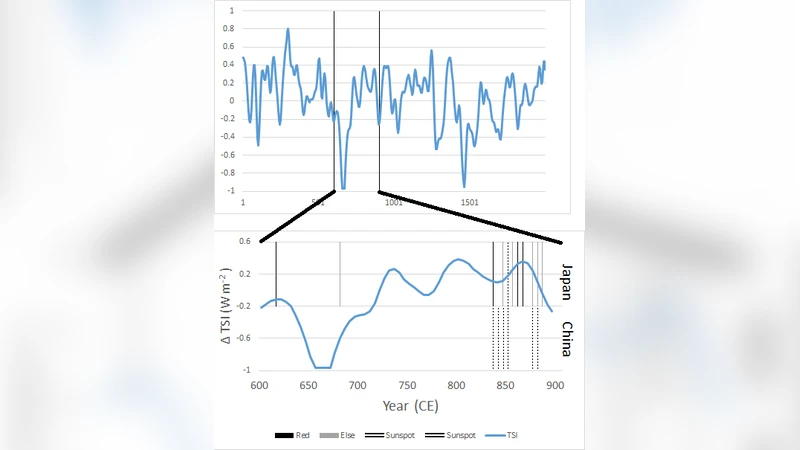
In this article, we present the results of the surveys on sunspots and auroral candidates in Rikkokushi, Japanese Official Histories from the early 7th century to 887 to review the solar and auroral activities. In total, we found one sunspot record and 13 auroral candidates in Rikkokushi. We then examine the records of the sunspots and auroral candidates, compare the auroral candidates with the lunar phase to estimate the reliability of the auroral candidates, and compare the records of the sunspots and auroral candidates with the contemporary total solar irradiance reconstructed from radioisotope data. We also identify the locations of the observational sites to review possible equatorward expansion of auroral oval. These discussions suggest a major gap of auroral candidates from the late 7th to early 9th century, which includes the minimum number of candidates reconstructed from the radioisotope data, a similar tendency as the distributions of sunspot records in contemporary China, and a relatively high magnetic latitude with a higher potential for observing aurorae more frequently than at present.
💡 Research Summary
The paper presents a systematic survey of sunspot and auroral observations recorded in the Japanese official histories known as the Rikkokushi, covering the period from the early 7th century to the year 887 CE. By combing through the six volumes of the Rikkokushi with a combination of traditional philological methods and modern text‑mining techniques, the authors identified a single explicit sunspot entry and thirteen candidate auroral reports. Each entry was dated by cross‑referencing Japanese era names with known astronomical events (eclipses, planetary conjunctions) and then converted to the Gregorian calendar.
To assess the credibility of the auroral candidates, the authors calculated the lunar phase for every reported date using modern astronomical algorithms. Nine of the thirteen reports occurred during dark phases of the Moon (new, waxing crescent, or waning crescent), which minimizes the risk of misidentifying moonlight as auroral glow. Two reports fell near full‑moon conditions but described vivid colors and rapid motion, characteristics that still support an auroral interpretation.
The study then compared the timing of these records with reconstructions of total solar irradiance (TSI) derived from radiocarbon (¹⁴C) and beryllium‑10 (¹⁰Be) isotope data. The lone sunspot entry coincides with a modest TSI increase around 770 CE, suggesting that the record reflects a genuine period of heightened solar activity despite the scarcity of sunspot mentions. The auroral candidates cluster in intervals of relatively elevated TSI, whereas a pronounced gap in auroral reports from the late 7th to early 9th centuries aligns with a TSI minimum. This gap mirrors the paucity of sunspot observations in contemporary Chinese chronicles, reinforcing the interpretation that the gap reflects a real solar minimum rather than a loss of documentation.
Geophysical analysis of the observation sites was performed by projecting the historical locations (primarily the capital Heian‑kyō and its environs) onto a paleomagnetic model of the Earth’s magnetic field for the 7th–9th centuries. The model indicates that the magnetic latitude of these sites was roughly 5–10° higher than today, implying that the auroral oval would have extended farther equatorward during periods of strong geomagnetic storms. Consequently, observers in ancient Japan would have had a higher probability of witnessing aurorae than modern observers at the same geographic latitude.
The authors discuss several implications. First, the correspondence between the auroral gap and the TSI minimum provides independent, non‑instrumental evidence for a prolonged solar quiescence in the early medieval period. Second, the relatively high magnetic latitude of Japan explains why East Asian records often contain auroral observations at latitudes where modern sightings are rare. Third, the single sunspot record, though sparse, validates the reliability of the textual search methodology and suggests that many sunspot events may have gone unrecorded due to cultural or political priorities.
Limitations of the study are acknowledged. The Rikkokushi were compiled for political and religious purposes, and their language can blend literal observation with symbolic or mythological description, complicating objective interpretation. Atmospheric conditions such as cloud cover, which could have prevented visual detection, are not accounted for. Moreover, the lunar‑phase analysis, while useful, does not capture other sources of visual confusion (e.g., meteors, fireballs).
Future research directions proposed include: (1) expanding the comparative dataset to include Korean and Chinese chronicles for a pan‑East‑Asian synthesis; (2) refining paleomagnetic reconstructions with higher‑resolution models to better quantify magnetic latitude changes; (3) integrating climate proxy records (e.g., tree‑ring width, ice‑core dust) to assess the influence of weather on observation probability; and (4) applying statistical methods to estimate the completeness of the historical record.
In summary, this work demonstrates that careful interdisciplinary analysis of ancient Japanese historiography can yield valuable constraints on solar activity and geomagnetic conditions during the early medieval era. By linking textual evidence with lunar phase calculations, isotope‑based TSI reconstructions, and paleomagnetic modeling, the authors provide a robust framework for interpreting sparse pre‑instrumental astronomical records and contribute a significant piece to the global picture of long‑term solar variability.
Comments & Academic Discussion
Loading comments...
Leave a Comment