Scaling and dynamics of washboard road
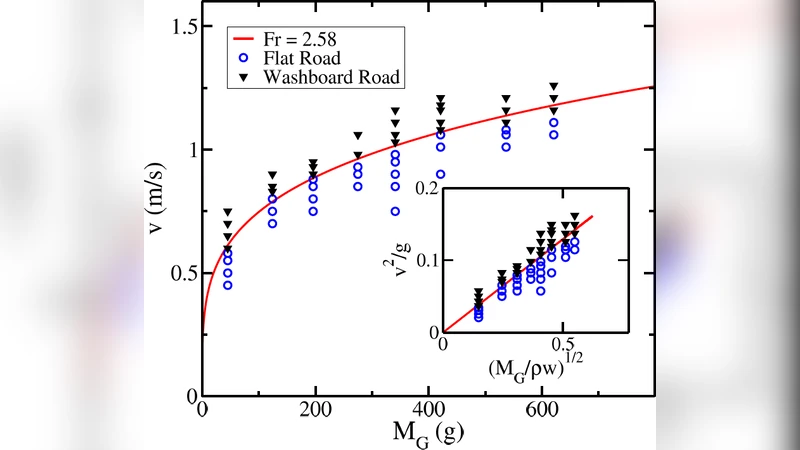
Granular surfaces subjected to forces due to rolling wheels develop ripples above a critical speed. The resulting pattern, known as “washboard” or “corrugated” road, is common on dry, unpaved roads. We investigated this phenomenon theoretically and experimentally, using laboratory-scale apparatus and beds of dry sand. A thick layer of sand on a circular track was forced by a rolling wheel on an arm whose weight and moment of inertia could be varied. We compared the ripples made by the rolling wheel to those made using a simple inclined plow blade. We investigated the dependence of the critical speed on various parameters, and describe a scaling argument which leads to a dimensionless ratio, analogous to the hydrodynamic Froude number, which controls the instability. This represents the crossover between conservative, dynamic forces and dissipative, static forces. Above onset, wheel-driven ripples move in the direction of motion of the wheel, but plow-driven ripples move in the reverse direction for a narrow range of Froude numbers.
💡 Research Summary
The paper investigates the spontaneous formation of ripples—commonly known as “washboard” or “corrugated” road—on dry granular beds when they are driven by rolling wheels or inclined plow blades. Using a laboratory‑scale circular track covered with a uniform layer of sand, the authors mounted either a wheel or a simple inclined plow on an arm whose weight and moment of inertia could be varied independently. By systematically changing the wheel (or plow) mass, inertia, forward speed, sand depth, and the angle of the plow, they recorded the onset of instability, the growth rate of the ripples, their wavelength, and the direction of propagation with high‑speed video and laser profilometry.
The experiments reveal a clear critical speed, v_c, below which the sand surface remains flat and above which a periodic pattern emerges. For the wheel, the ripples travel in the same direction as the wheel’s motion; their wavelength grows roughly linearly with speed. The plow, however, exhibits a more complex behavior: within a narrow band of a dimensionless parameter—identified as a Froude‑like number—the ripples propagate opposite to the plow’s motion (reverse or “backward” traveling waves). Outside this band the plow also generates forward‑traveling ripples, indicating that the reverse motion is not a generic feature but a consequence of a delicate balance between forces.
To rationalize these observations, the authors construct a scaling argument that compares the dynamic, inertial forces generated by the moving object with the static, gravity‑driven forces that resist deformation of the sand. They define a dimensionless group
\