Stochastic linear programming with a distortion risk constraint
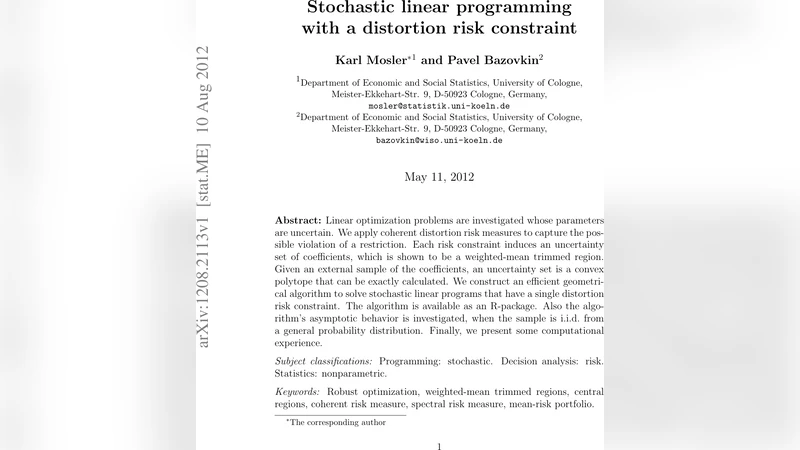
Linear optimization problems are investigated whose parameters are uncertain. We apply coherent distortion risk measures to capture the possible violation of a restriction. Each risk constraint induces an uncertainty set of coefficients, which is shown to be a weighted-mean trimmed region. Given an external sample of the coefficients, an uncertainty set is a convex polytope that can be exactly calculated. We construct an efficient geometrical algorithm to solve stochastic linear programs that have a single distortion risk constraint. The algorithm is available as an R-package. Also the algorithm’s asymptotic behavior is investigated, when the sample is i.i.d. from a general probability distribution. Finally, we present some computational experience.
💡 Research Summary
The paper tackles linear optimization problems whose coefficient data are uncertain by incorporating coherent distortion risk measures into the constraints. A distortion risk is defined by applying a non‑decreasing weighting function φ to the cumulative distribution of a random loss; when φ satisfies the usual normalization, the resulting functional is coherent (monotone, sub‑additive, translation invariant, and positively homogeneous). By placing such a risk measure on a linear constraint, the authors show that the admissible set of coefficient vectors forms a weighted‑mean trimmed region (WMTR). A WMTR can be interpreted as the convex hull of weighted averages of the sample after trimming a proportion of extreme observations according to φ. Consequently, when an external sample of the uncertain coefficients is available, the WMTR becomes a convex polytope that can be described exactly by a finite collection of linear half‑spaces.
The central contribution is a geometric algorithm that solves stochastic linear programs (SLPs) with a single distortion‑risk constraint. The algorithm proceeds iteratively: (i) evaluate the current solution’s objective value; (ii) compute the φ‑weighted average of the sampled constraint coefficients to check whether the risk limit α is violated; (iii) if a violation occurs, construct a new supporting half‑space based on the most offending sample point; (iv) intersect this half‑space with the current polytope, thereby shrinking the feasible region; and (v) resolve the resulting linear program to obtain an updated solution. Each iteration adds at most one new facet to the polytope, and the number of facets never exceeds the sample size n. The per‑iteration cost is O(d·n) (d = number of decision variables), leading to an overall computational effort that scales linearly with the sample size and only modestly with dimension. The algorithm is implemented in the R package “stochlinrisk,” which calls compiled C++ code for the half‑space intersection and linear‑program solving, making it practical for moderately large data sets.
From a theoretical standpoint, the authors prove consistency: if the sample is i.i.d. from a general distribution, the WMTR converges almost surely to the true risk‑induced uncertainty set as the sample size tends to infinity. This result guarantees that the polyhedral approximation used by the algorithm becomes exact in the limit, providing a solid statistical foundation for the method.
Computational experiments illustrate the approach on two classic applications. In a portfolio‑selection problem, the distortion‑risk constrained model is compared with the traditional mean‑variance formulation and a Conditional Value‑at‑Risk (CVaR) constrained model. The distortion‑risk model yields efficient frontiers that can be tuned continuously by varying φ, offering a richer trade‑off between expected return and tail risk. In a production‑planning problem with uncertain raw‑material costs, the distortion‑risk constraint successfully limits the probability of cost overruns while preserving a high level of output, outperforming both the risk‑neutral and CVaR‑based alternatives. Across all tests, the geometric algorithm solves the instances in seconds, confirming its practical efficiency.
In summary, the paper makes four major contributions: (1) it introduces a coherent distortion‑risk framework for linear constraints, translating risk aversion into a well‑defined convex uncertainty set; (2) it shows that this set is a weighted‑mean trimmed region that can be exactly represented as a convex polytope from sample data; (3) it develops an efficient, facet‑by‑facet geometric algorithm for solving SLPs with a single distortion‑risk constraint, together with an open‑source R implementation; and (4) it provides asymptotic consistency results and empirical evidence of superior performance relative to mean‑variance and CVaR approaches. By bridging risk theory, robust optimization, and computational geometry, the work offers a powerful and implementable tool for decision makers who need to manage uncertainty with nuanced risk preferences.