Press-Dyson Analysis of Asynchronous, Sequential Prisoners Dilemma
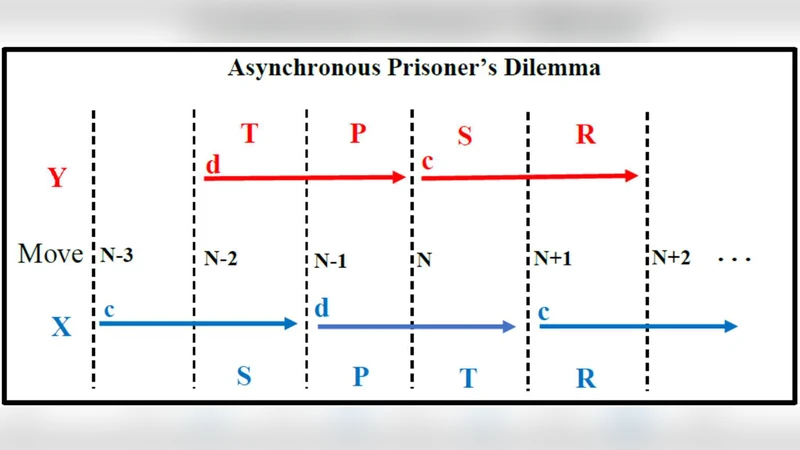
Two-player games have had a long and fruitful history of applications stretching across the social, biological, and physical sciences. Most applications of two-player games assume synchronous decisions or moves even when the games are iterated. But different strategies may emerge as preferred when the decisions or moves are sequential, or the games are iterated. Zero-determinant strategies developed by Press and Dyson are a new class of strategies that have been developed for synchronous two-player games, most notably the iterated prisoner’s dilemma. Here we apply the Press-Dyson analysis to sequential or asynchronous two-player games. We focus on the asynchronous prisoner’s dilemma. As a first application of the Press-Dyson analysis of the asynchronous prisoner’s dilemma, tit-for-tat is shown to be an efficient defense against extortionate zero-determinant strategies. Nice strategies like tit-for-tat are also shown to lead to Pareto optimal payoffs for both players in repeated prisoner’s dilemma.
💡 Research Summary
The paper extends the Press‑Dyson zero‑determinant (ZD) framework, originally developed for synchronous iterated Prisoner’s Dilemma (IPD), to a sequential or asynchronous version of the game in which players move one after the other. After a concise review of the original ZD theory—how a linear relation α·sX + β·sY + γ = 0 can be enforced by a memory‑1 strategy, yielding extortion, generous, or equalizer variants—the authors formalize the asynchronous PD. In each round a “leader” chooses first, the “follower” observes that choice and then decides. Consequently the state space is still the four outcome pairs (CC, CD, DC, DD), but the transition matrix becomes asymmetric because the follower’s conditional probabilities depend on the leader’s current move.
The authors derive the general form of a ZD strategy for this setting. By redefining the 8 conditional probabilities (four for the leader, four for the follower) they obtain a new linear system A·v = b that captures the long‑run expected payoffs v = (sLeader, sFollower). The extortion class is characterized by a parameter χ > 1 that forces the leader’s payoff to be χ times the follower’s payoff plus a constant. However, because the follower can condition its response on the observed leader move, the leader cannot unilaterally fix the follower’s cooperation rate. Solving the steady‑state equations shows that an extortion strategy only has a stable fixed point when the follower’s response probabilities satisfy a precise linear relation, which is rarely met in practice.
To illustrate the consequences, the paper analyzes Tit‑for‑Tat (TFT) as a memory‑1 strategy in the asynchronous game. TFT starts with cooperation and then copies the opponent’s previous move. In the sequential setting this means the follower simply mirrors the leader’s last action. The authors prove that TFT simultaneously satisfies the “nice” property (initial cooperation) and the “retaliatory” property (immediate punishment of defection). When the follower adopts TFT, any leader attempting an extortion ZD strategy finds the follower’s cooperation probability collapse, eliminating the leader’s payoff advantage. Numerical simulations across a range of payoff matrices (T > R > P > S) and χ values confirm that extortion yields higher payoffs only in the synchronous case; in the asynchronous case TFT neutralizes the extortionist and drives the system toward the cooperative payoff (R,R).
The paper also shows that when both players use TFT, the resulting stationary distribution places all probability mass on the cooperative outcome, achieving Pareto optimality. Thus, “nice” strategies remain robust defenses against exploitative ZD strategies even when the timing of moves changes.
In the discussion, the authors emphasize that many real‑world interactions—biological signaling, economic negotiations, and social exchanges—are inherently sequential. The structural asymmetry introduced by asynchrony fundamentally limits the power of extortion‑type ZD strategies, highlighting the importance of timing assumptions in game‑theoretic modeling. The work suggests several extensions: multi‑player asynchronous games, stochastic observation errors, and evolutionary learning dynamics that could further illuminate how cooperation emerges when moves are not simultaneous. Overall, the study provides a rigorous analytical bridge between the classic ZD literature and more realistic sequential decision environments, demonstrating that while ZD strategies retain mathematical elegance, their strategic impact is highly contingent on the underlying move structure.
Comments & Academic Discussion
Loading comments...
Leave a Comment