In this work, we conducted a survey on different registration algorithms and investigated their suitability for hyperspectral historical image registration applications. After the evaluation of different algorithms, we choose an intensity based registration algorithm with a curved transformation model. For the transformation model, we select cubic B-splines since they should be capable to cope with all non-rigid deformations in our hyperspectral images. From a number of similarity measures, we found that residual complexity and localized mutual information are well suited for the task at hand. In our evaluation, both measures show an acceptable performance in handling all difficulties, e.g., capture range, non-stationary and spatially varying intensity distortions or multi-modality that occur in our application.
Deep Dive into Image Registration for the Alignment of Digitized Historical Documents.
In this work, we conducted a survey on different registration algorithms and investigated their suitability for hyperspectral historical image registration applications. After the evaluation of different algorithms, we choose an intensity based registration algorithm with a curved transformation model. For the transformation model, we select cubic B-splines since they should be capable to cope with all non-rigid deformations in our hyperspectral images. From a number of similarity measures, we found that residual complexity and localized mutual information are well suited for the task at hand. In our evaluation, both measures show an acceptable performance in handling all difficulties, e.g., capture range, non-stationary and spatially varying intensity distortions or multi-modality that occur in our application.
1
Image Registration for the Alignment of Digitized Historical
Documents
AmirAbbas Davari1*, Tobias Lindenberger1*, Armin Häberle2, Vincent
Christlein1, Andreas Maier1, Christian Riess1
- Pattern Recognition Lab, Computer Science Department,
Friedrich-Alexander Universität Erlangen-Nürnberg, Erlangen, Germany
[amir.davari, tobias.lintob.lindenberger, vincent.christlein, andreas.maier,
christian.riess] @fau.de
- Bibliotheca Hertziana - Max-Planck-Institut für Kunstgeschichte, Rome, Italy
Haeberle@biblhertz.it
- Both authors contributed equally
1 Introduction
Novel imaging and image processing techniques provide technical tools to art
historians for a better understanding of the creation of an artwork. The approach of a
“work process analysis” of an artwork (e.g. a drawing or painting) by art historians aims
at segmenting and differentiating the unique steps of production and thus, following
the artist’s path from the starting point to his final image. About 70-75% of all old
master drawings consist of multiple materials, such as chalks of distinct colors,
graphite and/or ink, which mostly have been applied in a step by step manner. This
fact opens the opportunity for a chronological reconstruction of the genesis of the work.
To this end, material decomposition of drawn layers is oftentimes the most accurate
way to follow the artistic workflow.
One way to perform layer separation is by spectroscopy. However, this approach is
oftentimes destructive to the examined material. To allow for an examination of old
master drawings while preserving the drawing to the best extend possible, it is also
possible to acquire a multi- or hyperspectral image of the drawing, and separate the
layers within the range of visible wavelengths.
To obtain a reliable and consistent separation of artwork layers as a basis for art
historical interpretation, a number of technical challenges have yet to be solved
[Dav17]. First of all, there is the need for a pixel-wise “ground truth” map to objectively
compare competing approaches. One possibility to get such a ground truth is to mimic
the creation of a step-by-step layered artwork, and to image it after completing each
work step. A map for a layer can then be obtained by subtracting two subsequent
layers. However, one substantial issue lies in the fact that the acquisitions of two
subsequent layers do not exactly match onto each other, and therefore have to be
aligned.
There are many possible reasons for the mismatch, among which are distortions,
mechanical motion, and spherical and chromatic aberration of the optical devices. An
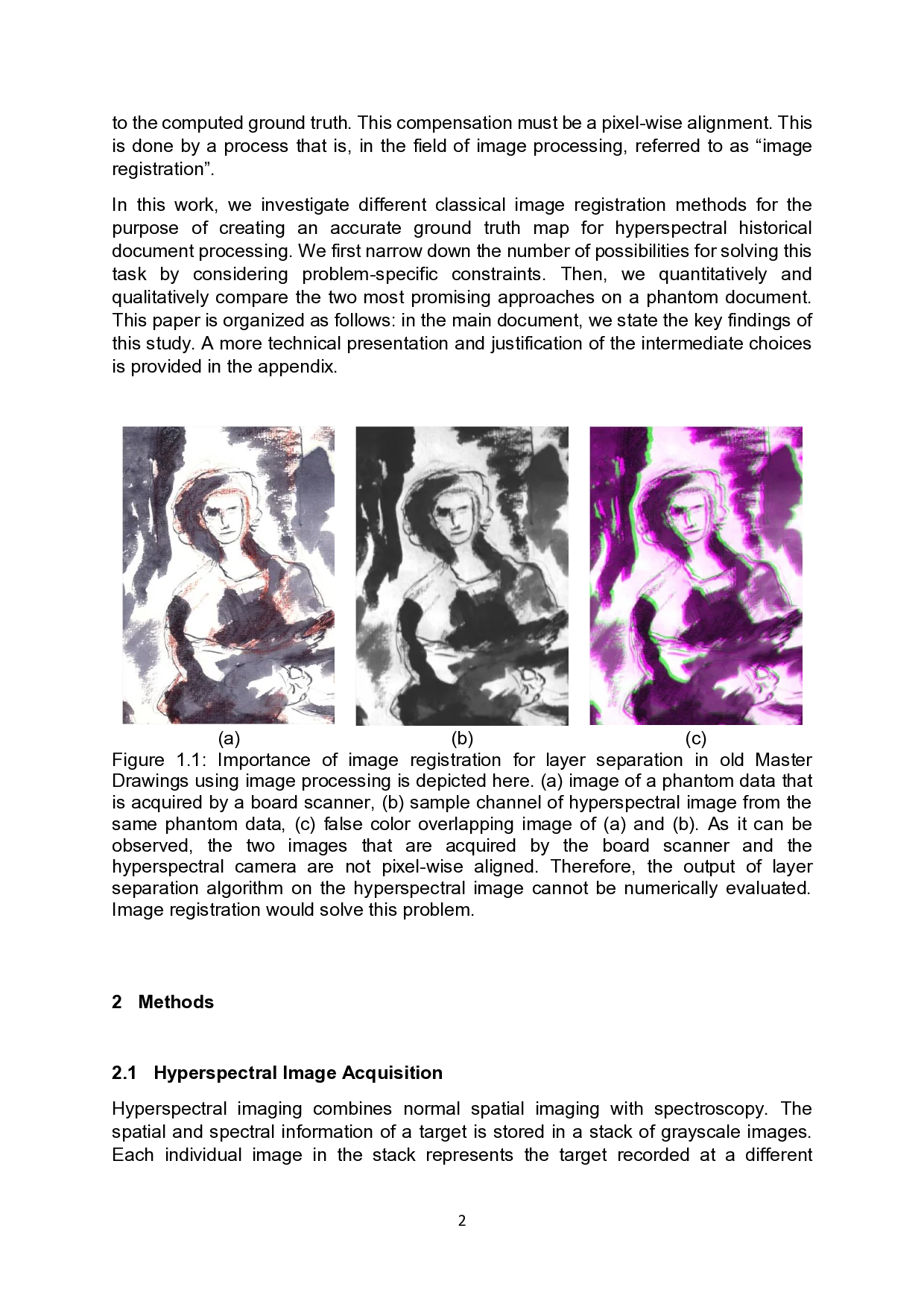
example mismatch is illustrated in Fig. 1.1. Similarly, a mismatch must be
compensated when the output of an algorithm for layer separation should be mapped
2
to the computed ground truth. This compensation must be a pixel-wise alignment. This
is done by a process that is, in the field of image processing, referred to as “image
registration”.
In this work, we investigate different classical image registration methods for the
purpose of creating an accurate ground truth map for hyperspectral historical
document processing. We first narrow down the number of possibilities for solving this
task by considering problem-specific constraints. Then, we quantitatively and
qualitatively compare the two most promising approaches on a phantom document.
This paper is organized as follows: in the main document, we state the key findings of
this study. A more technical presentation and justification of the intermediate choices
is provided in the appendix.
(a)
(b)
(c)
Figure 1.1: Importance of image registration for layer separation in old Master
Drawings using image processing is depicted here. (a) image of a phantom data that
is acquired by a board scanner, (b) sample channel of hyperspectral image from the
same phantom data, (c) false color overlapping image of (a) and (b). As it can be
observed, the two images that are acquired by the board scanner and the
hyperspectral camera are not pixel-wise aligned. Therefore, the output of layer
separation algorithm on the hyperspectral image cannot be numerically evaluated.
Image registration would solve this problem.
2 Methods
2.1 Hyperspectral Image Acquisition
Hyperspectral imaging combines normal spatial imaging with spectroscopy. The
spatial and spectral information of a target is stored in a stack of grayscale images.
Each individual image in the stack represents the target recorded at a different
3
wavelength. The stack can be used for further image analysis in the spatial and
spectral domain [Mid16c].
For this project, we used a hyperspectral push-broom camera. This camera type
features a two dimensional detector array that is combined with a spectrograph. The
target is illuminated along one of the spatial axes of the detector. This line contains
the full spectrum of the camera’s spectral axis. In push-broom scanning
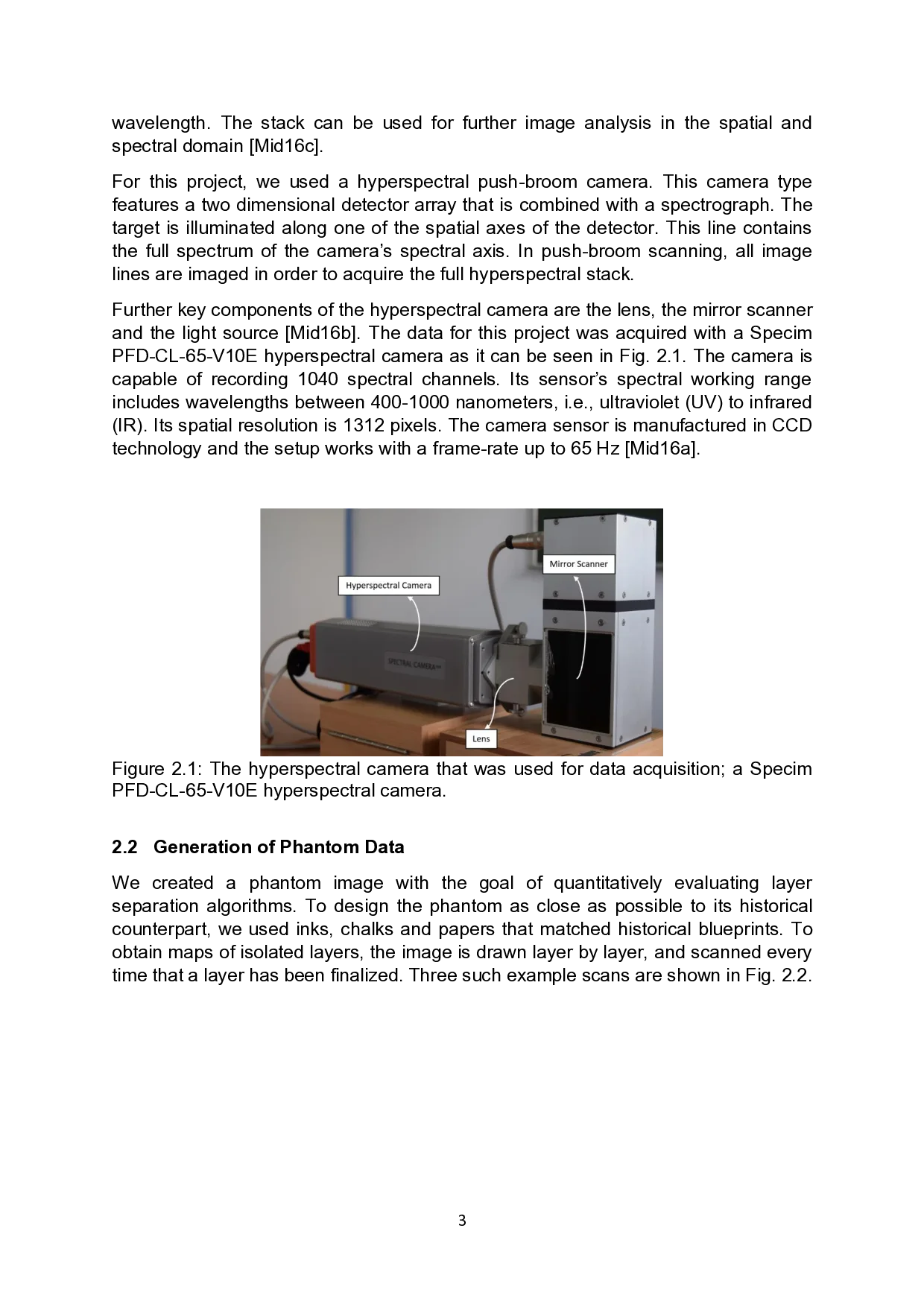
…(Full text truncated)…
This content is AI-processed based on ArXiv data.